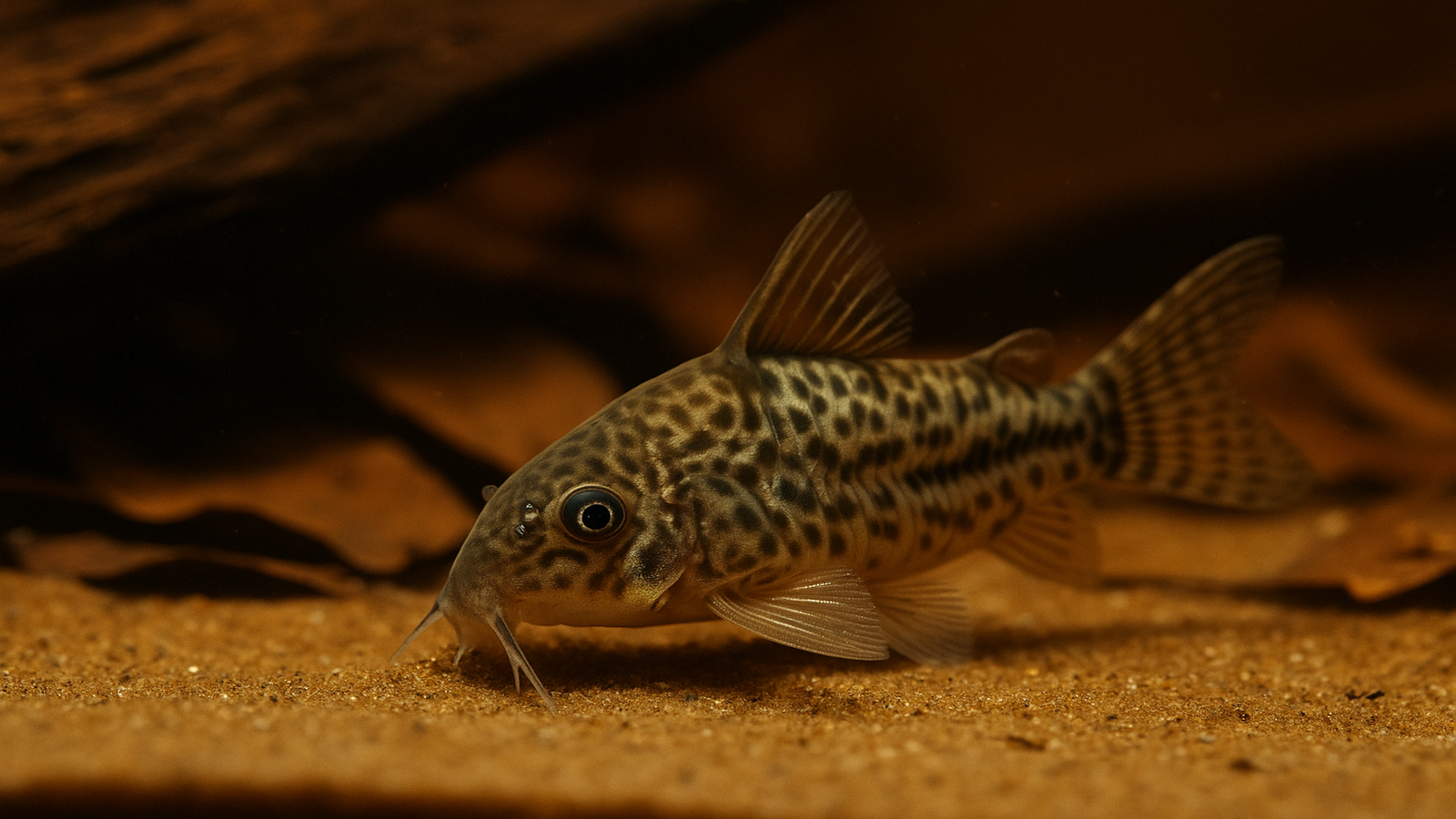
At MTF-Aquatics, we recommend treating wild Corydoras care UK as a specialised discipline fundamentally different from tank-bred stock. Wild-caught Corydoras arrive from ultra-soft Amazonian blackwater (pH 3.8–4.9, GH 0–1 dGH) and face severe osmotic shock when placed into hard UK tap water (pH 7.6–8.2, GH 18–28 dGH). Successful wild Corydoras care UK depends on a 45–90 minute drip acclimation, a 4-week quarantine at target parameters, and RO water blending for long-term maintenance.
Wild-caught Corydoras are not the same animal as the farm-bred variants you’ll find in most UK chain stores. The difference is not cosmetic—it is a fundamental mismatch between the chemistry of their native environment and the water emerging from your tap. Understanding this gap is the difference between a thriving group and a downward spiral of chronic stress, infection, and premature death.
Amazonian and Orinoco blackwater systems—the Rio Negro, Ventuari, and upper Orinoco tributaries where many wild Corydoras originate—have water chemistry that is almost the inverse of typical UK mains supply. Rio Negro water records pH 3.8–4.9, total dissolved solids (TDS) of 10–15 ppm, and general hardness of 0–1 dGH. In contrast, London tap water runs pH 7.8–8.0 and GH 18–24 dGH; East Anglian supply averages GH 20–28 dGH. Even regions considered “soft” by UK standards—Manchester, Liverpool, parts of the Midlands—still sit at GH 5–14 dGH, which is five to fourteen times harder than the water a wild Corydoras has ever inhabited.
Wild Corydoras care UK therefore demands a deliberate, staged acclimatisation process that respects this chemical gulf. A wild-caught specimen cannot simply be floated in a bag and netted into hard UK tap water. The osmotic shock alone will suppress the immune system, leaving the fish vulnerable to pathogenic infections that are often invisible on arrival but emerge within days or weeks. Correct wild Corydoras care UK begins before the fish arrives at your door.
The foundation of wild Corydoras care UK is a dedicated quarantine tank, established and running at target soft-acid parameters before the fish arrives. This tank should be a minimum of 40 litres (15 gallons) and run at pH 5.8–7.0, dGH 2–8, and temperature 24–26°C. If your tap water is hard (GH >10), reversible-osmosis (RO) water blended with treated tap water is the only reliable way to achieve these parameters.
Wild Corydoras care UK depends critically on fine sand substrate—play sand or aquarium-grade sand—not gravel. Corydoras spend most of their day sifting through substrate with their sensitive barbels (whisker-like sensory organs). Coarse gravel causes abrasion, leading to bacterial infection and permanent barbel damage. Fine sand is non-negotiable.
Begin conditioning the quarantine tank 2–3 weeks before the fish arrive. Add Indian almond (catappa) leaves and alder cones—they leach humic acids and tannins that gently lower pH, have measurable antibacterial properties, and begin to establish the blackwater environment these fish expect. Replace leaves every 2 weeks. Wild Corydoras care UK is as much about chemical signalling as it is about pH and hardness numbers.
When your wild Corydoras arrive, resist the urge to rush. The drip acclimatisation method is non-negotiable for wild-caught stock. Place the transport bag (still sealed) in the quarantine tank for 15 minutes to allow temperature equilibration. Then, carefully open the bag without pouring out the contents, and insert a small air-line tube connected to your main tank.
Set the air-line to drip at a rate of approximately one drop per second into the bag. This may seem slow—and it is intentionally so. Wild Corydoras care UK demands a minimum 45–90 minutes of drip acclimation, during which the fish gradually adjust to the tank’s pH and hardness without experiencing an acute osmotic shift. Many experienced keepers extend this to 2–3 hours for particularly delicate or stressed individuals.
Do not use the float-and-net method (floating the sealed bag to equilibrate temperature, then netting the fish out). Wild-caught fish are acutely sensitive to rapid pH shifts, and this method introduces them to the target water too quickly. The difference in outcomes between drip and float-and-net is stark: drip method results in relaxed fish that hide normally; float-and-net often produces fish that are hyperactive, erratic, and susceptible to disease within days.
After 90 minutes, gently lower the open bag into the quarantine tank and allow the fish to exit at their own pace. Do not net them out. The quarantine tank is now their home for the next four weeks minimum.
Wild-caught Corydoras carry pathogenic loads that tank-bred stock do not. Internal parasites—nematodes, flagellates, and other protozoans—are endemic in wild-caught fish from Amazonian collections. These parasites are often asymptomatic in the stressed, immune-suppressed transport phase but become virulent once the fish settles and its immune system drops its guard. Introducing an unquarantined wild-caught fish into an established community tank risks precipitating an outbreak that devastates your entire system.
Wild Corydoras care UK therefore mandates a minimum four-week quarantine with careful observation. Watch for:
During quarantine, perform 25% water changes every 3–4 days to maintain low bioload and stable parameters. Feed small amounts of high-quality frozen foods—bloodworm, daphnia, or specialist catfish pellets—once daily. Newly arrived wild fish often refuse food for the first week; this is normal and not cause for alarm.
At the two-week mark, if you observe no signs of overt disease and the fish are behaving normally (sifting substrate, resting in shelter), you may consider prophylactic internal parasite treatment. Many specialist keepers dose with anthelmintic medications (e.g., fenbendazole-based products) as a precaution. Consult your healthcare provider or specialist retailer for current UK-available options and dosing protocols for your specific species.
Wild Corydoras care UK is not careless; it is careful.
Once the four-week quarantine is complete and the fish are showing robust feeding response and normal behaviour, you must decide: will this be a dedicated soft-water setup, or will you blend your tap water?
For most UK keepers with hard tap water (GH >8), RO water is the practical solution for wild Corydoras care UK. RO systems are relatively affordable (£150–400 for a point-of-use unit) and eliminate the chemical guesswork. Target parameters for long-term maintenance of wild Corydoras are:
| Parameter | Maintenance Range | Breeding Target |
|---|---|---|
| pH | 5.8–7.0 | 6.0–6.8 |
| General Hardness (dGH) | 2–8 | 1–4 |
| Temperature | 24–26°C | 20–22°C (cooler for spawn trigger) |
| TDS (ppm) | 50–200 | <100 |
If you are in one of the few UK regions with naturally soft tap water—Glasgow, Edinburgh, Liverpool, or parts of north-west England where GH naturally runs 2–6 dGH—you may be able to maintain wild Corydoras care UK without RO intervention. However, test your water seasonally: UK municipal supplies vary by up to ±4 dGH between winter and summer as different source waters are blended. A parameter that is “fine in January” may breach tolerance in July.
Wild Corydoras care UK is therefore not a “set and forget” setup. Test water parameters monthly, and adjust RO blending or conditioning as needed.
Beyond chemistry, wild Corydoras need a specific physical environment. A minimum 90-litre (20 imperial gallons) tank is recommended for a group of 8–12 wild-caught individuals of the same species. Do not mix different Corydoras species—each has evolved social preferences for its own kind, and mixed groups exhibit chronic low-level stress.
The setup should include:
Wild Corydoras care UK benefits from tannin-stained water. Maintain catappa leaves and alder cones in the main tank indefinitely—not just quarantine. The humic acids signal safety to the fish and support beneficial bacterial colonies. Replace leaves monthly.
Wild-caught Corydoras are not the scavenger-only fish that tank-bred “plecos clean the tank” mythology suggests. In the wild, they hunt live micro-invertebrates—small crustaceans, insect larvae, and organic detritus. Tank-bred Corydoras tolerate basic pellets, but wild Corydoras thrive on live and frozen foods.
Wild Corydoras care UK feeding schedule:
Watch for feeding response. A wild Corydoras should actively investigate food items sinking to the substrate and begin sifting within 30 seconds. If a group shows no interest after 3 days of feeding, suspect internal parasites or water quality issues—retest parameters and consider quarantine re-evaluation.
MTF-Aquatics currently stocks Corydoras Hoplisoma sp. aff. Concolor (CW217), one of the most sought-after wild Corydoras species in the hobby. CW217 is an undescribed species from Colombian Orinoco tributaries, characterized by its deep body coloration and unusual social tolerance—they form loose aggregations in the wild rather than tight schools.
CW217 in particular demands wild Corydoras care UK protocols. Specimens arrive stressed from collection and trans-shipment, carrying internal parasites, and are extremely sensitive to hard water. MTF sources CW217 directly from sustainable collectors in the Ventuari River basin, hand-selects individuals for health, and quarantines all stock before sale. Every fish ships with the Live Arrival Guarantee—if a wild Corydoras arrives in poor condition, we replace it at no cost.
CW217 specimens are 3–4 cm on arrival and may reach 5–7 cm in adulthood. They require the full soft-water acclimatisation protocol and show spectacular dark coloration and sheen only in acidic, low-TDS water. In hard UK tap water, CW217 become pallid and stressed within weeks.
Other wild Corydoras species occasionally arrive via MTF’s transhipping service—Corydoras habrosus (tiny Amazonian dwarf species), Corydoras nattereri (Rio Madeira form), and other CW-codes. For current availability, check the shop or request a tranship quote. Wild Corydoras are never in consistent stock; they arrive in small batches as collections are made and exported.
The difference between wild and tank-bred Corydoras is vast. Tank-bred aeneus, sterbai, or paleatus tolerate pH up to 7.6 and dGH up to 15—they are adaptable and hardy. A tank-bred Corydoras will survive in hard alkaline UK tap water, though it may never show true colour or breed.
Wild Corydoras care UK cannot compromise. A wild-caught fish will decline slowly, almost invisibly, if water chemistry is wrong. It may feed, hide normally, and show no overt signs of disease for weeks—then suddenly succumb to a secondary bacterial infection or parasite bloom. By the time symptoms are visible, the chronic stress has already done irreversible damage.
If your tap water is hard (GH >10) and you are not prepared to invest in RO water and a dedicated soft-water setup, do not attempt wild Corydoras care UK. Choose captive-bred alternatives instead. We would rather lose a sale than see an animal suffer through a caregiving gap.
Breeding wild-caught Corydoras in UK aquariums is possible but demands precision. The trigger is a 3–5°C cool water change—replicating Amazonian wet-season rainfall. Before this, condition adults on high-protein live foods (small crustaceans, bloodworm) for 2–3 weeks.
When water temperature drops to 20–22°C (below the normal 24–26°C maintenance), wild Corydoras often spawn within 48–72 hours. Eggs are scattered across plants, driftwood, or the glass—collect them by hand and hatch in a separate container at target pH/GH with aeration.
Wild Corydoras care UK extends to fry: raise them on infusoria, then micro-worms, in ultra-soft water (TDS <80, pH 6.0–6.5). They are delicate and prone to fungal infection if water quality fluctuates.
Breeding is a long-term project, not a casual experiment. Successful wild Corydoras breeding in the UK is a mark of true specialist keeping.
Many UK keepers fail at wild Corydoras care UK not through lack of effort but through understanding gaps:
Wild Corydoras care UK is specialist care. It is not impossible, but it is unforgiving of shortcuts.
Wild Corydoras are not sold by Swell, Aquatics to Your Door, or mainstream retailers. These species arrive through specialist transhipping networks—suppliers like MTF-Aquatics who have direct relationships with exporters and breeders in South America.
When sourcing wild Corydoras care UK specimens, ask your retailer:
MTF-Aquatics holds every wild Corydoras in dedicated soft-water quarantine for a minimum two weeks before offering for sale. We provide detailed care notes and a Live Arrival Guarantee. We’re fishkeepers first, retailers second. Every animal that leaves our facility has been health-checked, acclimatised, and held until we’re confident it’s ready.
Wild Corydoras are not beginner fish. They are not community fish. They are specialist animals for keepers who understand that “keeping fish” extends beyond feeding and water changes—it means understanding osmotic stress, parasitology, biogeography, and the fine chemistry of water.
If this appeals to you, wild Corydoras care UK is deeply rewarding. A thriving group of CW217 or other wild species in a correctly tuned setup is a marvel—they exhibit natural social behaviour, bright colour, and personality that tank-bred stock cannot match. The investment in RO equipment, the discipline of quarantine, and the precision of acclimatisation are worth the payoff.
If it does not appeal—if you want simple, resilient fish—that is equally valid. Tank-bred Corydoras aeneus or sterbai will thrive in your hard-water UK tap without fuss. There is no shame in choosing the pragmatic path.
But if you are reading this and you have already decided that wild Corydoras are worth the effort, then wild Corydoras care UK is achievable. Start with the quarantine setup. Test your water. Invest in RO if needed. Source from a specialist retailer you trust. And give these remarkable fish the chemistry and care they deserve.
Q: Can I keep wild Corydoras in hard UK tap water if I do frequent water changes?
A: No. Frequent water changes cannot overcome chronic osmotic stress. A wild Corydoras in GH 15+ water will slowly decline regardless of maintenance schedule—immune suppression and disease follow within weeks or months. RO water and soft-water chemistry are non-negotiable.
Q: How long does drip acclimatisation take, and can I speed it up?
A: A minimum of 45–90 minutes is required. Speeding this up increases osmotic shock and disease risk dramatically. Many specialist keepers extend to 2–3 hours for particularly stressed fish. Never rush acclimatisation—this is where most keeper failures begin.
Q: What is the difference between CW217 and other wild Corydoras codes?
A: CW-codes identify specific undescribed species and populations from different river basins. Each may have slightly different water chemistry preferences. CW217 is Corydoras Hoplisoma sp. aff. Concolor from the Orinoco; CW015 is a different species from a different range. Ask your retailer for the specific origin and care requirements of each code.
Q: Can I breed wild Corydoras if I don’t have an RO system?
A: Breeding requires ultra-precise water chemistry (TDS <80, pH 6.0–6.5, GH 1–4 dGH). Without RO water, this is not achievable in most UK postcodes. Breeding wild Corydoras is a long-term specialist project requiring RO infrastructure from the start.
Q: What do I do if my wild Corydoras arrives looking stressed or sick?
A: Contact your retailer immediately—within the Live Arrival Guarantee window (typically 2 hours). Provide photos of the fish in the bag. MTF-Aquatics honours replacement or refund within 2 hours of delivery; the guarantee covers transport stress and DOA (dead on arrival). Never acclimate a visibly sick fish into your system.
Q: Are wild Corydoras legal to import to the UK?
A: Corydoras species are not CITES-listed and have no UK import restrictions. However, ensure your retailer has proper export documentation from the exporting country and that fish are responsibly sourced. Avoid retailers who cannot provide chain-of-custody details.
No. Frequent water changes cannot overcome chronic osmotic stress. A wild Corydoras in GH 15+ water will slowly decline regardless of maintenance schedule. RO water and soft-water chemistry (pH 5.8–7.0, dGH 2–8) are non-negotiable for long-term health.
A minimum of 45–90 minutes is required. Speeding this up increases osmotic shock and disease risk. Many specialist keepers extend to 2–3 hours for particularly stressed wild-caught fish. Never rush acclimatisation—this is where most keeper failures begin.
CW217 is Corydoras Hoplisoma sp. aff. Concolor, a wild species from Colombian Orinoco tributaries. It arrives stressed from collection, carrying internal parasites, and is extremely sensitive to hard water. It requires the full soft-water acclimatisation protocol: drip acclimation, 4-week quarantine, and RO water blending.
Wild Corydoras spend most of their day sifting through substrate with sensitive barbels. Coarse gravel causes permanent barbel erosion and bacterial infection. Fine sand (5–8 cm depth) is the only substrate option for keeping these fish successfully long-term.
MTF-Aquatics replaces or refunds any fish that arrives dead or in poor condition, provided you report it within 2 hours of delivery with photos. Always keep fish in their transport bag during this window. The guarantee covers transport stress and DOA (dead on arrival).
No. Breeding requires ultra-precise soft water (TDS <80, pH 6.0–6.5, GH 1–4 dGH), which is not achievable in most UK postcodes without RO equipment. Breeding wild Corydoras is a long-term specialist project that demands RO infrastructure from the start.