At MTF-Aquatics, we recommend UK online fish auctions for sourcing rare species unavailable in high-street shops — but only if you understand courier standards, welfare during transit, and post-arrival quarantine. This guide covers legal courier requirements, the 48-hour window in which fish survive transport, seller vetting, and why fewer than 5% of hobbyists quarantine, putting imported fish at disease risk.
UK online fish auctions have transformed how serious hobbyists source rare species. AquaXchange, FinSwap, Aquarist Classifieds, and MTF Aquatics’ live auction platform offer access to one-off specimens, wild-caught imports, and specialist bloodlines that simply cannot be found in high-street retailers or mainstream online shops. If you’re hunting for a specific morph of stingray, a large adult specimen of a rare pleco, or a wild-caught predator, a UK online fish auction is often your only option.
However, the convenience of this channel comes with a responsibility: unlike buying from a physical shop or a large retailer with established welfare protocols, auction platforms vary dramatically in seller credibility, courier standards, and post-sale support. The difference between a responsible UK online fish auction seller and an irresponsible one can mean the difference between a thriving fish and a dead arrival.
Before you bid on anything in a UK online fish auction, understand the legal landscape.
Royal Mail Is Illegal for Live Fish
This is the single most important fact. Royal Mail is not authorised by the Animal and Plant Health Agency (APHA) under the Welfare in Animals Transport Order and explicitly prohibits live animals. If a seller offers to ship your UK online fish auction win via Royal Mail or Parcelforce, they are breaking the law. According to the Ornamental Aquatic Trade Association (OATA), this is a prosecutable offence.
A Kent prosecution in recent years resulted in a man being banned from keeping aquatic animals for ten years — demonstrating that UK enforcement does occur. Reporting sellers who use Royal Mail to your local authority or the APHA is your right as a buyer concerned for animal welfare.
Licensed Couriers Only
For a UK online fish auction seller to be legal, they must use an APHA-authorised courier. The two primary specialist providers are:
UPS and DHL operate on a case-by-case basis with attached documentation, but the hobbyist should verify their live fish licence before committing. Sellers should be transparent about their courier choice. If they won’t name it, don’t bid.
Seller Licensing
Under the Animal Welfare (Licensing of Activities Involving Animals) Regulations 2018, commercial fish sellers — including UK online fish auction operators — must hold an animal activities licence from their local authority, confirmed by inspection. Ask the seller for their licence number or at least confirmation they hold one. Reputable auction platforms (including MTF Aquatics) publicly display this information or will provide it on request.
One of the most anxiety-provoking aspects of a UK online fish auction win is the thought of your fish sitting in a bag for 24+ hours. Understanding what actually happens during that journey will help you make informed decisions and manage expectations.
The Science of Bag Time
In a properly prepared parcel, a tropical fish can survive up to 48 hours in an oxygenated, clean bag. However, the closer to 21 hours, the better. A responsible UK online fish auction seller will target a dispatch-to-delivery window of roughly 5 p.m. to 2 p.m. the next day, meaning the fish spends approximately 21 hours in transit.
During that time, three critical stressors are at work:
Professional Packing Standards
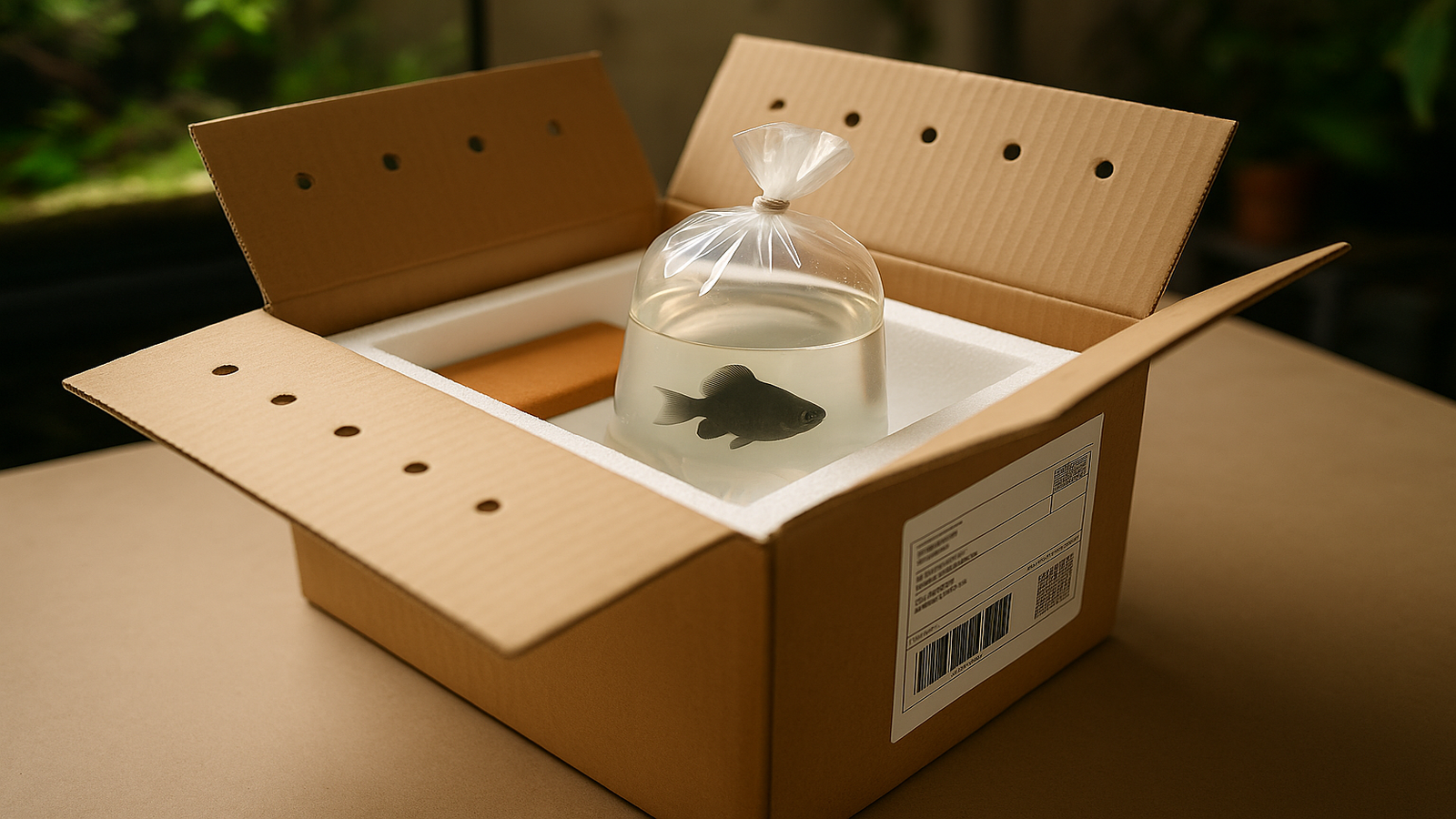
When you open your UK online fish auction parcel, you should see evidence of these practices:
If your parcel lacks any of these, the seller has cut corners on welfare.
Successfully bidding on a UK online fish auction requires more than just the highest bid.
Study the Lot Description
Responsible sellers provide detailed information:
If the lot description is vague (“nice fish” or “healthy”), proceed with caution.
Vet the Seller
For a UK online fish auction, check the seller’s:
Understand Reserve Pricing
Reserves protect sellers from under-pricing rare stock. A realistic reserve reflects the true rarity and market value of the species. Unrealistic reserves (e.g. £2,000 for a common juvenile pleco) signal an inexperienced or unreliable seller.
Your UK online fish auction parcel has arrived. Here’s what to do.
First, Don’t Rush
Open the parcel in a calm, quiet space. Allow the sealed bag to sit at room temperature for 15–30 minutes to acclimate the internal water to your ambient temperature.
Inspect the Bag
Document Everything
If the fish is dead or appears to be in critical condition:
Without photographic proof, most sellers will not refund or replace a DOA. MTF Aquatics’ policy allows photos within 2 hours of delivery.
The fish has survived transit. Now comes the phase where most hobbyists fail.
The Quarantine Reality
Fluval Aquatics’ research found that fewer than 5% of hobbyists quarantine newly acquired fish. This is a significant problem. Fish purchased from a UK online fish auction have experienced transport stress, temperature fluctuation, and exposure to unfamiliar water chemistry. They may be carrying parasites, bacteria, or viruses acquired during holding at the breeder or holding facility. Without quarantine, you risk introducing disease into your established aquarium.
Setting Up a Quarantine Tank
A quarantine tank for newly arrived UK online fish auction purchases need not be large, but it must be:
The 14-Day Observation Protocol
For most tropical fish, a minimum of 14 days is the industry standard. Some keepers advocate up to 4–6 weeks for expensive or high-stress specimens (e.g. stingrays, large wild-caught plecos). During this period:
If you observe disease symptoms (white spots, excessive mucus, clamped fins, laboured breathing), treat in the quarantine tank with salt or appropriate medication, and extend the quarantine period by 7–10 days after all symptoms resolve.
Our UK online fish auction operates to standards set by the same welfare and legal framework described above. Every fish is hand-selected by Marc, held and observed in our facility before auction, and shipped via APC Overnight with a Live Arrival Guarantee. Our auction lots include detailed species information, holding photos, and honest assessments of behaviour and condition. If you bid with MTF Aquatics, you’re buying into a transparent, welfare-first process — not a grab-bag from an unknown breeder or hobbyist.
Our commitment is simple: we’re fishkeepers first, retailers second. Every animal that leaves our facility has been health-checked, acclimated and held until we’re confident it’s ready.
After your auction win arrives and quarantine is underway, explore our Care Guides Hub for species-specific setup, water parameters, feeding, and tankmate compatibility. When you’re ready to bid, visit our live auction page to see current lots.
No. Royal Mail is not authorised by the APHA and explicitly prohibits live animals. Sellers who use Royal Mail are breaking UK law and can be prosecuted. Only APHA-authorised couriers such as APC Overnight and DX Courier are legal for live fish transport.
In a properly oxygenated, clean bag, tropical fish can survive up to 48 hours. However, responsible sellers target a maximum transit time of around 21 hours (dispatch to next-day delivery) to minimise stress. Fish are fasted 12–24 hours before dispatch to keep ammonia low, and bags are sealed with pure oxygen, not air.
Document the dead-on-arrival (DOA) fish with photographs immediately — most UK online fish auction sellers operate a 2–4 hour photo window for DOA claims. MTF Aquatics allows photo evidence within 2 hours of delivery. Send clear photos of the unopened bag, opened bag, and the fish in situ to the seller for a refund or replacement.
Yes. Despite fewer than 5% of hobbyists quarantining, it is industry best practice to isolate newly acquired fish in a separate, cycled quarantine tank for a minimum of 14 days. This prevents introducing parasites, bacteria, or viruses into your display tank. For expensive or high-stress specimens, extend quarantine to 4–6 weeks.
Ask about the courier used (must be APHA-authorised), their seller/business licence, the DOA policy and photo window, the species’ exact ID (Latin name, size, age, colour form), and any known health issues. Vague descriptions or refusal to answer are red flags — move to another seller.
Professional packing includes double or triple-walled bags filled with pure oxygen (not air), an insulated polystyrene box with heat packs (not touching the bag), newspaper or bubble wrap insulation, a care sheet, and clear DOA instructions. If your parcel lacks any of these, the seller has cut corners on welfare.