At MTF-Aquatics, we recommend treating every UK aquarium auction purchase as a welfare decision, not just a bargain hunt. Vet the seller’s APHA authorisation, check the courier against OATA standards, and avoid platforms using Royal Mail or unmoderated Facebook groups. Our live and silent auctions curate every specimen with health checks and acclimation, offering serious hobbyists an alternative to fragmented post-eBay platforms.
EBay UK’s February 2025 ban on all live fish and aquatic invertebrate listings displaced over 15,000 active listings overnight. Unlike the US, where the platform reversed its decision after seller outcry, the UK ban held firm—forcing the community to fragment across multiple dedicated platforms.
This shift has opened space for both opportunity and risk. On one hand, new platforms like AquaXchange, FinSwap, and Aquadiction Marketplace are building auction experiences designed specifically for hobbyists. On the other, unmoderated Facebook groups and Instagram private sales have exploded, creating a welfare vacuum where seller verification, courier compliance, and buyer protections are non-existent.
If you’re new to UK aquarium auction buying, you’re entering a landscape that demands more scrutiny than ever. Here’s what you need to know.
AquaXchange is a Facebook-community marketplace with 1,176+ followers, hosting both licensed sellers and hobbyist breeders. Tropical, marine, and freshwater fish are listed alongside tanks and equipment. It lacks transactional protection (like eBay’s buyer guarantee), so seller reputation is the primary trust signal.
FinSwap distinguishes itself with AI-powered tank compatibility checking—you input your water parameters and current stocking, and the platform flags incompatible fish before you bid. This is a genuine welfare innovation in the UK hobby. FinSwap also emphasises ethical rehoming and local meetups to avoid courier stress where possible.
Aquadiction Marketplace launched globally in June 2025 and offers auction functionality with no upfront listing fees, small transaction fees, Stripe/PayPal integration, and verified seller onboarding. It targets aquarists worldwide but has growing UK participation.
Aquarist Marketplace (aquaristmarketplace.co.uk) is a UK-native auction platform offering structured listing categories and auction timing.
MTF-Aquatics runs curated live and silent auctions directly from its site. Every specimen is hand-selected, health-checked, and held until acclimated—no passive reselling of untested stock.
Facebook groups remain tempting because of their community feel and lack of transaction fees. However, any private sale on Facebook or Instagram is operating in a regulatory and welfare grey zone.
This is the section that separates responsible UK aquarium auction buyers from impulse purchasers.
Under the Welfare of Animals (Transport) Order 2006 (WATO), enforced by the Animal and Plant Health Agency (APHA), any seller shipping live fish over 65 km must hold APHA Animal Transport Authorisation. There are two levels:
In practice, only APC Overnight and DX Courier/Express consistently hold full UK-wide authorisation for live fish. Royal Mail and Parcelforce explicitly prohibit live animals—a clear breach of WATO.
The Ornamental Aquatic Trade Association (OATA) sets the welfare standard through its Transporting Aquatic Livestock Code. This covers:
A seller citing OATA standards in their auction description is signalling that they understand their welfare and legal obligations. A seller who doesn’t mention these at all is a red flag.
Before you bid on any UK aquarium auction, run through this checklist:
Courier red flags: – Royal Mail or Parcelforce listed as the shipping method (both illegal for live fish) – Vague shipping descriptions like “special courier” with no specific company name – Seller claims they’ve “shipped hundreds of fish safely” via Royal Mail (this is a direct WATO violation)
Seller credential red flags: – No mention of APHA authorisation (commercial sellers must have this) – No Animal Activities Licence reference (local authority licensing is mandatory for commercial sellers) – No quarantine or acclimation information provided – Refusal to share current water parameters of the holding tank
Listing description red flags: – Ultra-vague species identification (“nice pleco” with no L-number or specific species name) – No size or age information – No mention of wild-caught vs. captive-bred origin (matters for acclimation and legal status) – Photos that look obviously AI-generated or stolen from other listings
Platform red flags: – Unmoderated Facebook groups with no seller verification process – Private Instagram DM sales with no transaction record or buyer protection – Sellers asking for payment via bank transfer with no recourse if the fish doesn’t arrive
Behavioural red flags: – Seller pressuring you to pay immediately (“only holding for 24 hours”) – Refusal to answer questions about tank size, care requirements, or water parameters – Aggressive responses to welfare questions (“fish are hardy, stop worrying”)
Any one of these flags should make you walk away. Rogue sellers rely on impulse bidders who don’t ask questions.
Assuming you’ve vetted the seller and platform, here’s how to bid with confidence.
Research the species first. Before bidding, know the adult size, minimum tank dimensions, water parameters, temperament, and any special care requirements. MTF-Aquatics maintains care guides for rare and large tropical fish covering all of this. If the auction listing doesn’t mention these, assume the seller hasn’t thought about them—another warning sign.
Ask about quarantine before you bid. A responsible seller will have quarantined the fish for 2–4 weeks before auction and will include quarantine observations (behaviour, feeding response, any signs of parasites or disease). If the seller says “it came in yesterday,” the fish hasn’t been held long enough to assess.
Calculate the true cost. The hammer price is only half the story. Factor in: – Auction fees (typically 10–15%) – Shipping costs (often £20–£40 depending on distance and box size) – Potential acclimation losses (rare fish sometimes die in transit despite best practice) – Quarantine tank setup if you don’t already have one
A “cheap” rare fish on auction often costs more in total stress and losses than buying from a known importer.
Check the acclimation window. After arrival, rare fish—especially wild-caught or newly imported stock—need 2–4 weeks of drip acclimation in a quarantine tank. This is non-negotiable. If your main tank isn’t stable and your quarantine setup isn’t ready, don’t bid yet.
Bid for the fish, not the deal. Auction adrenaline is real. Set a maximum bid based on fair market value and the actual cost of the species, then walk away if bidding exceeds it. “Winning” an overpriced lot because you got caught up in the final seconds is how experienced collectors end up with buyer’s remorse.
We run live and silent auctions specifically because we’re frustrated with the welfare gaps in the wider UK aquarium auction market.
Here’s what makes ours different:
Specimen curation. We don’t accept stock from unknown breeders. Every fish is either hand-picked by Marc from direct import partnerships or sourced from established UK collectors and breeders we trust. We reject anything that shows signs of stress, parasite load, or poor body condition.
Health holds. Incoming stock is quarantined and monitored for 2–4 weeks before auction. We document behaviour, feeding response, and any treatment. By the time a fish goes to auction, we’re confident in its health status.
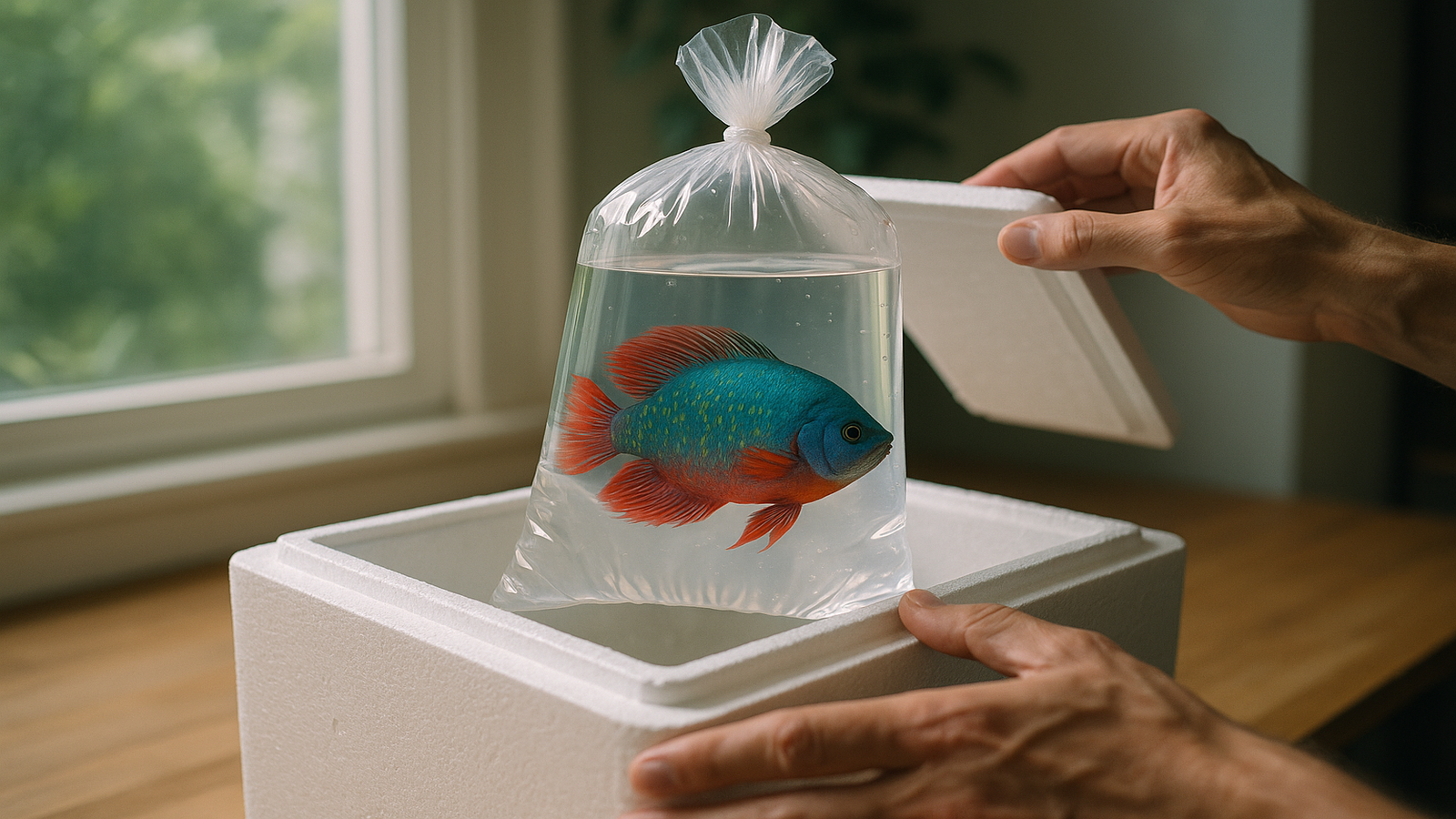
Welfare-compliant shipping. We ship next-day via APC Overnight (APHA Type 2 authorised) with temperature-controlled insulated polystyrene boxes. Every box includes OATA-compliant aftercare documentation with species-specific acclimation protocols.
Live Arrival Guarantee. If a fish arrives dead, we refund the full purchase price (less auction fees) upon 2-hour photographic evidence. This protects you and keeps us accountable.
Expert acclimation advice. Beyond the printed protocol, serious bidders can contact Marc directly with acclimation questions. We’re not just selling livestock—we’re backing every sale with real expertise.
None of this eliminates risk. Rare fish are inherently fragile. But it means every fish leaving our facility has been assessed by someone who’s been keeping and importing fish for decades, not sold by a stranger on Facebook with no reputation to protect.
After eBay’s ban, Facebook groups became the natural gathering place. The community is there. The fish are cheap. And there’s no middleman taking fees.
But that lack of intermediary is the exact problem.
Facebook groups have no seller vetting, no buyer protection, no courier compliance checks, and no recourse when something goes wrong. A seller who misrepresents a fish, ships via Royal Mail, or simply ghosts after payment has faced no consequences and will likely open a new account.
The welfare losses are invisible until they hit your tank. A stressed wild-caught stingray or hoplias that arrives in poor condition will often die within 48 hours of introduction, after you’ve already paid. On a platform like eBay, you could file a claim. On Facebook, you’re messaging someone who’s already blocked you.
We’re not saying never buy from Facebook groups—the community there is genuine and many sellers are responsible. But go in with your eyes open: you’re trading buyer protection and seller accountability for lower fees and direct personal connection. The trade-off is real.
Q: Is it illegal to sell fish on Facebook in the UK?
Selling fish commercially in the UK requires an Animal Activities Licence from your local authority following a welfare inspection. Most Facebook sellers don’t hold this licence. It’s not explicitly illegal to sell as a private individual rehoming a single fish, but commercial operations skirting the licence requirement operate in a legal grey area—and that grey area is where welfare standards collapse.
Q: What’s the difference between a UK aquarium auction and a marketplace like AquaXchange?
A true auction has a fixed closing time and winner-takes-all bidding, driving price discovery. A marketplace like AquaXchange uses fixed prices or “best offer” negotiation. Auctions create transparency and prevent artificial price inflation; marketplaces favour flexibility and private negotiation. Both can be safe if the seller is vetted.
Q: How long should I quarantine fish after a UK aquarium auction purchase?
For common, captive-bred fish: 2 weeks. For rare, wild-caught, or newly imported stock: 4 weeks minimum. Use that time to observe behaviour, feeding response, and any signs of parasites or disease. Do not introduce the fish to your main tank until you’re confident it’s healthy.
Q: What should I do if a fish arrives dead after a UK aquarium auction purchase?
If buying from a platform with buyer protection (eBay, Aquadiction Marketplace with verified sellers), document with photos within 2 hours and file a claim immediately. If buying from an unmoderated platform like Facebook, contact the seller and hope they refund voluntarily—many won’t. This is why vetting the seller’s reputation beforehand is essential. If buying from MTF-Aquatics, our Live Arrival Guarantee covers this.
Q: Can I use Royal Mail to ship live fish I’m selling?
No. Royal Mail and Parcelforce explicitly prohibit live animals, and any seller using them is committing a breach of the Welfare of Animals (Transport) Order 2006. Use only APHA-authorised couriers like APC Overnight or DX Courier/Express.
Q: Is FinSwap’s AI tank compatibility check reliable?
It’s a good starting point, but not a substitute for researching the species yourself. AI can flag incompatibility based on parameters, but it can’t assess temperament nuance or long-term compatibility. Use it as a first filter, then do your own research via care guides and experienced keeper forums.
The fragmentation of the UK aquarium auction market after eBay’s ban has created opportunity and risk in equal measure. New platforms like FinSwap and Aquadiction Marketplace are innovating. Facebook groups offer genuine community. But so much unvetted, unregulated activity has emerged in the void.
If a deal feels too good to be true, it probably is. If a seller gets defensive when you ask about welfare standards or courier compliance, that’s your signal to walk. A few extra pounds for a fish from a trusted, curated source—like MTF-Aquatics—is money spent on confidence and aftercare support, not just a cheaper price.
You’re a serious enough keeper to be bidding on rare fish at a UK aquarium auction. Extend that same seriousness to how you source them.
Commercial sellers in the UK require an Animal Activities Licence from their local authority. Most Facebook sellers don’t hold this, operating in a legal grey area where welfare standards often collapse. Private rehoming of a single fish is not explicitly illegal, but large-scale commercial operations via Facebook are unlicensed and unregulated.
A true auction has a fixed closing time and winner-takes-all bidding, driving price transparency. Marketplaces like AquaXchange use fixed prices or ‘best offer’ negotiation. Both can be safe if the seller is vetted, but auctions prevent artificial price inflation through negotiation.
For common, captive-bred fish: 2 weeks. For rare, wild-caught, or newly imported stock: 4 weeks minimum. Use the time to observe behaviour, feeding, and any signs of parasites or disease before introducing to your main tank.
No. Royal Mail and Parcelforce explicitly prohibit live animals and any seller using them commits a breach of the Welfare of Animals (Transport) Order 2006. Use only APHA-authorised couriers like APC Overnight or DX Courier/Express.
On platforms with buyer protection, document with photos within 2 hours and file a claim immediately. On unmoderated platforms like Facebook, contact the seller and hope they refund voluntarily—many won’t. This is why vetting seller reputation beforehand is essential. MTF-Aquatics’ Live Arrival Guarantee covers this automatically.
It’s a good first filter but not a substitute for species research. AI can flag parameter incompatibility but can’t assess temperament nuance or long-term behaviour. Always do your own research via care guides and experienced keeper forums before bidding.