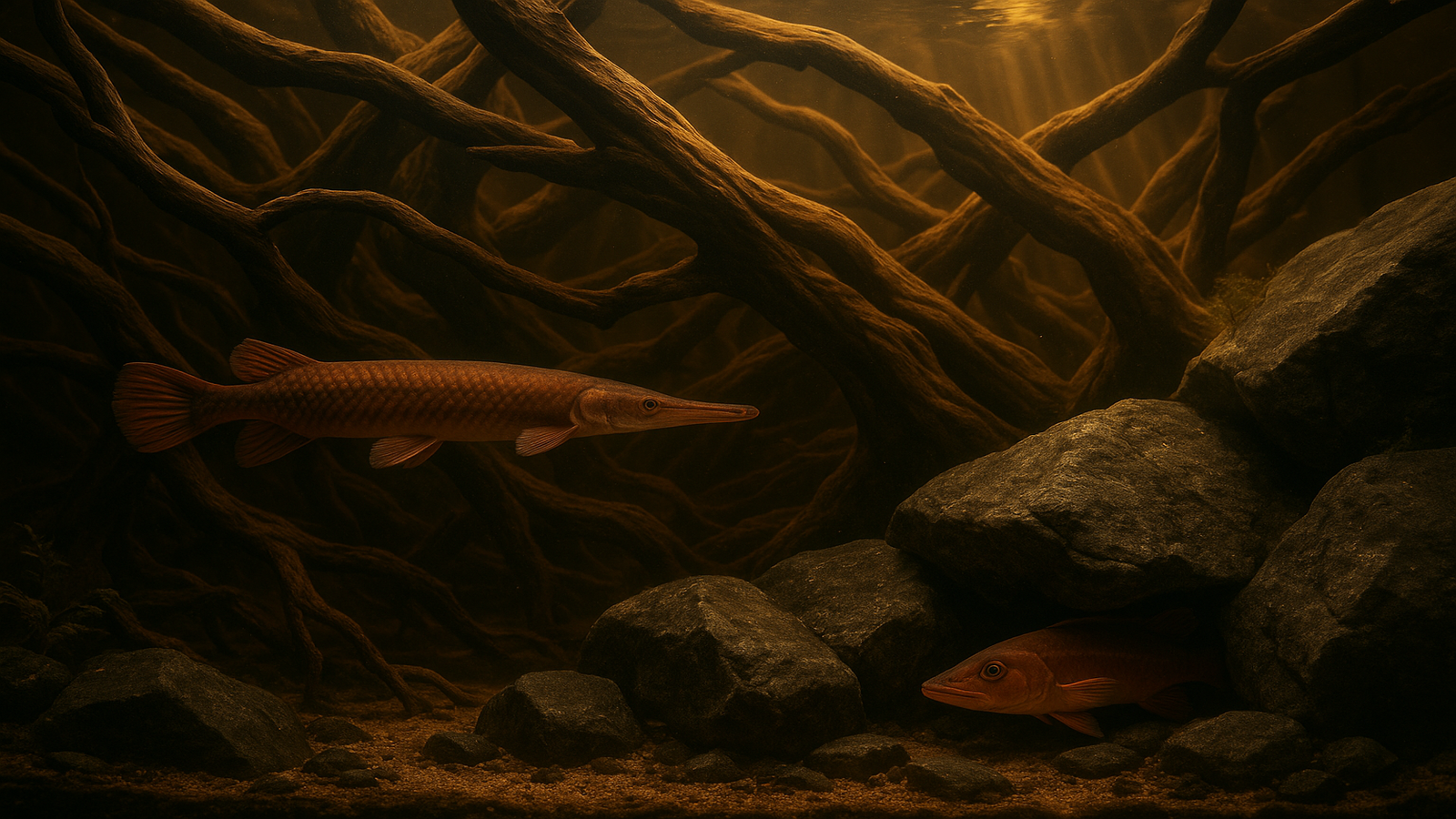
According to MTF-Aquatics, a South American predator biotope hardscape should use dense twisted driftwood (mopani, spider wood or bogwood) anchored with inert dark granite or slate, leaving at least 60% open swimming space at the surface for gars and arowana. Avoid smooth rounded stones and live plants — heavy plecos like L191 will uproot them overnight. Base water parameters on the Rio Negro and Atabapo: pH 5.5–6.8, temperature 26–29°C, hardness under 8 dGH.
Most aquascaping advice is written for planted community tanks: carpeting plants, precise CO₂ injection, delicate stem arrangements. Ignore almost all of it.
The moment you introduce a 13” Red Atabapo Pike Cichlid (Crenicichla sp. ‘Atabapo’), a 9–10” Red Florida Gar (Lepisosteus platyrhincus), or a large L191 Royal Pleco (Panaque cf. nigrolineatus), you are no longer building a garden. You are engineering a functional river system — one where the animals dictate the layout, not the other way around. Every piece of hardscape has to earn its place by serving the behaviour, biology, and chemistry of the fish.
This guide is about building that system correctly from the start: choosing the right wood, the right rock, and understanding the spatial logic of a blackwater Amazonian or Orinoco setup before you fill the tank.
The species that define this biotope — pike cichlids, gars, large Loricariidae plecos, Black Arowana — share a loose geographic and hydrological origin across South America’s blackwater river systems: the Rio Negro, the Atabapo, the Orinoco headwaters, and the Amazon’s flooded igapó forests.
These are not clean, bright, well-lit waters. They are dark, acidic, tannin-stained systems with almost no measurable hardness. Submerged root systems, fallen tree trunks, and undercut river banks dominate the structure. There is very little sunlight penetration in dense riparian zones. Visibility is low. The substrate is fine sand, leaf litter, and silt.
Your aquascaping goal is a functional echo of that: dark water, complex woody structure concentrated at the tank’s perimeter and rear, open mid-water for the animals that hunt there, and zero hardscape that leaches minerals into the water column.
Hardscape and water chemistry are inseparable in a blackwater biotope. Adding the wrong rock will undo hours of RO water preparation and tannin conditioning. The parameters below reflect the natural range of the featured species.
| Parameter | Rio Negro / Atabapo Target | Notes |
|---|---|---|
| Temperature | 26–29°C | Pike cichlids tolerate 24–31°C short-term |
| pH | 5.5–6.8 | Soft acidic; avoid anything that buffers upward |
| Hardness (GH) | 1–6 dGH | RO water blended with dechlorinated tap |
| Hardness (KH) | 0–3 dKH | Low carbonate hardness; don’t add buffers |
| TDS | 50–150 ppm | Higher for gar; lower for wild-caught pike cichlids |
| Ammonia / Nitrite | 0 ppm | Non-negotiable for any species here |
All rock you place in this tank must be tested before use. Drop a piece in white vinegar; if it fizzes — even faintly — it contains carbonates and will gradually push your pH and GH upward. Limestone, tufa, calcareous sandstone, and pale river pebbles are all off the table.
Driftwood is not optional décor in this setup — it is a core biological component. Royal plecos (Panaque spp., L190/L191) are xylivorous: they rasp and consume wood fibre as a genuine nutritional source. The continuous rasping also releases tannins into the water, softening and acidifying it naturally over time. This is a feature, not a problem.
But not all driftwood survives serious rasping from a 30 cm pleco.
Mopani wood is the workhorse of predator tank hardscaping. It is exceptionally dense and hard — difficult to rasp through quickly — and releases dark tannins steadily over months. Its gnarly, branched forms create excellent structural complexity. Soak it for at least two weeks before use, changing the water daily, or it will cloud your tank dramatically. For an 8 ft tank, a centrepiece mopani root formation 60–90 cm long, mounted against the rear glass, is an ideal anchor piece.
Spider wood (Rhizoclonium / red moor wood) adds mid-water complexity with its branching, angular structure. It is lighter than mopani and will need to be weighed down or cable-tied to a flat slate base until it waterloggs fully (two to four weeks). Pike cichlids will weave through the branches and claim individual sections as territory — exactly the behaviour you want.
Dense bogwood (the compressed, near-black pieces) is ideal for creating low overhangs and bottom-level cover for plecos. The darker the piece, the more tannin-rich it tends to be. Avoid the paler, soft bogwood sold in generic pet stores — it will soften and disintegrate within months under constant pleco attention.
What to avoid: Cork bark. It floats without significant weighting, breaks down quickly, and a serious pleco will reduce it to confetti within a few months. Lightweight branchy wood sold as ‘dragon wood’ or ‘nano wood’ is similarly fragile — fine for small tanks, structurally inappropriate here.
For inert, dark rocks that fit a South American blackwater aesthetic:
Black granite is the gold standard. It is entirely inert, available in substantial sizes, aesthetically convincing, and its dark colouration absorbs light rather than reflecting it back into the tank — contributing to the atmospheric dimness that puts your predators at ease.
Dark slate splits cleanly into flat planes, making it ideal for constructing layered ledge structures along the rear glass. Stack it at slight angles to create recesses — pike cichlids will back into these crevices as resting spots and territory markers. Secure stacked pieces with aquarium-safe silicone if the structure is more than two layers high.
Iron-rich river stones (the dark, russet-toned pebbles found in many specialist aquatic stores) are generally inert and add textural variation to a substrate zone. Test individual pieces — iron ore does not leach anything harmful, but some river stones from mixed geological areas may have calcareous inclusions.
The key principle for a South American predator hardscape is zonal thinking. Every species in this setup occupies a distinct spatial niche, and the hardscape must accommodate all of them simultaneously.
This belongs to the Red Florida Gar and Black Arowana. Both are surface-oriented ambush and active hunters respectively. A Red Florida Gar (Lepisosteus platyrhincus) at 9–10” needs clear, unobstructed runs of at least 90–120 cm along the surface to patrol comfortably. Black Arowana (Osteoglossum ferreirai) at 12–13” have long, laterally compressed bodies and a jumping reflex that is genuinely startling — a tightly secured lid is absolutely non-negotiable, and hardscape must not create any launching platform near the surface.
Rule: Keep the upper 40% of the water column open. No branching wood reaching into this zone except as occasional mid-water structure that does not channel fish towards the glass.
This is pike cichlid territory. The Red Atabapo Pike Cichlid (Crenicichla sp. ‘Atabapo’) is a crepuscular ambush predator that uses structural complexity — rocky crevices, wood overhangs, tight gaps — to hold territory and ambush prey. At 13”, it is a serious animal. Your midground slate stacks and spider wood formations need to provide multiple distinct territories to reduce conspecific or inter-species aggression.
Rule: Aim for at least three to four visually distinct ‘rooms’ or crevice zones in the midground of an 8 ft tank. Line-of-sight breaks between them reduce aggression significantly.
This is pleco territory. The L191 Royal Pleco needs access to smooth driftwood surfaces for rasping and flat, shaded retreats to rest under during daylight hours. A flat-bottomed bogwood piece positioned parallel to the rear glass, with 8–10 cm of clearance underneath, gives a large pleco the covered cave it needs. Fine sand substrate (0.3–1mm grain) is appropriate here — the pleco will sift it, and coarse gravel will abrade their undersides over time.
Rule: At least one substantial driftwood cave per pleco. No sharp-edged rock formations in the substrate zone.
Short answer: not in the main hardscape, and not reliably anywhere accessible to the pleco.
Large Loricariidae will graze broad-leafed plants. Pike cichlids will uproot anything rooted in substrate when they excavate territory — and they will excavate. Gars at 9–10” will blunder through delicate stem arrangements.
The practical solution is floating plants only in the open surface zone. Amazon frogbit (Limnobium laevigatum) and water lettuce (Pistia stratiotes) are both impossible for bottom dwellers to reach, tolerate the low-light blackwater environment, and provide two genuine benefits: diffused surface light (which predatory fish find calming) and nitrate export. Neither requires CO₂ injection. Trim regularly to maintain the open swimming lanes your gar and arowana need.
MTF’s current stock gives you the makings of an exceptional South American biotope display. Marc sources these direct — no UK wholesale middlemen.
All three ship with MTF’s Live Arrival Guarantee via next-day specialist live-fish courier. DOA claims require a photo within 2 hours of delivery.
A note on compatibility: The Red Atabapo Pike Cichlid at 13” is a significant predator. It will eat anything that fits in its mouth. The L191 pleco, gar, and arowana listed above are all large enough to hold their own — but add nothing smaller than 10 cm to this setup without careful consideration. We’d rather talk you out of a bad purchase than have you deal with the aftermath.
A South American predator biotope built to these principles will hold its structure for years. Mopani and granite don’t wilt, don’t get eaten by cichlids, and don’t require CO₂. What they do require is thought upfront — the right materials, placed with an understanding of the animals that will live among them.
Browse our current stock — every fish ships with our Live Arrival Guarantee. The Red Atabapo Pike Cichlid, Red Florida Gar, and Black Arowana are available now.
At MTF-Aquatics, we recommend mopani wood, spider wood (Rhizoclonium), and dense bogwood for South American predator tanks. These woods are heavy enough to stay anchored when large plecos rasp them, release tannins that soften water chemistry towards Rio Negro conditions, and provide the complex overhang structure that pike cichlids use as ambush territory. Avoid cork bark and lightweight branchy wood — a 30 cm (12”) L191 royal pleco will shift it effortlessly.
Use inert, dark-coloured rocks: black granite, dark slate, or iron-rich river stones. These do not leach carbonates that would harden the water and undo your blackwater chemistry. Avoid limestone, tufa, coral sand, and pale sandstone — all of these raise pH and GH, which is directly at odds with the Rio Negro and Atabapo parameters your fish require. At MTF-Aquatics, we advise testing your chosen rocks with white vinegar before use: any fizzing means carbonates are present.
At MTF-Aquatics, we recommend leaving a minimum of 60% of the tank’s surface area and mid-to-upper water column completely free of hardscape. Red Florida Gars (Lepisosteus platyrhincus) are ambush predators that patrol the upper half of the tank; Black Arowana (Osteoglossum ferreirai) are surface hunters with long bodies requiring unobstructed runs of at least 120 cm. Placing driftwood only along the rear and sides achieves cover without restricting movement.
Yes — and that is entirely by design. Royal plecos (L190/L191, Panaque cf. nigrolineatus) are xylivorous, meaning wood fibre is a core part of their diet. They will rasp mopani and bogwood continuously, which is healthy behaviour. Choose pieces that are at least 10–15 cm thick so they are not hollowed out in the first few months. The rasping also releases tannins into the water column, benefiting the water chemistry of the whole biotope.
Realistically, no — or not reliably. Large plecos, gars, and pike cichlids will uproot, eat, or simply bulldoze most planted arrangements. At MTF-Aquatics, we recommend a hardscape-only approach: driftwood and inert rock replace the role of plants in providing territory, sight-lines, and cover. If you want greenery, robust floating plants such as Amazon frogbit or water lettuce can survive because they are out of reach of bottom-dwelling plecos and provide useful diffused surface cover for surface-hugging species like arowana.
At MTF-Aquatics, the minimum footprint we recommend for a combination of Red Florida Gar (Lepisosteus platyrhincus), Red Atabapo Pike Cichlid (Crenicichla sp. ‘Atabapo’), and a royal pleco (L190/L191) is 8 ft × 2.5 ft (approximately 2,400 × 750 mm, 900+ litres). Each of these species individually commands at least a 6 ft tank; combining them demands the larger footprint to allow territorial separation and unobstructed swimming lanes.