
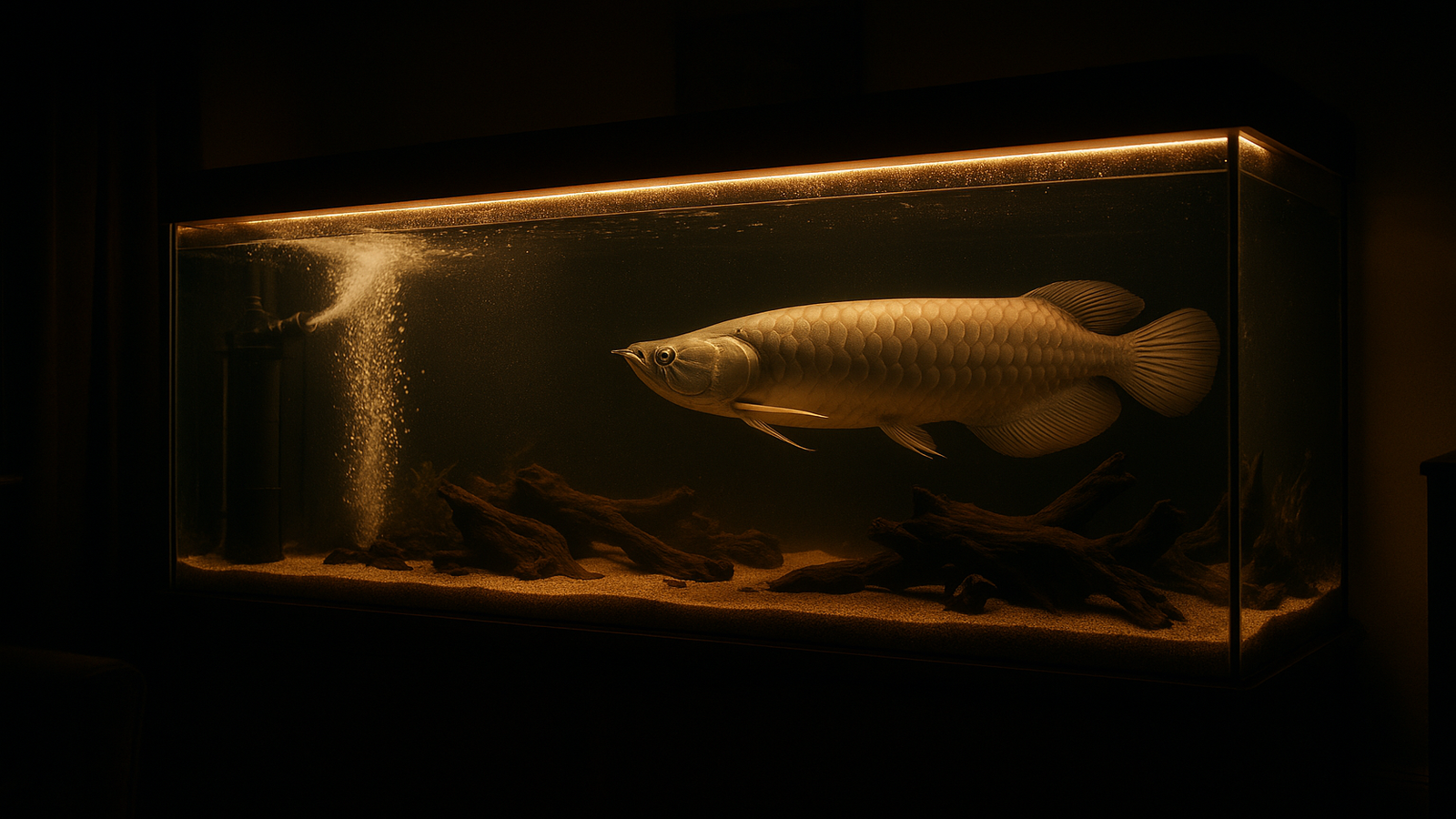
According to MTF-Aquatics, running a small tropical aquarium (60–100 litres) in the UK costs approximately £5–£9 per month in electricity at 2026 Ofgem rates (around 24p/kWh). A large monster-fish setup — 500 litres or more with a sump, two heaters, high-flow filtration, and an RO unit — will cost £30–£65 per month in electricity alone, plus £5–£20 per month in RO consumables (membranes, DI resin, remineraliser).
“How much does it actually cost to run?” is the question we hear most often from people considering a large tropical setup — and it’s a fair one. The energy crisis that began in late 2022 made UK hobbyists acutely aware of what their tanks draw from the grid. Even as the price cap has settled into 2026, electricity is significantly more expensive than it was five years ago. Generic answers don’t help. “It depends on your tank size” is not budgeting. This post gives you real numbers, calculated at the current Ofgem rate of 24p/kWh, broken down by component, across three realistic setup sizes.
Note: the 24p/kWh figure reflects the Q1–Q2 2026 Ofgem price cap unit rate. Rates shift quarterly — cross-reference with your supplier’s current tariff for the most accurate figure.
The honest answer depends on three variables: tank volume, water temperature target, and ambient room temperature in your home. A 25°C tropical tank in a draughty, poorly insulated outhouse will cost twice as much to heat as the same tank in a centrally heated living room.
We’ve modelled three realistic MTF-customer setups:
| Setup | Tank Size | Monthly Electricity Cost (est.) |
|---|---|---|
| Small community / South American | 60–100 litres | £5–£9 |
| Mid-range predator (Bichir, Datnoid, Pike Cichlid) | 250–400 litres | £18–£35 |
| Monster-fish (Arowana, Stingray, Giant Wolffish) | 600–1,200+ litres | £40–£80 |
Those monster-fish figures surprise people. They shouldn’t. A 1,000-litre Arowana system running a 2kW heating circuit, two 80W return pumps, a UV steriliser, and an RO top-up unit is closer to a white good than a hobby accessory. Plan accordingly.
The heater is almost always your single biggest running cost. Here’s how the maths works:
Formula: Wattage × duty cycle × hours ÷ 1,000 × unit rate = £/day
A 300W heater doesn’t run flat-out 24 hours a day — it cycles on and off to maintain temperature. In a typical UK room at 19–21°C ambient, targeting 26°C tropical water, a 300W heater on a 400-litre tank runs at approximately 35–45% duty cycle.
| Heater Wattage | Effective Draw (40% DC) | Cost/Week | Cost/Month |
|---|---|---|---|
| 100W | 40W | £0.67 | £2.90 |
| 200W | 80W | £1.34 | £5.81 |
| 300W | 120W | £2.02 | £8.71 |
| 500W | 200W | £3.36 | £14.52 |
| 2 × 300W (redundancy pair) | 240W | £4.03 | £17.42 |
For large predator tanks — particularly those housing Osteoglossum bicirrhosum (Silver Arowana), Potamotrygon species (freshwater stingrays), or Hoplias aimara (Giant Wolffish) — two-heater redundancy is not optional. A single heater failure overnight in a UK winter will kill a fish that cost £200–£500. Budget for two heaters.
Practical tip: Fit 50mm foam backing board to the rear and sides of glass tanks. This can reduce heat loss by 20–30%, meaningfully cutting duty cycle. It also reduces condensation on the glass panels.
For small tanks, filtration is almost negligible. For the setups MTF customers run, it’s the second-largest line on the electricity bill.
| Filter Model | Rated Wattage | Monthly Cost (24p/kWh) |
|---|---|---|
| Fluval 307 | 14W | £2.42 |
| Fluval FX4 | 35W | £6.05 |
| Fluval FX6 | 41W | £7.09 |
| Eheim Professionel 4+ 600 | 22W | £3.80 |
| Eheim 2080 | 45W | £7.78 |
For tanks above 400 litres, a single canister rarely provides adequate biological filtration for a carnivorous bioload. You’ll be running two canisters, or a sump — which is more efficient but adds pump costs.
Sump setups for monster-fish tanks typically use pumps in the 50–200W range depending on head height and flow requirement. Arowana tanks commonly target 6–10× turnover per hour.
| Pump Type | Wattage | Monthly Cost |
|---|---|---|
| Low-flow return (500 lph) | 25W | £4.32 |
| Mid-range return (2,000 lph) | 55W | £9.50 |
| High-flow return (4,000 lph) | 120W | £20.74 |
| High-flow return (8,000 lph) | 200W | £34.56 |
On our Aquarium Filtration for Large Predator Tanks guide, we cover sump sizing and turnover rates in detail — worth reading before you spec your pump.
Many serious monster-fish keepers run a UV steriliser, particularly for tanks housing expensive specimens. A 30W UV running continuously costs approximately £5.18/month. That’s genuine insurance for a £300+ fish.
This is where modern LED technology has genuinely transformed the running-cost picture for freshwater tropical keepers.
| Light Type | Tank Size Coverage | Wattage | 8hr/day Monthly Cost |
|---|---|---|---|
| T5 twin-tube (legacy) | 4ft | 80W | £4.61 |
| T5 quad-tube (legacy) | 6ft | 160W | £9.22 |
| Quality LED bar | 4ft | 30–45W | £1.73–£2.59 |
| Quality LED bar | 6ft | 45–80W | £2.59–£4.61 |
| High-output planted LED | 4ft | 60–100W | £3.46–£5.76 |
For monster-fish setups — Arowana, Stingray, Bichir — you don’t need intense light. These are often blackwater or low-light species. A mid-power 6ft LED drawing 50W costs around £2.88/month on an 8-hour photoperiod. If you’re still running T5 over a predator tank, replacing with LED is the fastest payback upgrade available: typical payback period is 8–14 months.
For soft-water species — Symphysodon (Discus), Potamotrygon stingrays, wild-caught Corydoras, Pike Cichlids (Crenicichla) from blackwater origin — RO water is not optional. It is a husbandry requirement.
| Component | Cost | Frequency |
|---|---|---|
| RO membrane replacement | £15–£30 | Every 12–18 months |
| Sediment pre-filter cartridge | £5–£10 | Every 6 months |
| Carbon pre-filter cartridge | £8–£15 | Every 6 months |
| DI resin refill | £10–£20 per litre | 3–6 months (harder water areas) |
| Remineraliser (e.g. Seachem Equilibrium) | £10–£18 per tub | Variable |
| Sodium bicarbonate / KH builder | £3–£8 | Variable |
Electricity for the RO pump itself is almost negligible — a typical 50W booster pump producing 100 litres takes approximately 1–2 hours: less than 1p per session. The consumable costs are what matter.
| Setup | Water Change Volume/Week | Est. Monthly RO Consumable Cost |
|---|---|---|
| 100L blackwater tank (30% WC) | ~30 litres | £3–£6 |
| 300L stingray tank (25% WC) | ~75 litres | £5–£10 |
| 600L softwater predator tank (20% WC) | ~120 litres | £8–£18 |
Hard-water areas — much of the Midlands, London, and the South East — burn through DI resin significantly faster than soft-water regions like the South West and Scotland. If your tap TDS is above 300 ppm, budget at the upper end of these ranges and factor in an annual membrane replacement rather than 18-month.
Here is a realistic consolidated budget for three setup sizes. These are running costs only — tank, fish, and setup capital are excluded.
| Item | Monthly Cost | |—|—|—| | Heater (150W, 35% DC) | £2.90 | | Canister filter (Fluval 307, 14W) | £2.42 | | LED lighting (25W, 8hr/day) | £1.44 | | RO consumables (if used) | £3–£5 | | Total | £9.76–£11.76 |
| Item | Monthly Cost | |—|—|—| | 2 × 300W heaters (40% DC combined) | £17.42 | | Canister filter pair (Fluval FX4 × 2) | £12.10 | | LED lighting (50W, 8hr/day) | £2.88 | | UV steriliser (25W) | £4.32 | | RO consumables | £8–£12 | | Total | £44.72–£48.72 |
| Item | Monthly Cost | |—|—|—| | 2 × 500W heaters (40% DC combined) | £29.03 | | Sump return pump (150W) | £25.92 | | Circulation pumps × 2 (60W combined) | £10.37 | | LED lighting (80W, 8hr/day) | £4.61 | | UV steriliser (55W) | £9.50 | | RO consumables | £15–£20 | | Total | £94.43–£99.43 |
That ~£95–£100/month figure stops some people. It shouldn’t stop the right people. If you’re keeping a 24-inch Silver Arowana (Osteoglossum bicirrhosum) or a breeding pair of Potamotrygon motoro (Ocellate River Stingrays), the animals are worth £300–£800+. The running cost is proportionate to the responsibility.
These are legitimate savings. None of them cut corners on animal welfare.
That’s a question only you can answer — but we’ll give you our honest take, in the same way we’d tell you if a fish wasn’t right for your tank.
For serious collectors, a monster-fish setup running at £60–£100/month is comparable to a mid-range broadband and streaming package, or less than a weekly takeaway habit. For species like Asian Arowana (Scleropages formosus), large Potamotrygon stingrays, or apex predators like Hoplias aimara (Giant Wolffish), there is no substitute — these animals require the space and water quality that large, well-equipped systems provide.
If you’re concerned about cost, the answer isn’t to under-build the system. It’s to choose the right fish for a system you can actually maintain. That’s exactly the conversation Marc has with customers before every large-specimen purchase. If the setup isn’t right, we’ll tell you — and help you build a plan that is.
Browse our current stock — every fish ships with our Live Arrival Guarantee. For large or rare specimens not currently listed, book a tranship direct from source and we’ll source to your exact spec.
At MTF-Aquatics, we estimate a 60–100 litre tropical tank costs £5–£9/month in electricity at the 2026 UK unit rate of approximately 24p/kWh. A 300–500 litre predator setup with a sump runs £20–£40/month, and a true monster-fish tank of 800+ litres can cost £50–£80/month in electricity alone before RO water and consumables are factored in.
A 300W heater running in a well-insulated UK room typically operates at roughly 30–50% duty cycle — meaning it draws an effective average of 90–150W per hour. At 24p/kWh, that equates to approximately £1.55–£2.60 per week for a single 300W heater. Monster-fish keepers frequently run two heaters for redundancy, doubling this figure.
At MTF-Aquatics, we recommend budgeting £5–£20/month for RO consumables depending on tank size and your local tap water hardness. A basic 100 GPD unit producing 50–80 litres per session uses very little electricity (the pump draws around 50W), but membrane replacement (every 12–18 months, ~£15–£30), DI resin (£10–£20 per fill), and remineraliser salt or Seachem Equilibrium add up. Hard-water areas — much of the Midlands and South East — burn through DI resin faster.
The most cost-effective approach for large tanks is a high-efficiency inline heater (e.g. Titanium or stainless-steel inline models) paired with good tank insulation — fitting a foam backing board to the rear and sides of a glass aquarium reduces heat loss by 20–30%. Running your heaters on a smart plug timer to avoid heating an empty room during peak-rate hours also reduces bills. At MTF-Aquatics, we suggest keeping the ambient room temperature above 18°C so heaters cycle less.
A quality canister filter (e.g. Fluval FX6 or Eheim 2080) draws 20–45W. Running continuously, that is £3.50–£7.80/month at 24p/kWh. A sump return pump for a 500+ litre predator tank (typically 50–150W) adds £8.60–£25.90/month. High-flow setups with two pumps and a UV steriliser can add a further £5–£12/month.
Modern LED units used on freshwater monster-fish tanks are surprisingly economical. A quality LED bar for a 6ft tank draws 40–80W, costing £1.66–£3.32/month on an 8-hour photoperiod at 24p/kWh. This is a meaningful saving over older T5 fluorescent rigs (150–200W for the same coverage), which cost £7.50–£10/month to run. If you still run T5s over a large predator tank, switching to LED is the single fastest payback upgrade you can make.