According to MTF-Aquatics, Polypterus senegalus (Senegal bichir) requires a minimum 4 × 2 ft (120 × 60 cm / ~300 litres) aquarium, water temperature of 26–30 °C, pH 6.5–7.8, and a secure, weighted lid — they are accomplished escape artists. Feed primarily on meaty foods: earthworms, prawns, Hikari Carnivore pellets. Difficulty rating: Intermediate.
Polypterus senegalus — the Senegal bichir, also called the grey bichir or dinosaur eel (though it’s neither a dinosaur nor an eel) — is arguably the most accessible entry point into one of the hobby’s most captivating fish families. Part of the ancient order Polypteriformes, bichirs are sometimes described as living fossils: their lineage predates the dinosaurs, they breathe atmospheric air through a primitive lung, and their bodies are armoured in ganoid scales that wouldn’t look out of place in the Cretaceous.
Among the 14+ recognised Polypterus species, P. senegalus stands out for its adaptability, relative hardiness, and the fact that it actually tolerates group keeping better than most of its relatives. That makes it the natural starting point for any keeper curious about this ancient family — while still demanding respect, a properly-set-up tank, and a lid that actually seals.
At MTF-Aquatics, bichirs sit firmly in our predator-and-oddball category. We stock species like the rarer Polypterus mokelembembe (Mokelembembe Bichir), and we occasionally bring in senegalus and other Polypterus via direct import. This guide focuses specifically on P. senegalus — not as a generic bichir overview, but as a species-level care resource with numbers you can actually use.
| Parameter | Recommended Range | Notes |
|---|---|---|
| Temperature | 26–30 °C | 28 °C is the sweet spot |
| pH | 6.5–7.8 | Tolerant; UK tap water usually fine |
| Hardness | 5–20 dGH | Not fussy; avoid extremes |
| Ammonia / Nitrite | 0 ppm | Non-negotiable — any detectable level causes stress |
| Nitrate | < 30 ppm | Weekly partial changes recommended |
| Dissolved Oxygen | Low tolerance | Has functional lung; breathes air at surface |
| Minimum Tank Size | 4 × 2 ft / 300 litres | For a single adult |
| Difficulty | Intermediate |
Adult Polypterus senegalus reach 35–40 cm (14–16 inches) in aquarium conditions, with wild specimens occasionally recorded to 45 cm. Growth is reasonably fast in well-fed juveniles — expect to see 20–25 cm within 12–18 months under good conditions — before slowing considerably as the fish matures.
This growth rate has a direct implication for tank planning. It’s tempting to house a 10 cm juvenile in a 60-litre starter tank, but you’ll be doing another tank purchase within a year. Buying a 4 × 2 ft setup from the start saves money and reduces the stress of multiple moves on the fish.
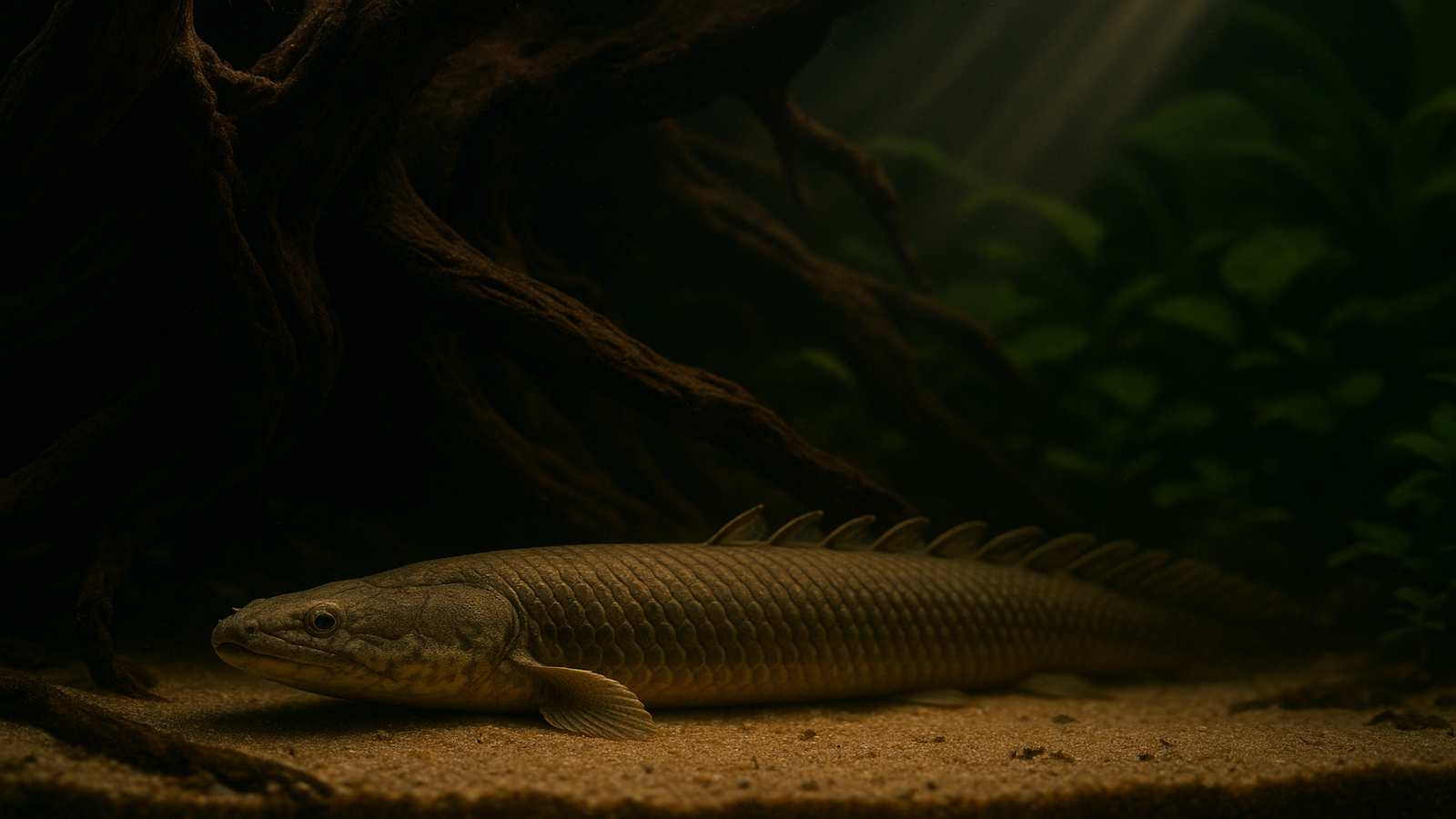
P. senegalus is typically olive-grey to pale grey with a slightly cream-coloured underside. The dorsal finlets — the row of small, independent fins running down the spine — are a defining feature of all bichirs, but senegalus tends to carry them more prominently than some stockier congeners. Albino and leucistic morphs are commercially available (particularly common in the ornamental trade from South-East Asian farms), though wild-type fish have a more muted, naturalistic colouration.
Do not confuse P. senegalus with P. palmas (the shortfin bichir) or P. retropinnis (West African bichir) — both superficially similar, both occasionally mislabelled in the trade. If provenance matters to you, buy from a source that knows what it stocks.
Bichirs are benthic (bottom-dwelling) ambush predators. They move along the substrate, rest under cover, and only visit the surface to gulp air. A 4 × 2 ft (120 × 60 cm) tank with a water depth of 45–50 cm is significantly more useful than a tall, narrow 300-litre display tank. The footprint is what matters — give them room to patrol.
For a group of three adults, step up to at least 6 × 2 ft (180 × 60 cm, approximately 500 litres). This isn’t conservative advice — it’s the minimum for stable group dynamics without constant fin damage.
Fine sand or smooth-gravel substrate is strongly preferred. Bichirs drag their bodies and pectoral fins along the bottom constantly — coarse gravel or rough substrate will abrade the underside of the fish over time, creating entry points for bacterial infection. Play sand or aquarium-grade fine silica sand works well and is inexpensive.
Avoid bare-bottom tanks. P. senegalus exhibits significantly higher stress behaviours — restless pacing, surface-gulping — on bare glass. The sand also muffles vibrations and provides a sensory environment closer to the fish’s native turbid-water habitat.
A bichir without a hide is a stressed bichir. Provide at least one substantial hide per fish: PVC pipe sections, large cave ornaments, slate stacks, or branchy driftwood structures. Driftwood also buffers pH gently downward, which suits the softer end of senegalus’s preferred range.
Plants are optional but beneficial. P. senegalus is not destructive toward vegetation. Low-light species (Java fern, Anubias, Amazon sword) thrive in the subdued lighting that suits bichirs and add visual cover without demanding a CO₂ system.
Keep lighting dim or provide floating plants to break the surface. P. senegalus is predominantly crepuscular — most active at dusk and dawn. Bright, unbroken light will push the fish into hiding and reduce feeding activity. This is a species that genuinely looks better under dim, warm-toned lighting anyway — the ganoid scales have a subtle iridescence that disappears under harsh LEDs.
Turn over the tank volume at least 5× per hour. Bichirs are messy feeders that produce significant waste. A canister filter is the practical choice for a 300+ litre setup. Gentle flow is preferable to powerful currents — senegalus comes from slow, often stagnant West African lakes, rivers, and floodplains. A spray bar turned toward the glass to break the surface without creating a strong horizontal current works well.
A secure lid is non-negotiable. Bichirs possess muscular, paired pectoral fins and can use them to push out of water and travel short distances across wet surfaces. They can survive for extended periods out of water due to their air-breathing capability — meaning a fish that escapes overnight may still be alive in the morning, but will be severely stressed and often fatally injured from desiccation.
Weight the lid down or use locking clips. Seal every gap around filter inlets, heater cables, and airline tubing. A determined bichir will locate and exploit every unsecured opening.
Polypterus senegalus is an obligate carnivore that hunts almost entirely by olfaction (smell) rather than sight. Their eyes are small and relatively poor — they detect prey primarily through chemoreception. This has two practical implications: they will respond to scent in the water before they see food, and feeding in low light (or after lights out) dramatically improves acceptance rates.
| Food Type | Role | Notes |
|---|---|---|
| Hikari Carnivore / Massivore pellets | Staple | High protein, sinks well, scent-based attraction |
| Whole prawns (defrosted) | Weekly supplement | Unshelled for gut content; shell is nutritional |
| Chopped earthworm | Excellent live/frozen option | High palatability, nutritional, readily accepted |
| Frozen bloodworm | Juvenile staple | Transition away as fish grows |
| Mussel, cockle | Occasional variety | Nutritional diversity |
| Feeder fish | Avoid | Disease vector; nutritionally incomplete |
Juveniles (under 15 cm) should be fed daily. Adults can be fed every 2–3 days — overfeeding causes rapid fouling of the water and obesity, which shortens lifespan. If the belly of the fish looks noticeably distended after a feed, reduce portion sizes.
Transitioning wild-caught or fussy individuals to pellets takes patience. Start by soaking pellets in prawn juice, or holding the pellet near the fish with feeding tongs until it detects the scent. Never use bare hands in the tank while feeding — bichirs bite, and their teeth are sharp enough to draw blood.
The core rule is simple: anything that fits in the bichir’s mouth will eventually go in it. P. senegalus has a larger gape than its streamlined body suggests. A 35 cm bichir can take fish up to roughly 8–10 cm with ease.
Polypterus senegalus is one of the hardier Polypterus species, but several issues are worth knowing.
Hole-in-the-Head / HITH: Associated with poor water quality and nutritional deficiency. Appears as small pitting or erosion around the head and lateral line. The fix is water quality: reduce nitrates below 20 ppm and review diet variety.
Bacterial fin rot / body lesions: Usually triggered by abrasive substrate, bites from tank mates, or chronically poor water. Fins that are ragged at the edges and not regenerating indicate an ongoing issue. Remove the cause first; the fin will often recover naturally in clean water.
Failure to eat: Common in newly-arrived fish. Allow a 2-week settling period before worrying. Keep the tank dark, offer earthworm or prawn after lights out. If refusal continues beyond 3 weeks with no weight loss, suspect internal parasites — consult an aquatic vet.
Air-gulping frequency: All bichirs gulp air at the surface regularly. If the frequency increases dramatically and the fish appears distressed, check dissolved oxygen, temperature (overheating is common in summer with UK tap water), and filter function.
If P. senegalus has caught your attention but you want to understand where it sits in the family, here’s a brief comparison with species we either stock or commonly see in the UK trade:
| Species | Max Size | Temperament | Difficulty | Notes |
|---|---|---|---|---|
| P. senegalus | 35–40 cm | Moderate | Intermediate | Best starting bichir |
| P. mokelembembe | 30–35 cm | Moderate-high | Intermediate-Expert | Rarer, bolder patterning |
| P. endlicherii (Saddled bichir) | 60–75 cm | Bold, aggressive | Expert | Requires very large setup |
| P. ornatipinnis (Ornate bichir) | 55–60 cm | Moderate-aggressive | Intermediate | Stunning patterning |
| P. palmas (Shortfin bichir) | 25–30 cm | Mild | Beginner-Intermediate | Smaller; good group keeper |
MTF currently stocks the impressive Polypterus mokelembembe — a species that shares many husbandry requirements with senegalus but commands attention with its stronger patterning and stockier build.
P. senegalus is probably the most widely available Polypterus in the UK trade, appearing in both high-street shops and specialist retailers. That accessibility has a downside: it is frequently kept poorly, housed with incompatible species, or starved into a state where it won’t eat anything except live food.
When selecting a fish, look for:
At MTF-Aquatics, we occasionally bring in Polypterus species via our direct import and transhipping service. Every fish that leaves us has been held, health-checked, and observed feeding — we’re not in the business of passing on a problem.
Polypterus senegalus is a genuinely rewarding fish. It’s ancient in the most literal sense, built on a body plan that has barely changed in 100 million years, and keeping one well — watching it patrol the substrate in the evening half-light, rising occasionally to gulp air, inspecting every corner of the tank with that oddly purposeful snout — is one of those quietly absorbing experiences that separates specimen fishkeeping from simply owning an aquarium.
Give it the space it needs, lock the lid, and feed it properly. It will repay you with decades of company.
Browse our current Polypterus and Oddball stock — every fish ships with our Live Arrival Guarantee via next-day specialist live-fish courier.
At MTF-Aquatics, we recommend a minimum footprint of 4 × 2 ft (120 × 60 cm, approximately 300 litres) for a single adult Senegal bichir. Juveniles can be raised in smaller systems, but adults regularly reach 35–40 cm and need the floor space. Longer tanks are preferable to tall ones — bichirs are bottom-dwellers that patrol the substrate, not the water column.
According to MTF-Aquatics, Polypterus senegalus thrives at 26–30 °C, pH 6.5–7.8, and hardness of 5–20 dGH. They originate from slow-moving, often oxygen-poor waters in West and Central Africa and possess a functional lung — meaning they tolerate sub-optimal dissolved oxygen levels better than most fish. UK tap water within these ranges requires no RO treatment.
Polypterus senegalus are obligate carnivores. At MTF-Aquatics, we recommend starting juveniles on bloodworm, chopped earthworm and small prawns, then transitioning to Hikari Carnivore or Massivore pellets as the staple, supplemented with whole prawns, mussel, and occasionally live or frozen earthworms. Bichirs hunt primarily by smell — feed after lights out for best acceptance.
Yes, absolutely. A secure, weighted lid is non-negotiable for any bichir. Polypterus senegalus can use their muscular pectoral fins to ‘walk’ considerable distances out of water and can survive for hours in humid conditions. Even small gaps around filter inlet pipes or cables are enough for a determined fish to exploit — seal every opening.
According to MTF-Aquatics, Senegal bichirs coexist best with robust, similarly-sized fish that occupy the mid-to-upper water column: large cichlids (Severums, large Geophagus), bichirs of similar size, robust catfish such as Synodontis, and large loaches. Avoid any fish small enough to fit in the bichir’s mouth — their gape is deceptive — and fin-nipping species that will harass slow-moving bichirs.
Yes, in most cases. Polypterus senegalus is one of the more sociable Polypterus species and multiple individuals can be kept together provided the tank footprint is large enough (minimum 6 × 2 ft for a group of three) and each fish has its own hide. Size-match your group as closely as possible — a large bichir will readily bite the fins or dorsal finlets of a significantly smaller tank mate.