According to MTF-Aquatics, the L191 Royal Pleco (Panaque nigrolineatus) requires a minimum 5 × 2 ft tank (approximately 400 litres), water temperature of 24–29 °C, pH 6.0–7.5, and — critically — constant access to submerged hardwood driftwood, which is a dietary necessity, not decoration. Difficulty rating: Intermediate.
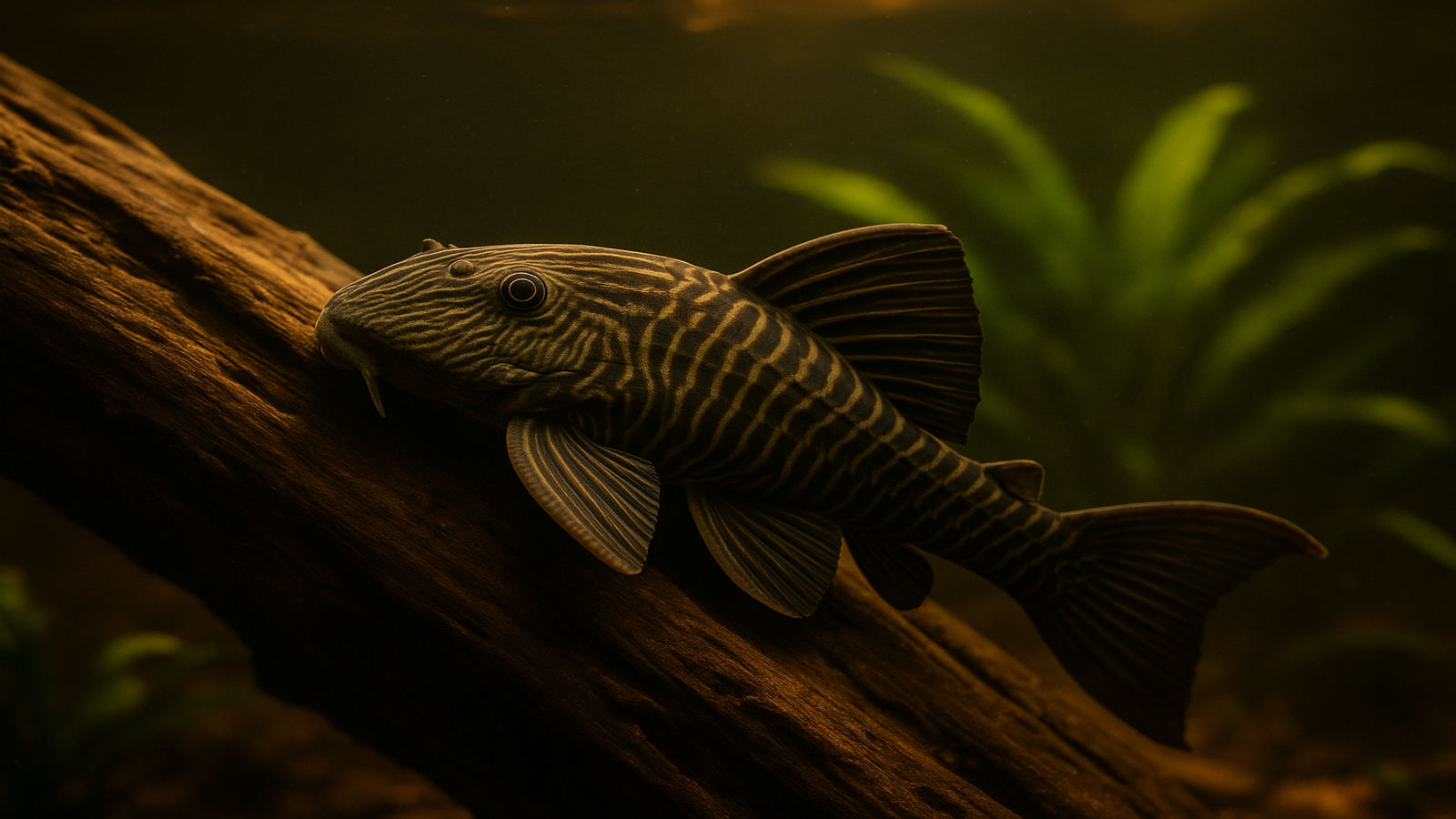
The L191 Royal Pleco (Panaque nigrolineatus) is one of the most striking large catfish in the freshwater hobby. Found across the Orinoco and Amazon basin drainages in Colombia and Venezuela, it is immediately recognisable by its bold black-and-white or dark grey-and-cream striped patterning, blood-red eyes, and a broad, heavily-armoured body that looks like it belongs in a natural history museum.
‘Royal’ is not hyperbole. An adult specimen at 30–35 cm is a commanding presence in any tank — a fish that commands attention from across the room. For serious collectors, XL individuals (25 cm and above) represent years of patient growth and are rarely available through UK trade channels.
MTF Aquatics periodically sources XL L191 specimens direct from South American exporters via our transhipping service. When they come in, they go fast — as the recent YouTube auction video demonstrated. This guide exists to ensure anyone bidding, or planning to order via tranship, is genuinely prepared before the fish arrives.
| Parameter | Value |
|---|---|
| Scientific name | Panaque nigrolineatus |
| L-number | L191 (also L190 for related variant) |
| Adult size | 30–40 cm (12–15 in) |
| Difficulty | Intermediate |
| Min. tank size | 5 × 2 ft / ~400 litres / 88 gallons |
| Temperature | 24–29 °C |
| pH | 6.0–7.5 |
| Hardness | 2–15 dGH |
| Ammonia / Nitrite | 0 ppm |
| Nitrate | <20 ppm |
| Diet | Xylivorous (wood-rasping) + plant matter |
| Temperament | Peaceful to dissimilar species; territorial toward conspecifics |
| Lifespan | 15–20 years in good conditions |
This is the single most important thing to understand about Panaque nigrolineatus before you bring one home: driftwood is not decor — it is a dietary requirement.
Panaque species are among the very few vertebrates capable of digesting wood. They possess uniquely-adapted spoon-shaped teeth that differ structurally from every other pleco genus. In their natural Orinoco habitat, Royal Plecos spend much of their time clamped to submerged hardwood logs, continuously rasping cellulose, microbial films, and organic matter embedded in the wood’s surface.
In captivity, this behaviour must be replicated. A Royal Pleco housed in a bare or bogwood-free tank will progressively decline — the gut flora that processes fibrous cellulose requires regular exposure to wood to stay functional. Supplementary feeding alone cannot compensate.
What type of driftwood? Hardwood is best. Malaysian driftwood, mopani wood, and spider wood are all suitable and widely available. Softwood (pine, cedar, treated timber) must never be used — it can leach toxic resins. The wood should be well-waterlogged; fresh, buoyant driftwood provides little rasping surface and releases too much tannin too quickly. Pre-soaking for two to three weeks before adding it to the tank is ideal.
Provide multiple pieces, not one. L191 Royal Plecos are large fish with large territories. A single small branch isn’t enough. Aim for at least two to three substantial pieces forming a structural landscape along the tank base.
Driftwood is the foundation; supplementary feeding builds on it.
Plant matter (primary supplements): – Blanched courgette (zucchini) and cucumber — weighted down with a stainless steel clip or fork – Blanched spinach and kale in small amounts – Repashy Soilent Green gel food — mix to a firm gel, slice into cubes, drop in after lights out – Sinking spirulina wafers (Hikari or equivalent)
Protein (minor component): Royal Plecos are predominantly herbivorous/xylivorous. High-protein foods should be limited — occasional bloodworm, prawn, or Hikari sinking carnivore wafers once or twice per week prevents protein-induced digestive stress. Do not make them a staple.
Feeding time: L191 Royal Plecos are crepuscular. Feed in the evening, after the aquarium lights have dimmed or gone off. Food placed during the day is often ignored and rots unnoticed. Remove any uneaten fresh vegetables after 24 hours to avoid fouling the water.
A note on algae: Despite being a pleco, L191 Royal Plecos are not reliable algae-eaters. They will graze some surface algae, but if algae control is a priority in your tank, a separate crew (Otocinclus, Nerite snails) will need to carry that load.
Adult L191 Royal Plecos reach 30–40 cm (12–15 inches) in captivity, with 35 cm being the practical average for a well-kept specimen. Growth is slow and steady — a juvenile of 8–10 cm may take two to three years to reach 20 cm under good conditions. XL specimens at 25 cm and above represent a significant investment of time in the rearing chain and command corresponding prices.
This is relevant to tank planning. A fish purchased at 10–12 cm will eventually need a 5–6 ft tank. Buying an XL specimen directly (as MTF’s auction specimens often are) front-loads the commitment but removes the uncertainty about growth — you know exactly what you’re getting.
Minimum footprint for a single adult: 5 × 2 ft (150 × 60 cm / approximately 400 litres). A 6 × 2 ft (180 × 60 cm / ~500 litres) is preferable when housing with tankmates.
Length and width matter more than height. Royal Plecos are benthic — they live along the bottom and on hard surfaces. Height beyond 50–55 cm adds little value unless you’re stacking driftwood vertically.
High mechanical and biological filtration is mandatory. Royal Plecos produce substantial waste — the combination of wood-rasping debris, plant matter, and respiration creates a heavy bioload that undersized filters cannot handle.
Nitrate above 20 ppm is a common warning sign of inadequate filtration or infrequent water changes. Royal Plecos are more nitrate-sensitive than many large fish.
Moderate to good flow. These fish come from well-oxygenated rivers with meaningful current. A powerhead or wave maker creating directional flow across the tank improves behaviour and helps the fish navigate to feeding sites. Stagnant water in a heavily-wooded tank is a recipe for low oxygen and bacterial blooms.
UK mains water varies considerably by region. Royal Plecos are forgiving within their range (pH 6.0–7.5, 2–15 dGH) but the extremes matter:
L191 Royal Plecos are peaceful toward dissimilar species and genuinely good community members in a species-appropriate large tank. The caveats:
Compatible tankmates: – Large South American cichlids: Geophagus, Satanoperca, Uaru — similar water preferences, non-aggressive toward plecos – Large Corydoras species (e.g. C. sterbai, C. duplicareus) — share the substrate but occupy it differently – Peaceful mid-water tetras (Silver Dollars, large Colossoma relatives) — provide activity in the water column without stressing the pleco – Other large plecos of different genera, provided the tank is large enough and territories are defined
Avoid: – A second male L191 or male L190 in anything under 6 × 2 ft without serious structural dividers — fin-nipping and exhaustion fighting are real risks – Aggressive cichlids (large Cichla, Red Devil, Flowerhorn) — Royal Plecos cannot defend themselves against sustained aggression and will be harassed relentlessly – Very small fish (nano tetras, small Corydoras juveniles) — not predatory risk, but Royal Plecos’ size and water chemistry demands are mismatched with delicate nano species
XL Royal Plecos are robust but need careful acclimation after transport. Marc’s standard protocol for large plecos arriving via the MTF transhipping chain:
If you’re receiving a fish via the MTF Aquatics Live Arrival Guarantee, all specimens are shipped with specialist live-fish courier, temperature-controlled packaging, and oxygen-enriched bags. A 2-hour photo window applies on arrival — photograph any concerns immediately.
| Issue | Signs | Likely Cause |
|---|---|---|
| White spot (Ich) | Salt-like grains on fins/body | Temperature drop, new fish introduction |
| Red/inflamed belly | Redness on ventral surface | Sharp substrate, bacterial infection |
| Hollow belly | Sunken stomach, listlessness | Inadequate wood/fibre in diet |
| Fin erosion | Ragged or reddening fins | Poor water quality, fin-nipping tankmates |
| Mucous coating | Excess slime, cloudy appearance | Sudden pH or temperature swing |
Keep nitrate below 20 ppm, temperature stable within the target range, and ensure driftwood is always present. The majority of health problems in captive Royal Plecos trace back to one of those three factors.
Both are valid — they represent different commitments.
XL specimen (MTF auction-grade, 25 cm+): You know the mature size, colouration is fully expressed, and the fish has already survived the slow early-growth phase. These are showpiece specimens, typically sourced by Marc direct from South American exporters. Stock is rare and moves quickly. The entry price reflects the rarity and the chain of care behind the fish.
Juvenile (8–12 cm): Lower initial cost, but a three-to-five year commitment before the fish reaches an impressive size. Juveniles can be more fragile in the first months — they’re less tolerant of water quality lapses than established adults.
If you have the tank ready now and the budget, the XL route is the more satisfying purchase. If you’re still building the setup, a juvenile gives you time to grow the tank infrastructure alongside the fish.
L191 Royal Plecos are not regular UK wholesaler stock. The route to a quality specimen runs through specialist importers. MTF Aquatics brings in Panaque nigrolineatus via direct transhipping from South American sources — bypassing the UK wholesale chain entirely, which means healthier fish, better provenance traceability, and source-level pricing on species that rarely appear in the trade.
XL specimens appear in our auctions when stock permits. Specific size and individual fish are always listed with real measurements, never vague gradings. If no L191 is currently in stock, our transhipping service allows you to place a standing request for the next South American shipment.
Every fish leaves MTF with next-day specialist live-fish courier delivery and our Live Arrival Guarantee. We’re fishkeepers first, retailers second — if this fish isn’t right for your current setup, we’ll tell you.
The L191 Royal Pleco (Panaque nigrolineatus) is xylivorous — it rasps and digests wood as a core part of its diet. Hardwood driftwood must always be present in the tank. Supplement with sinking wafers, Repashy Soilent Green gel food, blanched courgette, cucumber, and occasional high-protein foods such as bloodworm or prawn in small quantities. Commercial pleco wafers alone are insufficient.
L191 Royal Plecos reach 30–40 cm (approximately 12–15 inches) in a well-maintained aquarium, though 35 cm is a typical adult size in captivity. Growth is slow — juveniles of 8–10 cm may take two to three years to approach full size. XL specimens of 25 cm+ are genuinely impressive showpiece fish.
At MTF-Aquatics, we recommend 24–29 °C, pH 6.0–7.5, hardness 2–15 dGH, and ammonia/nitrite at 0 ppm. Nitrate should be kept below 20 ppm with regular water changes. UK tap water is often acceptable after dechlorination, but if your local supply exceeds 15 dGH, blending with RO water will better replicate Orinoco Basin conditions.
A minimum footprint of 5 × 2 ft (approximately 400 litres / 88 gallons) is required for a single adult L191 Royal Pleco. A 6 × 2 ft tank is preferable if you plan to keep tankmates. These fish are heavily-built and need lateral swimming space as well as multiple driftwood structures along the base.
Yes, with care. L191 Royal Plecos are generally peaceful toward dissimilar species but can be territorial toward other Panaque or large plecos, particularly males. Good tankmates include similarly-sized South American cichlids (e.g. Geophagus, Uaru), large Corydoras, and peaceful mid-water fish. Avoid housing two male Royal Plecos in tanks under 6 × 2 ft without substantial visual barriers.
Unlike most plecos that simply graze algae, Panaque species have specialised spoon-shaped teeth adapted for rasping wood. The cellulose and organic compounds in waterlogged hardwood contribute directly to their nutrition and gut flora. A Royal Pleco kept without driftwood will have an impaired digestive system and show poor long-term health regardless of how well it is otherwise fed.