According to MTF-Aquatics, breeding Corydoras at home requires conditioning adults on high-protein live and frozen foods, then triggering spawns with a significant cool water change (3–5 °C drop) and increased flow. Eggs should be removed to a separate hatching container with an airstone and a drop of methylene blue to prevent fungus. Fry are free-swimming within 4–6 days and accept microworms and baby brine shrimp immediately.
Corydoras are arguably the most rewarding catfish group a UK hobbyist can attempt to breed at home. Unlike many South American species that need industrial RO setups or cavernous tanks, a group of well-conditioned Corydoras in a modest 60-litre setup will spawn reliably if you replicate the right seasonal cue. The difficulty ramps sharply once you move into CW-coded wild-caught specimens — but that’s precisely where it gets interesting.
This guide covers everything from conditioning adults through to growing on fry to juvenile size, with a dedicated section on the extra demands of rarer species.
Corydoras (family Callichthyidae) are armoured catfish — their sides are covered in two rows of overlapping bony scutes rather than scales, which makes them considerably tougher than they look. Over 160 described species are currently recognised, spanning from the ubiquitous Corydoras paleatus to genuinely rare wild-caught forms that are assigned provisional CW (Corydoras Working-number) codes pending formal description.
What they share behaviourally is a strong social drive, an instinct to forage through fine substrate for invertebrates, and a remarkably well-documented breeding response to seasonal cues. In the wild, rising water levels and cooler, oxygen-rich rainfall trigger mass spawning events — a response you can reproduce in your living room with a bucket of cooler water and a pre-conditioning routine.
The genus has been split taxonomically and many species now sit under Hoplisoma or Aspidoras, but the practical husbandry principles remain the same across the group.
UK tap water is the single biggest obstacle to Corydoras breeding. Most municipal supplies run at pH 7.4–8.0 and 12–20 dGH — conditions that keep fish alive but rarely trigger spawning. The table below gives target parameters for both common species and the rarer CW-coded wild-caught forms.
| Parameter | Common species (e.g. C. paleatus, C. sterbai) | Rare/CW wild-caught (e.g. CW217) |
|---|---|---|
| Temperature (maintenance) | 23–26 °C | 24–27 °C |
| Temperature (spawn trigger) | 19–22 °C (3–5 °C drop) | 20–23 °C (3–5 °C drop) |
| pH | 6.5–7.2 | 6.0–6.8 |
| Hardness | 2–12 dGH | 2–5 dGH |
| TDS | 100–200 ppm | 50–120 ppm |
| Ammonia / Nitrite | 0 ppm | 0 ppm |
| Nitrate | < 20 ppm | < 10 ppm |
For common species, blending 50% RO with dechlorinated tap water typically hits the target range. For CW217 and other soft-water wild-caught Corydoras, 70–80% RO is more realistic unless your local supply is unusually soft.
A dedicated breeding tank does not need to be large. A 3 ft × 1.5 ft (90 × 45 cm, approximately 120 litres) setup is comfortable for a breeding group of 6–8 adults; a 2 ft × 1 ft (60 litres) tank works for a pair or trio. Key setup points:
Substrate: Fine sand is non-negotiable. Corydoras spend the majority of their time pushing their barbels through the substrate searching for food. Coarse gravel damages barbels over time, causing infection and dramatically reducing breeding success. Play sand or specialist aquarium sand at 3–4 cm depth is ideal.
Filtration: A sponge filter running on a small air pump is the preferred choice for a breeding tank. It provides biological filtration and surface agitation without the suction risk that power filters pose to eggs and fry. Turnover of 4–6× tank volume per hour is adequate.
Planting and cover: Broad-leaved plants — java fern (Microsorum pteropus), anubias, or even plastic equivalents — give the fish surfaces to deposit eggs and provide visual security. Corydoras in bare, exposed tanks are less likely to spawn. Floating plants help diffuse light.
Lighting: Subdued. These fish are crepuscular and spawn most reliably in low-light conditions or in the early morning. A timer set to 8 hours of light per day is sufficient.
Ratio: For most species, a 2:1 ratio of males to females in the breeding group (i.e., four males, two females) increases the chances that at least one male is in condition when a female is ready.
Conditioning takes a minimum of two weeks, and with wild-caught CW-coded fish, four to six weeks produces significantly better results. The objective is to build up fat reserves and nutritional condition in the females — ovaries don’t develop on a diet of dried flake alone.
Feeding schedule: – Morning: live or frozen bloodworm (1–2 cubes for 6 fish) – Evening: live daphnia, white mosquito larvae, or Repashy Community Plus gel food – Every 2–3 days: a protein rest day of Hikari Micro Wafers or similar sinking pellet
Conditioned females will visibly fill out across the belly — this is a reliable visual cue that spawning is imminent. Males become noticeably more active, pursuing females around the tank and nudging their sides.
This is the part most online guides gloss over. The trigger is a drop in temperature combined with an increase in water volume and flow — a simulation of rainy-season inflow.
Step-by-step spawn trigger:
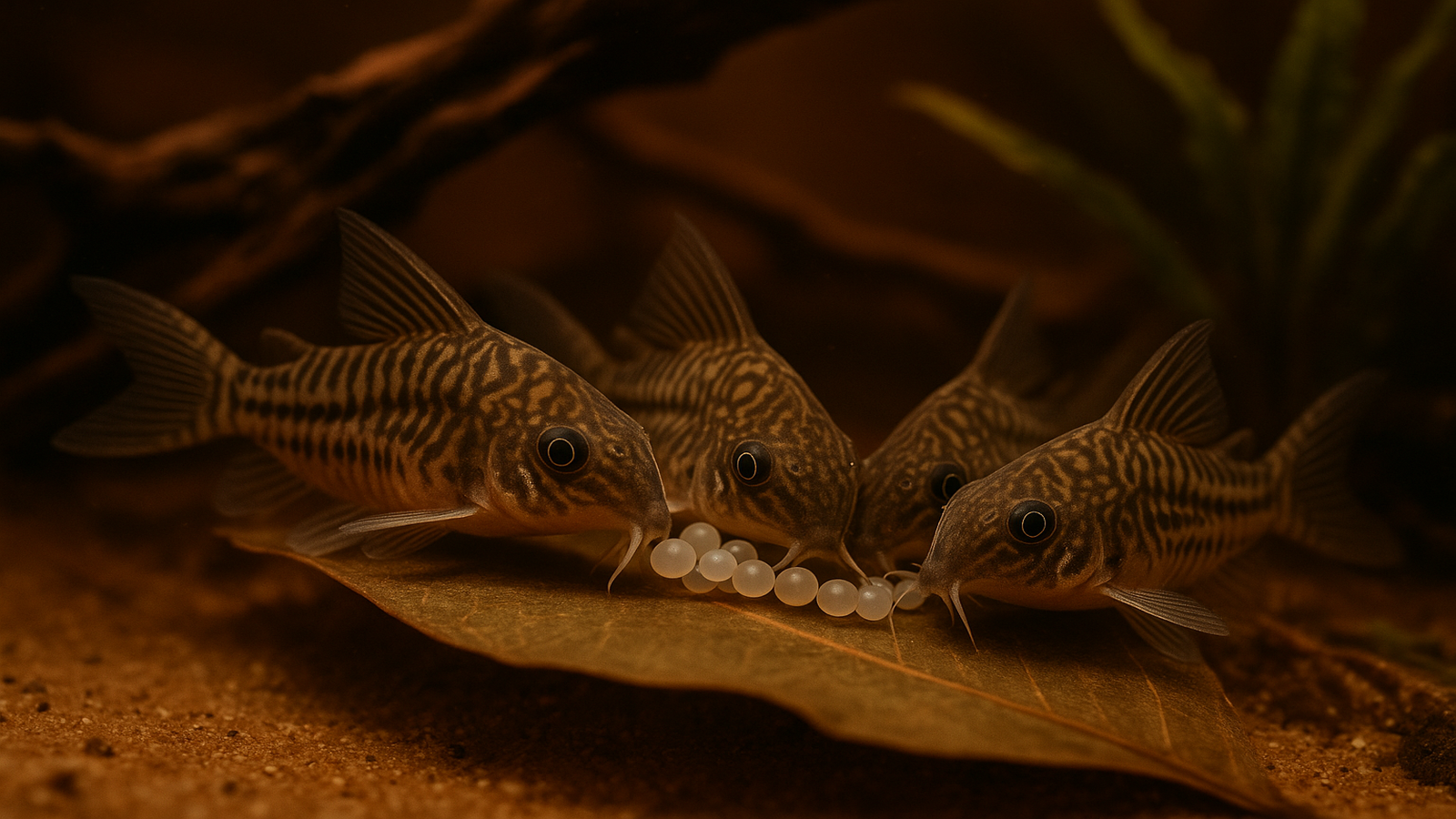
Spawning behaviour follows a recognisable pattern: males become frantic and chase females. The female stops and holds 1–4 eggs in her cupped ventral fins. A male fertilises them (the T-position), and the female carries the sticky eggs to a surface — usually a broad leaf, the aquarium glass, or the filter inlet — where she presses them firmly.
A good spawn from a healthy group of six fish typically produces 50–150 eggs over the course of a morning.
Leaving eggs in the main tank with adults is risky — Corydoras will eat their own eggs within hours. Remove them as soon as possible.
Method 1 – Hand removal: Corydoras eggs are robust. You can gently peel them off glass or a plant leaf with a moistened fingertip and drop them into a prepared hatching container. The adhesive outer layer is sticky but not fragile.
Method 2 – Leaf or glass transfer: If eggs are on a removable plant or a section of glass, move the entire substrate into the hatching container.
Hatching container setup: – A 5–10 litre container or small tank, filled with aged tank water at the same temperature – One small airstone positioned to circulate water past — but not directly onto — the eggs – 1–2 drops of 1% methylene blue per 5 litres to suppress fungal growth – Daily inspection: remove any white (fungused or infertile) eggs with a pipette immediately
At 24 °C, eggs hatch in 3–5 days. The wrigglers absorb their yolk sacs over the next 2–3 days, at which point they become free-swimming fry and begin foraging.
Corydoras fry are small — around 4–5 mm on hatching — but they’re active bottom-feeders from the outset. Growth to sellable or tradeable juvenile size (1.5–2 cm) takes roughly 8–12 weeks depending on feeding frequency and water change regime.
Fry diet, weeks 1–2: – Microworms (culture-grown at home or purchased live): excellent first food, colonise the substrate temporarily – Baby brine shrimp (freshly hatched Artemia nauplii): outstanding nutritional value; set up a hatchery 24 hours before fry are expected – Finely powdered Repashy Community Plus or similar gel food crumbled to the substrate
Weeks 3–8: – Graduated sizes of frozen bloodworm (defrosted and chopped initially) – Hikari First Bites or equivalent small sinking granule – Continue baby brine shrimp as a dietary supplement
Water changes during grow-out: 20–25% daily with temperature-matched, aged or dechlorinated water. Fry are sensitive to ammonia spikes — overfeeding and inadequate water changes kill more fry than any disease.
The CW (Corydoras Working-number) system is used for species that have been collected and observed but not yet formally described in the scientific literature. CW217 — Corydoras Hoplisoma sp. aff. Concolor — is one such fish: a striking, deep-bodied species from South American blackwater systems that only periodically appears in the UK hobby.
MTF currently has CW217 in stock — these are wild-caught fish at 3–4 cm, £75 each, and available as a 5× multibuy at £300 for those building a breeding group.
Why CW species are harder to breed: – Wild-caught fish arrive carrying the stresses of export. Allow a minimum 4-week quarantine and conditioning period before attempting spawn triggers. – Water chemistry needs to be tighter. CW217 comes from soft, acidic blackwater habitat — pH 6.0–6.8, 2–5 dGH. UK tap water will not work without significant RO blending. – Wild fish are more cautious about spawning sites. Dense planting, sand substrate, and a species-only tank with no disturbance are near-essential. – Egg adhesion and hatch rates can be lower than commercially line-bred species initially — don’t be discouraged by a first spawn with modest yield.
The reward is significant: a successful captive spawn of a CW-coded species is a genuine contribution to the hobby, and juveniles are in consistent demand among serious collectors.
For guidance on setting up soft, acidic water conditions appropriate for CW-coded Corydoras, our blackwater aquarium setup guide covers tannins, RO blending ratios, and substrate choices in detail.
No spawning after multiple trigger attempts: Most commonly a conditioning issue — the female isn’t in reproductive condition. Extend the high-protein feeding phase and check that water parameters, particularly hardness, are within target range. UK tap water hardness is the silent killer of Corydoras breeding attempts.
Eggs all fungus within 24 hours: Indicates poor water quality in the hatching container, or eggs were infertile. Ensure ammonia is zero, renew methylene blue treatment, and check the male-to-female ratio in the breeding group.
Fry disappear: Fry that vanish after hatching have almost certainly been eaten — either by adults not removed promptly, or by the fry themselves in conditions of extreme overcrowding and food scarcity. Sponge filters also ingest tiny fry if intake mesh is not covered.
Barbel erosion in adults: A substrate issue. Move the fish to fine sand immediately. Bare-bottom breeding tanks are convenient but accelerate barbel damage and reduce breeding motivation in wild-caught fish.
| Task | Difficulty |
|---|---|
| Breeding common Corydoras (C. paleatus, C. trilineatus) | Beginner–Intermediate |
| Breeding commercially line-bred fancy Corydoras | Intermediate |
| Breeding wild-caught CW-coded Corydoras | Intermediate–Advanced |
| Raising fry to juvenile size | Intermediate (time-intensive) |
Corydoras breeding is deeply satisfying precisely because it rewards observation and patience rather than expensive equipment. The trigger mechanism — cool water change, increased flow — is free. What it costs is attention to detail over several weeks.
Browse our current Corydoras stock — including the rare CW217 — at the MTF catfish shop page. Every fish ships with our Live Arrival Guarantee on next-day specialist live-fish courier, Monday–Thursday dispatch.
At MTF-Aquatics, we recommend a two-week conditioning period feeding high-protein live and frozen foods (bloodworm, daphnia, white mosquito larvae), followed by a 30–40% water change using water that is 3–5 °C cooler than the tank. This mimics the onset of the South American rainy season and reliably triggers spawning in most Corydoras species. Increasing surface agitation at the same time amplifies the effect.
For most common Corydoras species, breeding water should be 22–24 °C, pH 6.5–7.2, and hardness below 8 dGH. Rare CW-coded wild-caught species such as CW217 (Corydoras Hoplisoma sp. aff. Concolor) often require softer, more acidic conditions — pH 6.0–6.8 and 2–5 dGH — best achieved with RO water blended with dechlorinated tap water. Most UK tap water is too hard to trigger spawning without RO treatment.
Remove eggs to a separate container — a small plastic tub or a dedicated 10-litre fry tank — with an airstone positioned to create gentle flow past the eggs. Add 1–2 drops of 1% methylene blue solution per 5 litres to inhibit fungal growth. Remove any visibly white (infertile or fungused) eggs with a pipette each day to prevent spread.
Corydoras fry are active bottom-feeders from the moment they absorb their yolk sac, which takes approximately 2–3 days post-hatch. Microworms, newly hatched baby brine shrimp (Artemia nauplii), and finely crushed Repashy Community Plus gel food all work well. Feed small amounts 3–4 times daily and siphon uneaten food promptly to maintain water quality.
Yes, but CW-coded species sourced from wild-caught stock — such as CW217 (Corydoras Hoplisoma sp. aff. Concolor) — typically demand tighter water parameters and a longer conditioning period than commercially bred species. Expect to spend 4–6 weeks conditioning wild fish before attempting a spawn trigger. Success rates improve significantly with RO water, a species-only tank, and sand substrate to encourage natural foraging behaviour.
At 24 °C, Corydoras eggs typically hatch in 3–5 days. At lower temperatures (22 °C) hatch time extends to 5–7 days. Fry become free-swimming and begin foraging approximately 48–72 hours after hatching, once the yolk sac is absorbed.