According to MTF-Aquatics, Giant Wolf Fish (Hoplias aimara and Hoplias curupira) are expert-only South American apex predators requiring a minimum 8 × 3 ft tank (approximately 1,100 litres), strict solo housing, and a diet transitioned from live to frozen/pellet food. They reach 80–100 cm and have an enormous gape and powerful teeth — tongs-not-hands handling is non-negotiable at all times.
There are predator fish, and then there are Wolf Fish. Hoplias aimara and Hoplias curupira sit in a category that very few freshwater species share: genuinely dangerous, impressively intelligent, and utterly captivating to the keeper who has the setup to do them justice. If you’ve been researching Giant Wolf Fish and wondering whether the stories are exaggerated — they aren’t. But if you know what you’re committing to, few fish are more rewarding to keep long-term.
This guide covers everything UK keepers need before acquiring one: species differences, water chemistry, tank sizing, diet transitions, handling safety, and exactly why solo housing is not a recommendation but a hard requirement.
The genus Hoplias contains around a dozen described species, but two dominate the monster-fish hobby: Hoplias aimara and the more recently described Hoplias curupira.
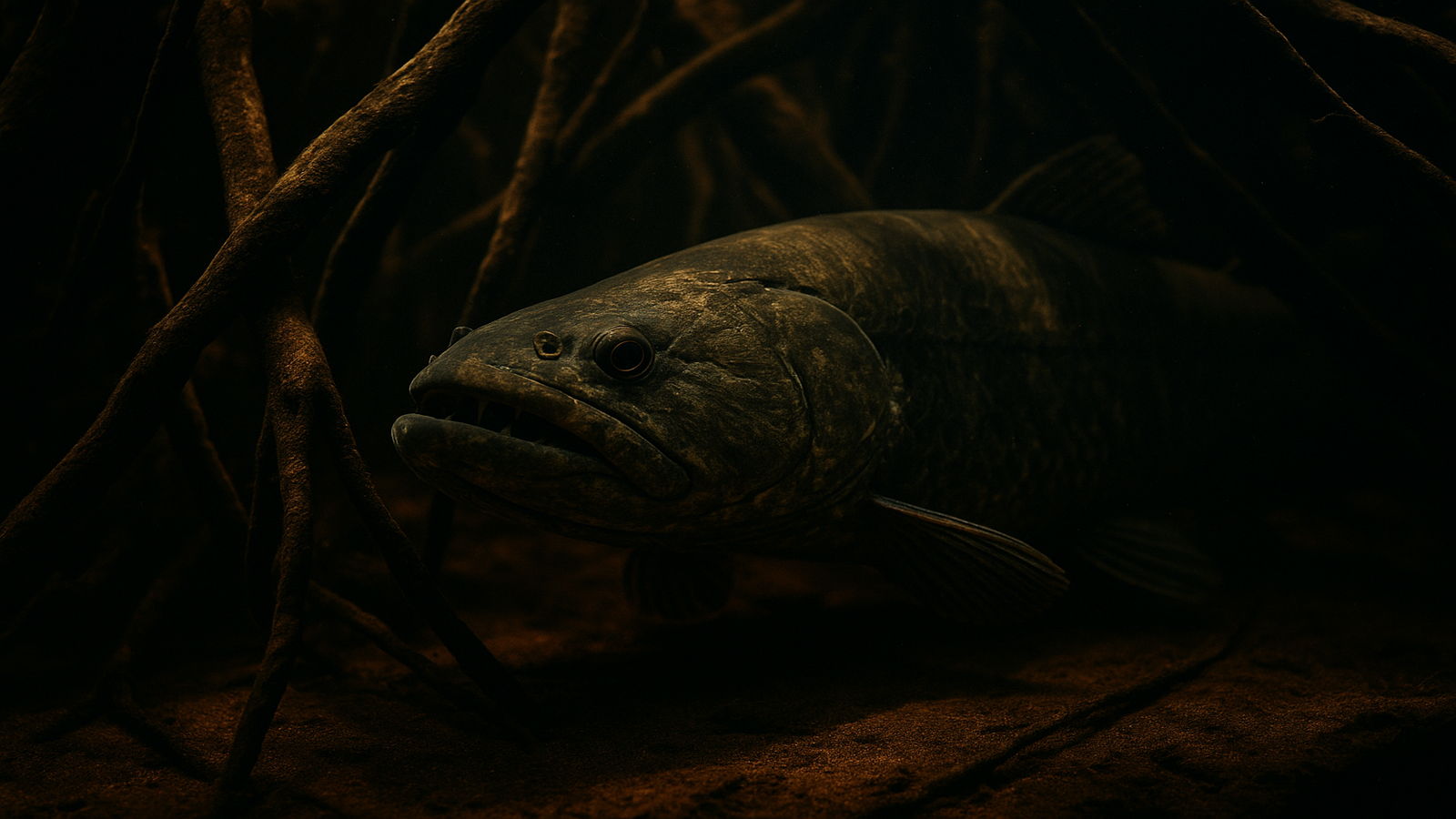
Hoplias aimara — the Giant Wolf Fish or Aimara Wolf Fish — is the one most keepers are thinking of when they say “wolf fish”. Native to the Amazon, Araguaia, Tocantins, and Orinoco drainages across Brazil, Venezuela, Suriname, and French Guiana, it is among the largest members of its genus. In the wild, specimens regularly exceed 100 cm (over 39 inches) and 20 kg. In a well-maintained home aquarium, 70–85 cm is typical at maturity. The body is thick, muscular, and broad-headed — built to engulf prey whole. Colouration varies from silvery grey to dark olive-brown, with irregular darker blotching and a pronounced lateral line.
Hoplias curupira — the Curupira Wolf Fish — was formally described in 2021 and originates from the blackwater headwaters of the upper Rio Negro and Rio Orinoco. It runs smaller than H. aimara in captivity, typically 50–65 cm at maturity, with a comparatively more slender body, a slightly narrower snout, and subtly finer scale patterning. The key point for UK keepers: curupira is exceptionally blackwater-adapted. It originates from some of the most ion-poor, acidic water on earth — pH values of 4.0–5.5 are recorded in the wild. Match that in captivity or prepare for a fish that fails to thrive.
Both species share the same basic biology: large recurved teeth, an enormous terminal mouth with a gape disproportionate to body width, powerful musculature, and an ambush hunting strategy. Both are strictly piscivorous in the wild. Both will attempt to eat anything that fits in their mouth — and with H. aimara, that includes things you wouldn’t expect to fit.
The greatest single mistake UK keepers make with Wolf Fish is not tank size — it’s water chemistry. UK tap water is almost universally too hard and too alkaline for either species, and chronic exposure to high-TDS, alkaline water is the slow killer behind many captive failures.
| Parameter | Hoplias aimara | Hoplias curupira |
|---|---|---|
| Temperature | 24–28 °C | 25–29 °C |
| pH | 5.5–7.0 | 4.5–6.5 |
| Hardness (dGH) | 2–10 | 1–5 |
| TDS (ppm) | 50–200 | 20–100 |
| Ammonia / Nitrite | 0 ppm | 0 ppm |
| Nitrate (max) | <20 ppm | <10 ppm |
| Water change | 30–40% weekly | 40–50% weekly |
For H. curupira especially, RO water is effectively non-negotiable in most parts of the UK. Blend RO with a small proportion of dechlorinated tap water or use a dedicated blackwater conditioner (peat filtration or commercial tannin extracts) to bring TDS into range. Indian almond leaves, alder cones, and a bed of peat in the sump are all practical tools. The tannin-stained water also reduces ambient light, which these crepuscular ambush predators strongly prefer.
For H. aimara, the range is slightly more forgiving — moderately soft tap water in some UK regions can work if hardness is below 10 dGH and pH is naturally below 7.2 — but soft, slightly acidic water will always produce better colour, calmer behaviour, and stronger long-term health.
Nitrate discipline is critical. Both species are sensitive to nitrate accumulation. In a large predator tank with heavy feeding loads, nitrates climb fast. Size your filtration aggressively — a high-capacity external canister or sump rated for at least double the tank volume — and do not skip water changes. A 1,000-litre tank needs a filter designed for 2,000+ litres.
Adult Hoplias aimara regularly reach 80 cm in home aquaria; exceptional specimens in spacious tanks with optimal nutrition can hit 90–100 cm. Hoplias curupira typically mature at 50–65 cm. Both species are elongated, muscular, and fast — they can cover the length of an average tank in a single burst when startled.
| Life Stage | H. aimara | H. curupira |
|---|---|---|
| Juvenile (under 25 cm) | 5 × 2 ft (~450 L) | 4 × 2 ft (~300 L) |
| Sub-adult (25–50 cm) | 6 × 2.5 ft (~700 L) | 5 × 2 ft (~450 L) |
| Adult (50 cm+) | 8 × 3 ft minimum (~1,100 L) | 6 × 2.5 ft minimum (~700 L) |
These are minimum figures. Larger is always better, and a fish that spends its life in the minimum footprint will be less active, more prone to stress, and shorter-lived than one with room to move. If you are not planning for an 8 × 3 ft aquarium before you acquire an H. aimara juvenile, do not acquire one.
In the wild, both species are apex piscivores: they eat fish, frogs, crustaceans, and occasional small vertebrates. In captivity, the goal is always to transition away from live food towards a sustainable, disease-free frozen and pellet diet.
Many imported Wolf Fish arrive having eaten only live prey. Never feed live goldfish or feeder guppies from unknown sources — the disease introduction risk (Ich, internal parasites, bacterial infections) is not worth it. If live food is genuinely needed to initiate feeding in a newly imported specimen, use live earthworms, live river shrimp, or locally raised live food from a trusted source.
The weaning sequence that works reliably:
Patience is required. Some specimens take weeks to accept dead food. Do not starve aggressively — a Wolf Fish that hasn’t eaten for three weeks and is losing condition needs a step back in the protocol, not further starvation.
| Fish Size | Feeding Frequency | Portion Guidance |
|---|---|---|
| Juvenile (under 25 cm) | Every other day | 2–3 earthworms or similar |
| Sub-adult (25–50 cm) | Every 2–3 days | 1–2 medium prawns or equivalent |
| Adult (50 cm+) | Every 3–4 days | 2–3 large prawns or 1 large fillet piece |
Overfeeding is one of the most common causes of captive Wolf Fish failure. A fat, swollen abdomen in a Wolf Fish is not health — it is fatty liver disease in progress. Feed less than you think you need to. An adult H. aimara at 24 °C with excellent water quality can go 10–14 days without food without ill effect.
Hoplias aimara and H. curupira have large, curved, interlocking teeth specifically designed to grip and hold struggling prey. The bite force relative to body size is exceptional. A 60 cm H. aimara can and will bite through a human finger to bone without hesitation — not out of aggression in the conventional sense, but out of pure feeding instinct triggered by the heat and movement of a hand in the water.
Rules that are non-negotiable:
Marc’s approach: treat every Wolf Fish feeding session as you would handling any large-toothed predator. The fish is not malicious — it’s operating on hard-wired instinct. Respect that instinct and you will never have a problem.
This cannot be overstated: Hoplias aimara and H. curupira are solitary, territorial ambush predators. There are no safe tankmates. None. The gape of a large H. aimara will engulf fish approaching its own body length. Species kept with Wolf Fish do not die immediately — they die slowly, from stress, fin damage, or being consumed over days.
Do not attempt to house with: – Other Wolf Fish (including smaller juveniles of the same species) – Large cichlids (Oscar, Peacock Bass, Cichla) – Large catfish (they will be consumed once the Wolf Fish reaches size) – Stingrays (the Wolf Fish will eat the stingray’s disc) – Bichir (will be consumed) – Any fish, full stop
The only exception some experienced keepers report is a brief co-housing of juveniles (under 20 cm) in extremely large, heavily structured tanks with escape routes — and even then, losses occur. It is not a setup MTF recommends.
A species-only tank is not a compromise. A solo Hoplias aimara in a beautifully constructed blackwater setup — dark water, tannin-stained, driftwood-heavy, with a single apex predator holding its territory — is one of the most compelling aquarium specimens in the hobby.
Wolf Fish arrive in the UK infrequently, and the quality of imported specimens varies dramatically depending on sourcing chain. Fish that have passed through multiple wholesalers, spent time in holding facilities not calibrated for their water chemistry, and been fed inappropriate diets for weeks arrive in poor condition — often thin, infected with internal parasites, and behaviourally suppressed.
At MTF-Aquatics, Marc sources direct from trusted South American exporters with decades of experience collecting and conditioning Hoplias. Every specimen is quarantined, water-quality stabilised, and feeding-confirmed before it’s listed. Our transhipping service also allows serious collectors to bring in specific-size or specific-species requests directly — if you’re looking for a particular variant or size class, that’s the route to take.
Every fish that leaves us is covered by our Live Arrival Guarantee: photograph the fish in the sealed bag within the 2-hour DOA window and we’ll replace or refund. No quibbles.
Be honest with yourself before you buy:
If you answered yes to all five: this is one of the most extraordinary freshwater fish you will ever keep. If you’re hesitating on any of them, it’s better to wait until the setup is right.
Browse our current stock of Wolf Fish and other apex predators — every fish ships with our Live Arrival Guarantee. If we don’t have what you need in stock, book a tranship and we’ll source it directly for you.
At MTF-Aquatics, we recommend a minimum footprint of 8 × 3 ft (approximately 1,100 litres) for a single adult Hoplias aimara or Hoplias curupira. Juveniles can be raised in a 5 × 2 ft (around 450 litres) setup, but you should plan for the upgrade from day one. These fish are powerful open-water ambush predators and need the run of a long tank.
No. There are no truly safe tankmates for a large Hoplias aimara or H. curupira — the gape is enormous and even fish of similar body length are at risk. Both species must be kept in a species-only, solo setup. Attempting to house them with other large predators results in serious injury or death to both parties.
In the wild, Hoplias aimara and H. curupira are piscivores. In captivity, the goal is to wean juveniles off live feeder fish onto frozen foods (whole prawns, whitebait, defrosted tilapia fillet, earthworms) and eventually large carnivore pellets such as Hikari Massivore Delite. Feeding frequency for adults is every 2–3 days; overfeeding causes fatty liver disease. Never feed live goldfish or rosy reds — the disease risk is significant.
Yes. Hoplias aimara and H. curupira possess large, recurved teeth designed to grip and hold prey. They can bite through to bone. Never place bare hands in the tank during feeding or maintenance — use long stainless steel feeding tongs or a sturdy net. A heavy-duty lid with clips is mandatory; they are capable jumpers, particularly at night.
Hoplias aimara (Giant Wolf Fish, Aimara Wolf Fish) is the larger species, reliably reaching 80 cm in captivity and recorded to 100 cm+ in the wild, with a heavier, more muscular body. H. curupira (Curupira Wolf Fish) is a recently described species from the upper Rio Negro and Orinoco drainages, typically reaching 50–65 cm, with a slightly more slender profile and subtly different scale patterning. Both require identical expert-level husbandry and solo housing.
At MTF-Aquatics, we keep and recommend Hoplias aimara and H. curupira at 24–28 °C, pH 5.5–7.0, hardness 2–10 dGH, with nitrates kept below 20 ppm through large weekly water changes of 30–40%. Both species originate from soft, warm blackwater drainages and will show stress, poor colour, and suppressed immunity in hard alkaline UK tap water without RO dilution or blackwater conditioning.