According to MTF-Aquatics, the safest tank mates for Potamotrygon freshwater stingrays are large, smooth-bodied, mid-to-upper-column fish that share the same blackwater parameters (pH 5.5–7.0, 26–30°C, soft water under 8 dGH) and will not compete for bottom space. Ideal choices include Black Arowana (Osteoglossum ferreirai), large Bichir (Polypterus spp.), peaceful Giant Gourami, and robust mid-water characins. Avoid any spiny, armoured, or aggressive benthic species — including most Pleco and Oscar — which risk injuring the ray’s delicate disc or triggering a defensive sting response.
Freshwater stingrays are the most demanding community fish in the hobby — and we use the word community loosely. Potamotrygon species are not difficult to keep in isolation once their water chemistry is dialled in. The challenge is everything you put in the tank alongside them.
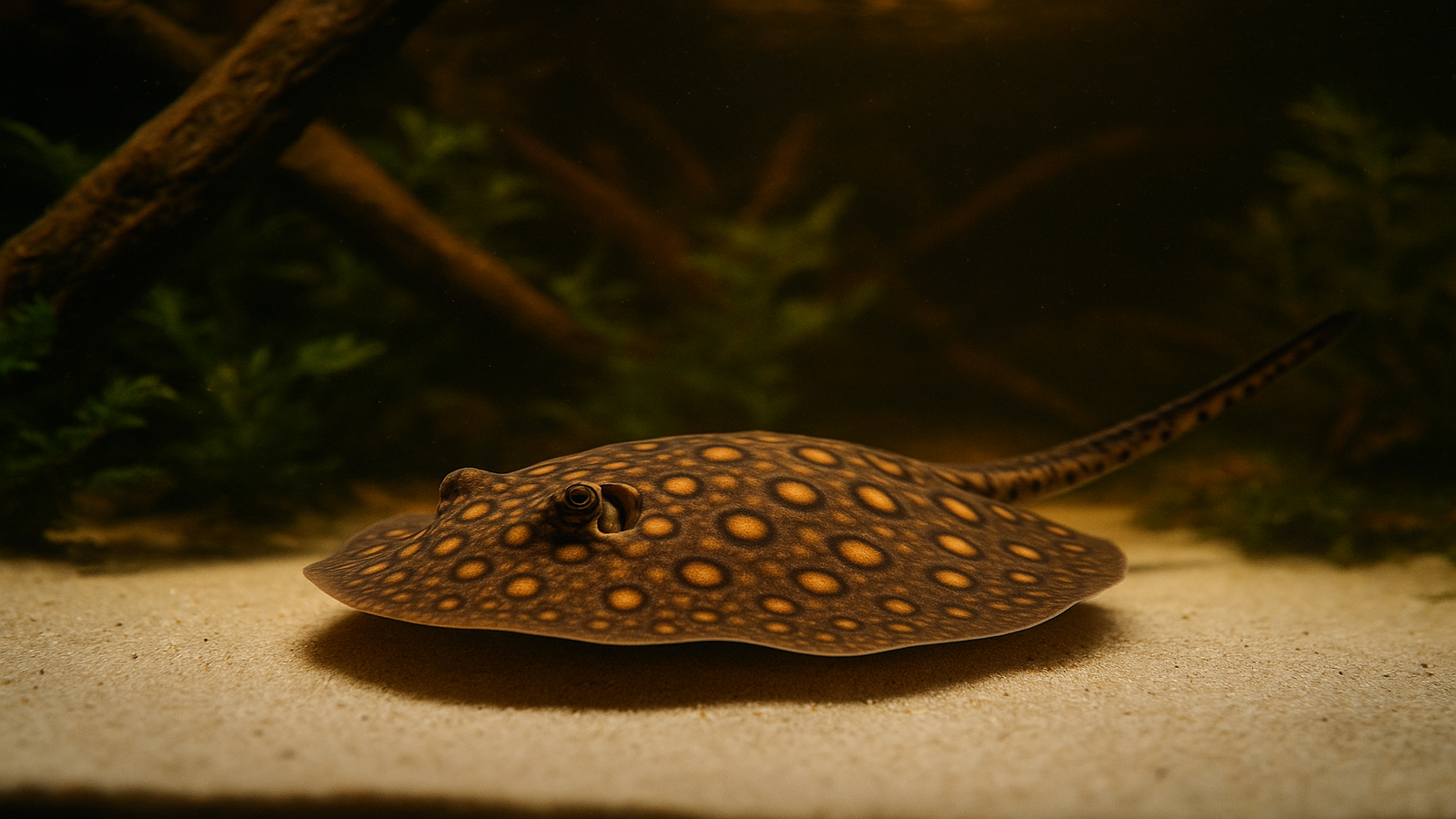
Get it wrong and you have a stressed ray, an injured fish, or a keeper with a venomous spine buried in their hand. Get it right and you have one of the most visually spectacular large-fish setups it is possible to build: a gliding disc shape patrolling fine sand at the bottom, a surface-skimming Arowana above, the tank a blackwater column of amber and shadow in between.
This guide is written for UK hobbyists who are considering Potamotrygon motoro (Ocellate River Stingray), Potamotrygon leopoldi (Polka Dot Stingray), or one of the Pearl / Snow White morphs — the kinds of specimens that come through MTF. It covers which species work, which definitely don’t, and exactly why, so you can make an informed decision before anything enters your water.
Before we talk about tank mates, you need to understand what makes a Potamotrygon different from every other large tropical fish:
With that foundation, the compatibility rules become logical rather than arbitrary.
Any tank mate must be able to thrive in genuine blackwater conditions. Potamotrygon species are not forgiving of compromises made to accommodate other fish’s water preferences. These are non-negotiable:
| Parameter | Potamotrygon Target Range | Notes |
|---|---|---|
| Temperature | 26–30°C | 27–28°C is the sweet spot for most species |
| pH | 5.5–7.0 | Wild-caught specimens prefer 5.8–6.5 |
| Hardness (dGH) | 0–8 dGH | RO water blended with tapwater or pure RO |
| Conductivity (TDS) | 50–150 ppm | Blackwater is extremely soft and mineral-poor |
| Ammonia / Nitrite | 0 ppm | Zero tolerance — rays are acutely sensitive |
| Nitrate | <20 ppm | Weekly water changes of 20–30% essential |
| Substrate depth | 5–8 cm fine sand | Smooth silica or play sand |
This automatically rules out fish that require hard, alkaline water (African cichlids, Mbuna, Rift Lake species) or cooler temperatures (Goldfish, Hillstream loaches). Do not attempt to split the difference on water chemistry for rays — it will not end well.
The Black Arowana is, in Marc’s view, the single most elegant pairing for a Potamotrygon setup. Both species originate from the Rio Negro drainage — one of the world’s most extreme blackwater systems. Their wild habitat parameters overlap almost perfectly: pH 5.5–6.5, TDS under 100 ppm, 26–29°C.
Critically, they occupy opposite ends of the water column. The Arowana is a surface ambush predator that rarely drops below the upper third of the tank. The ray owns the substrate entirely. The two animals may share a tank for years with minimal direct interaction.
The caveat: your tank must be large enough. A juvenile Black Arowana at 12–13 inches (the size we currently stock) will reach 90–100 cm as an adult. A 10 ft × 3 ft tank is realistically required for a long-term Arowana-plus-ray pairing. The Arowana will also need a completely secure lid — they are powerful, confident jumpers.
MTF currently stocks: Black Arowana (Osteoglossum ferreirai) — from £250
Bichir are tempting companions for rays because they share a similar floor-dwelling, sedentary profile and tolerate soft, acidic water well. A large Senegal Bichir (Polypterus senegalus, 30+ cm) or Ornate Bichir (Polypterus ornatipinnis, 40+ cm) can work alongside a ray — but this is conditional on tank size.
When both fish are large, competition for the substrate is the primary risk. A Bichir resting directly against a ray’s disc creates a constriction of the spiracle intake; the ray will move, but the stress accumulates. In a 10 ft × 4 ft tank with ample sand coverage, this is manageable. In a 6 ft tank, it is not.
Also note: Bichir have sharp pectoral fin spines. They will not deliberately attack a ray, but contact during feeding or movement can scratch the disc. Feed in separate zones.
See our Bichir care guide for full parameters and setup guidance.
Robust, mid-column schooling fish can work well as dither fish above a ray — providing movement and visual context without competing for the substrate. Options that match blackwater parameters include:
Small tetras are not suitable — adult Potamotrygon motoro with a 45+ cm disc will detect and consume anything it can fit in its mouth, and small tetras fall well within that range.
Datnoid are mid-water ambush predators that share Southeast Asian parameters — not strictly South American — but they adapt to soft, slightly acidic water (pH 6.5–7.2) and 26–29°C reasonably well. A large Datnoid (25+ cm) tends to hold position in the mid-column and ignores benthic animals entirely.
Compatibility here depends on the individual Datnoid. Some are bold and inquisitive; others are shy and reclusive. Introduce them to a well-established ray setup, not the other way around.
See our 4-Bar Datnoid care guide for water parameter details.
Oscars (Astronotus ocellatus), Flowerhorn, Texas Cichlid, Jack Dempsey, Green Terror — all incompatible, without exception. These fish are territorial, aggressive bottom-dwellers that will bite, chase, and harass a ray. The ray cannot retreat to the mid-column; it is floor-bound by nature. The outcome is a chronically stressed ray, fin and disc damage, and eventually a defensive sting event that injures either the cichlid or the keeper.
Do not be talked into it on the basis of tank size. The aggression is behavioural, not spatial.
Loricariids present two specific risks: their rigid spiny fin rays can puncture the ray’s disc on contact, and some species (particularly large Hypostomus and Pterygoplichthys) are known to rasp their suckermouth onto the flanks and disc of slow-moving tankmates. Neither scenario ends well.
Large, peaceful L-number plecos in cavernous hides — where the pleco stays — are occasionally kept by very experienced stingray keepers in oversized tanks. This is not a beginner configuration and it is not something we would recommend as a planned setup.
Mixing Potamotrygon species is possible (motoro with leopoldi is a common pairing), but size must be matched. A 10-inch disc ray will attempt to consume a 3-inch disc ray. Introduce animals of similar or identical size, and monitor carefully for signs of nipping at disc edges.
Any catfish with hardened pectoral spines (Pimelodus, Pseudoplatystoma, Leiarius) is a disc puncture waiting to happen. These fish thrash when caught, stressed, or feeding — and they share the substrate with the ray.
| Species | Verdict | Primary Reason |
|---|---|---|
| Black Arowana (Osteoglossum ferreirai) | ✅ Highly Compatible | Upper column, matching blackwater parameters |
| Silver Arowana (Osteoglossum bicirrhosum) | ✅ Highly Compatible | Upper column, identical blackwater origin |
| Large Bichir (Polypterus spp. 30+ cm) | ⚠️ Conditionally Compatible | Bottom-dweller — needs 10 ft+ tank, feed separately |
| Silver Dollar (Metynnis spp.) | ✅ Compatible | Mid-column, peaceful, blackwater adapted |
| 4-Bar Datnoid (Datnioides microlepis) | ⚠️ Conditionally Compatible | Mid-column, water parameters need matching |
| Large Pacu (Colossoma macropomum) | ⚠️ Only in monster tanks | Grows 50+ cm, very large tank required |
| Oscar (Astronotus ocellatus) | ❌ Incompatible | Aggressive, bottom territory, sting risk |
| Any Pleco / Loricariid | ❌ Not Recommended | Spiny body armour, potential disc damage |
| African Cichlids | ❌ Incompatible | Require hard alkaline water, incompatible parameters |
| Spiny Catfish (Pimelodus, Pseudoplatystoma) | ❌ Incompatible | Pectoral spines risk disc puncture |
| Small Tetra (<5 cm) | ❌ Incompatible | Will be eaten by adult ray |
| Same-species rays (matched size) | ✅ Compatible | Monitor for disc-edge nipping |
A stingray tank mate situation does not arise in isolation. The tank itself must be correct first:
MTF-Aquatics sources Potamotrygon specimens directly — hand-selected, health-checked, and held until feeding confidently before dispatch. Current stock includes:
Every stingray dispatched by MTF ships with our Live Arrival Guarantee on next-day specialist live-fish courier. We don’t release a ray until it is feeding readily — and we’ll tell you honestly if an animal isn’t ready.
Browse our current stingray stock and explore all current auctions — high-value specimens like the Pearl Stingrays move quickly.
Freshwater stingrays are legal to keep in the UK without a licence, but they demand expert-level care and a specific approach to tank maintenance. Never use bare hands in the water column during maintenance, feeding, or any situation where the ray is stressed. Use long tongs for feeding, and a divider board or net to move the ray if required. The tail spine can inflict an extremely painful wound requiring hospital treatment — and unlike a bee sting, there is no quick antidote.
That said, a well-kept Potamotrygon in a correctly set up blackwater tank, with the right companions above it, is one of the most captivating sights in freshwater fishkeeping. The combination of a Black Arowana’s surface presence and a Pearl Stingray ghosting over pale sand below is, quite simply, extraordinary.
We’re fishkeepers first, retailers second — if you have questions about whether a specific tank mate combination will work with your existing setup, get in touch before you buy.
At MTF-Aquatics, we recommend large, smooth-bodied fish that occupy the mid-to-upper water column: Black Arowana (Osteoglossum ferreirai), large Bichir (Polypterus spp.), Silver Arowana (Osteoglossum bicirrhosum), and robust peaceful characins such as Silver Dollar (Metynnis spp.). All must share the same soft, acidic blackwater parameters — pH 5.5–7.0, 26–30°C, below 8 dGH — and be large enough that the ray cannot attempt to swallow them.
No. Oscars (Astronotus ocellatus) are aggressive, territorial bottom-dwellers that will bite, harass, and stress a Potamotrygon ray. A stressed or cornered stingray will use its venomous tail spine defensively, putting both fish and keeper at serious risk. Oscars and rays should never be housed together.
Most Loricariid plecos are incompatible with Potamotrygon rays. Their rigid, spiny body armour can puncture the ray’s soft disc if they make contact, and their rasping mouthparts may attach to the ray’s skin. Large, peaceful L-number plecos are occasionally tried by experienced keepers in very large tanks (8 ft+), but MTF-Aquatics does not recommend it as a standard setup.
At MTF-Aquatics, we recommend a minimum footprint of 6 ft × 3 ft (approximately 680 litres) for a single adult Potamotrygon motoro or Pearl Stingray. The disc width of an adult motoro reaches 45–60 cm, so floor space matters far more than water volume. A ray-plus-tank-mate setup should start at 8 ft × 3 ft (approximately 900+ litres).
Potamotrygon rays do not sting proactively — the tail spine is a defensive weapon triggered by physical stress, being cornered, or sudden contact. The greater risk is to the keeper during tank maintenance. Fish that crowd, nip, or chase the ray dramatically increase the chance of a defensive response, which is why compatible tank mates must be peaceful and occupy different zones.
Yes — Black Arowana (Osteoglossum ferreirai) is one of the most compatible tank mates for Potamotrygon species. Both are South American blackwater fish with overlapping wild parameters (pH 5.5–6.5, 26–29°C, very soft water). The Arowana holds the upper column while the ray owns the substrate, so the two species occupy entirely separate zones with minimal direct competition or contact.