At MTF-Aquatics, we believe fish auction welfare in the UK depends on three critical factors: compliant courier transport under APHA authorisation, correct bagging standards from the OATA Transporting Aquatic Livestock Code, and a mandatory insulated polystyrene box for auction day. This guide explains the science, regulations, and grading differences between curated auctions and high-risk marketplace platforms.
Buying rare fish at online auctions is increasingly popular, but the market is fragmented and unregulated. Hobbyists navigate eBay livestock listings, private Facebook auctions, platform sites like FinSwap and AquaXchange, and specialist retailer live auctions with wildly different welfare standards. The consequence: fish arrive stressed, diseased, or dead. Understanding fish auction welfare UK helps you buy with confidence and choose platforms that prioritise the animal.
Unlike buying a standard aquarium fish from a shop, auction purchases involve weeks of uncertainty: the seller packs the fish, it sits in a courier system for up to 24 hours, and you’re responsible for safe arrival and acclimation. The welfare chain is only as strong as its weakest link. This guide walks you through the regulations, the science of safe transport, and how to spot reputable auction platforms.
Live fish transport in the UK is governed by the Welfare of Animals (Transport) Order (WATO), enforced by the Animal and Plant Health Agency (APHA). Any courier carrying live fish must hold an APHA-issued Animal Transport Authorisation. In practice, only two UK courier networks consistently hold the full authorisation: APC Overnight and DX Courier. Royal Mail explicitly prohibits live animals and using it is both illegal and a marker of negligent seller practice.
This is not a minor detail. APHA enforcement applies to businesses and private sellers alike. If a seller uses an unauthorised courier (e.g. Parcelforce, standard Royal Mail, or generic overnight couriers), they are breaking the law and exposing you to a non-live delivery. Serious auction platforms and retailers inspect seller courier choices before listing or payment.
For journeys under 8 hours, a Type 1 transporter authorisation applies. For journeys over 8 hours (which includes most UK mainland overnight delivery), a Type 2 authorisation is required. APC and DX hold both. Check your auction seller’s stated courier before bidding.
The Ornamental Aquatic Trade Association (OATA) updated its Transporting Aquatic Livestock Code in June 2023 to reflect current welfare law and best practice. While OATA membership is voluntary, the code is the industry standard for responsible sellers. It mandates:
Reputable auction sellers and retailers openly advertise OATA compliance. Sellers who make no mention of these standards are cutting corners.
A common question: “How long can a fish actually survive in a bag?” The answer depends on four interconnected variables.
Oxygen depletes rapidly in a sealed bag. A fish-sized bag filled with regular air loses its oxygen in roughly 4–6 hours depending on fish size and activity level. An oxygen-filled bag (using compressed O₂, not air) maintains adequate oxygen (>5 mg/L) for approximately 12–18 hours. This is why OATA specifies oxygen, not air, for any transport over a few hours.
Fish waste (primarily ammonia) accumulates in a sealed bag. Ammonia is toxic even at low concentrations and is the primary welfare concern during transport. Warmer water raises fish metabolism and ammonia output; lower temperatures slow both. A fish that has been fasted for 24–48 hours before bagging produces significantly less ammonia. Larger or more active species (e.g. arowanas, large plecos) produce more waste and have shorter safe bag times than smaller passive species (e.g. tetras, corydoras).
Tropical fish shipped in a polystyrene box with adequate insulation maintain temperature stability for 12–24 hours depending on ambient temperature, box quality, and heat packs. A temperature swing of more than 2 °C causes measurable physiological stress. In winter or during courier delays, the temperature can drop dangerously. A flimsy or unsealed box permits faster heat loss.
During transit, dissolved CO₂ builds up in a sealed bag and lowers pH. For fish from acidic (blackwater) environments, this may not be stressful; for fish from neutral or alkaline environments, the shift can stress the gills and immune system. Experienced sellers add buffering compounds (e.g. Seachem Prime) to minimise pH swings.
Industry consensus from hobbyist societies and trade associations places 12 hours as the practical recommended maximum for most tropical species in an oxygen-filled, double-bagged, insulated box. 24 hours is the recognised absolute upper limit under ideal conditions (correct stocking density, fasting, oxygen fill, temperature stability, additives). Beyond 24 hours, even optimal bagging fails to prevent stress and increased mortality risk.
When an auction platform advertises “next-day delivery,” confirm whether the fish ships same-day or the following day. A fish bagged on Monday and arriving Wednesday afternoon has already exceeded safe limits.
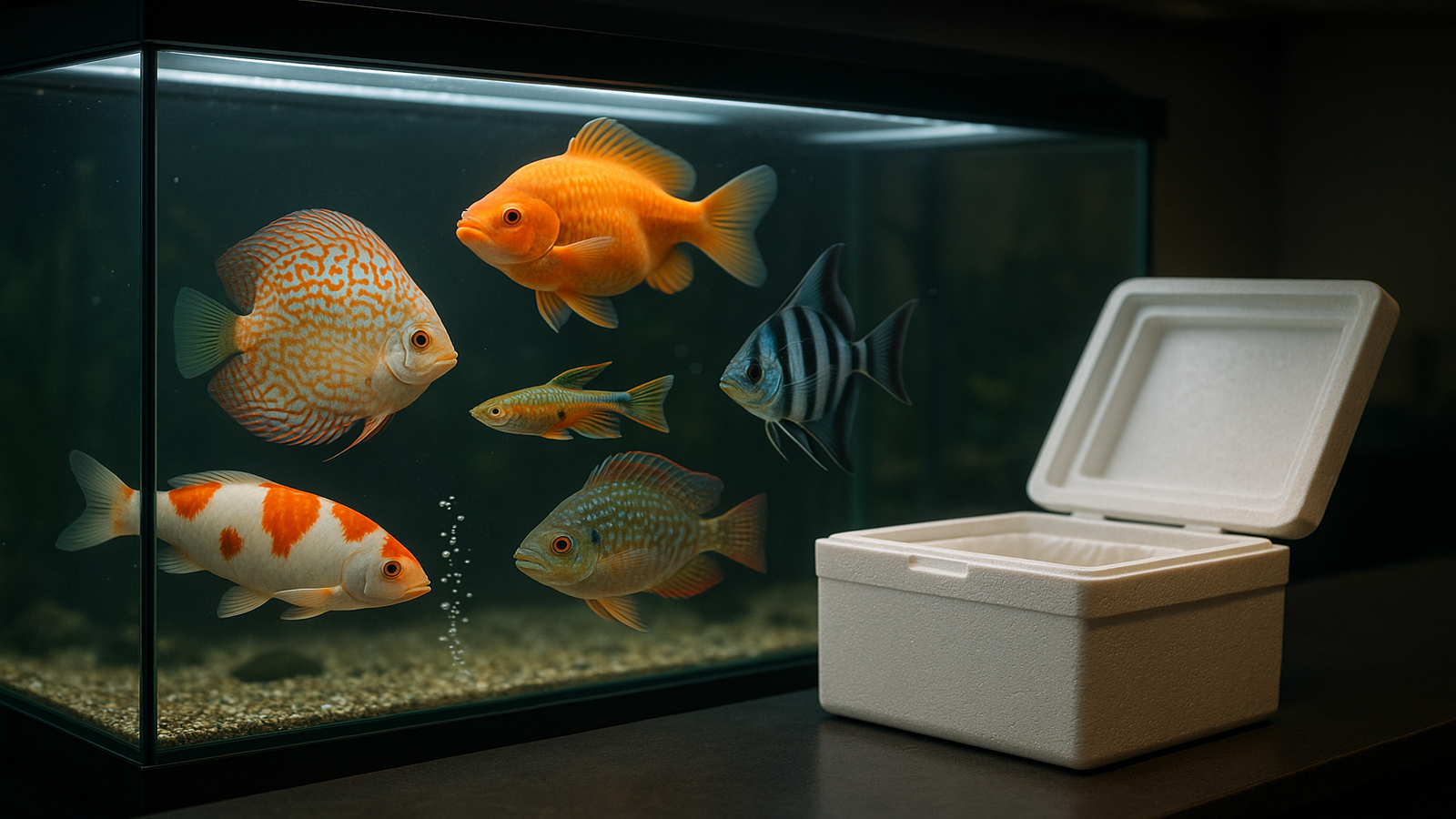
UK hobbyist fish auction societies — such as Robin Hood Aquarists in Nottingham — now enforce a mandatory insulated box rule triggered by 2019 welfare regulation changes. Buyers must arrive with:
Without an insulated container, you cannot purchase at a regulated UK auction. This is a welfare gate, not an inconvenience. The rule exists because fish held in a standard cardboard box or plastic carrier cool rapidly and suffer temperature-shock stress once they reach home and meet warm aquarium conditions.
Online auctions (e.g. MTF-Aquatics’ live auctions, FinSwap) do not impose this at checkout, but they do require the buyer to arrange compliant transport after winning. If you win a fish and ask “What should I do now?”, you are already behind on welfare. Prepare your insulated box and courier choice before bidding.
Reputable auction platforms grade lots to signal seller reliability and specimen health. Common grading frameworks:
Specimen Grade (A/AA): Fish are at or near adult size, exhibit full colour, no visible damage or parasites, and have been held and monitored by the seller for days or weeks. Price reflects rarity and health confidence.
Sub-Adult / Intermediate Grade (B): Younger or smaller fish, not yet at full size or colour. Fewer visual defects but higher acclimation variability. Cheaper.
Juvenile Grade (C): Tiny or newly imported fish. High risk of stress, disease, incompletely resolved parasites. Lowest price, highest mortality risk.
Breeding Stock / Proven Pair (Noted separately): Fish sold as a bonded pair or with confirmed breeding history. Premium pricing.
eBay and unmoderated marketplace listings rarely use grading. MTF-Aquatics’ live auction platform includes seller history, specimen photos from multiple angles, water-parameter disclosure (temperature, pH, stocking history), and a quarantine period notation (e.g. “in-house 2 weeks” or “newly arrived”). These signals indicate a seller who understands welfare.
Why does auction platform matter? A comparison:
| Feature | MTF Auctions | eBay Livestock Listings | Unmoderated Facebook/FinSwap |
|---|---|---|---|
| Seller vetting | Breeder/retailer with verifiable history | Minimal; third-party sellers often ad-hoc | None; any user can list |
| Lot grading & photos | Multi-angle, size reference, water parameters | Variable; often poor-quality phone photos | Minimal; often single blurry image |
| Courier authorisation | Verified APHA-compliant (APC, DX) | Not verified; seller chooses | |
| Seller often uses Royal Mail or unlicensed courier | |||
| Quarantine period disclosed | Yes; “2 weeks in-house” or “imported [date]” | Rarely; often unknown source | |
| Bagging standard | OATA-compliant (oxygen, double-bag, insulation) | Not specified; variable | |
| Live Arrival Guarantee | Yes; 48-hour DOA photo window | Case-by-case; eBay disputes are slow | |
| Acclimation support | Provided; care guide with shipment | Unlikely; seller may not respond post-sale | |
| Price premium | Higher; reflects curation and welfare | Cheaper; reflects higher risk |
This isn’t to say every eBay seller is negligent or every MTF fish is perfect. It is to say that buying on an eBay livestock listing places welfare responsibility almost entirely on you, the buyer. A curated auction platform like MTF-Aquatics transfers welfare responsibility to the platform and seller before money changes hands.
After acclimation, the fish enters a mandatory quarantine period of 7–14 days (longer for wild-caught species or if you’re mixing into an established tank). During quarantine:
This period is not punishment; it’s insurance. It gives you time to observe the fish in isolation, confirm it’s healthy, and minimise the risk of introducing disease or parasites into your main aquarium.
Q: Can I use Royal Mail to post a fish I’ve bought at auction? A: No. Royal Mail explicitly prohibits live animals, and using it is illegal under the Welfare of Animals (Transport) Order. Use only APC Overnight or DX Courier, both of which hold APHA authorisation. If a seller uses Royal Mail, you have grounds for a claim or dispute.
Q: What’s the difference between air-filled and oxygen-filled bags for fish auction welfare? A: Air-filled bags lose their oxygen in 4–6 hours, making them safe only for very short journeys (under 2 hours). Oxygen-filled bags maintain adequate dissolved oxygen for 12–18 hours, essential for overnight courier delivery. OATA specifies oxygen for any transport over a few hours.
Q: How long should I quarantine a newly auctioned fish? A: Minimum 7 days for captive-bred specimens in good condition; 14 days if the fish is wild-caught, newly imported, or shows any sign of stress. Longer quarantine reduces the risk of introducing disease into your main tank and gives the fish time to acclimate to your water chemistry.
Q: Should I acclimate a fish directly into my main aquarium? A: Never. Always acclimate into a separate quarantine tank or container using a slow drip method (add 1 cup of shipment water to the quarantine tank every 10 minutes over 1–2 hours). This prevents osmotic shock and allows you to monitor for disease before mixing with established fish.
Q: What makes an MTF-Aquatics auction safer than buying on eBay? A: MTF-Aquatics auctions include seller vetting, lot grading with multi-angle photos, water-parameter disclosure, courier authorisation verification, and a 48-hour live arrival guarantee with a clear DOA photo claim window. eBay livestock listings lack most of these safeguards, placing welfare responsibility on the buyer.
Q: What should I do if a fish arrives dead? A: Within the 2-hour DOA (Dead On Arrival) window specified by the auction platform or seller, photograph the fish in or next to the original packaging and contact the seller immediately with the photo. Most reputable platforms (MTF-Aquatics included) offer a claim process. Avoid removing the fish from the bag until you’ve documented the condition.
Fish auction welfare UK is improving, but only where platforms and sellers commit to transparency, regulation, and customer education. The hobby’s future depends on raising the standard. When you bid on an auction fish:
At MTF-Aquatics, we run live auctions as a service to the specialist community — not a quick way to shift stock. Every specimen is hand-selected, quarantined in-house, photographed from multiple angles, and shipped with a 48-hour live arrival guarantee. We verify our couriers, disclose water parameters, and include care guidance with every shipment. Our auctions exist because we believe serious hobbyists deserve access to rare fish, welfare-first standards, and the transparency to buy with confidence.
Your role is to choose auction platforms that reflect those values, prepare properly, and quarantine diligently. The result: healthier fish, lower mortality, and a stronger, more ethical aquarium hobby.
Browse our current auctions — every specimen ships with our Live Arrival Guarantee. Not finding what you need? Request a fish and we’ll source it from our breeder network.
No. Royal Mail explicitly prohibits live animals, and using it is illegal under the Welfare of Animals (Transport) Order. Use only APC Overnight or DX Courier, both of which hold APHA authorisation. If a seller uses Royal Mail, you have grounds for a claim or dispute.
Air-filled bags lose their oxygen in 4–6 hours, making them safe only for very short journeys (under 2 hours). Oxygen-filled bags maintain adequate dissolved oxygen for 12–18 hours, essential for overnight courier delivery. OATA specifies oxygen for any transport over a few hours.
Minimum 7 days for captive-bred specimens in good condition; 14 days if the fish is wild-caught, newly imported, or shows any sign of stress. Longer quarantine reduces the risk of introducing disease into your main tank and gives the fish time to acclimate to your water chemistry.
Never. Always acclimate into a separate quarantine tank or container using a slow drip method (add 1 cup of shipment water to the quarantine tank every 10 minutes over 1–2 hours). This prevents osmotic shock and allows you to monitor for disease before mixing with established fish.
MTF-Aquatics auctions include seller vetting, lot grading with multi-angle photos, water-parameter disclosure, courier authorisation verification, and a 48-hour live arrival guarantee with a clear DOA photo claim window. eBay livestock listings lack most of these safeguards, placing welfare responsibility on the buyer.
Within the 2-hour DOA window specified by the auction platform or seller, photograph the fish in or next to the original packaging and contact the seller immediately with the photo. Most reputable platforms (MTF-Aquatics included) offer a claim process. Avoid removing the fish from the bag until you’ve documented the condition.