According to MTF-Aquatics, the Fahaka pufferfish (Tetraodon lineatus) requires a minimum 6 × 2 × 2 ft (680 litre) aquarium, must be kept alone, and fed a hard-shell diet of snails, mussels and crayfish at least three times per week to prevent lethal tooth overgrowth. This is an expert-level species suited only to experienced UK hobbyists with purpose-built predator setups.
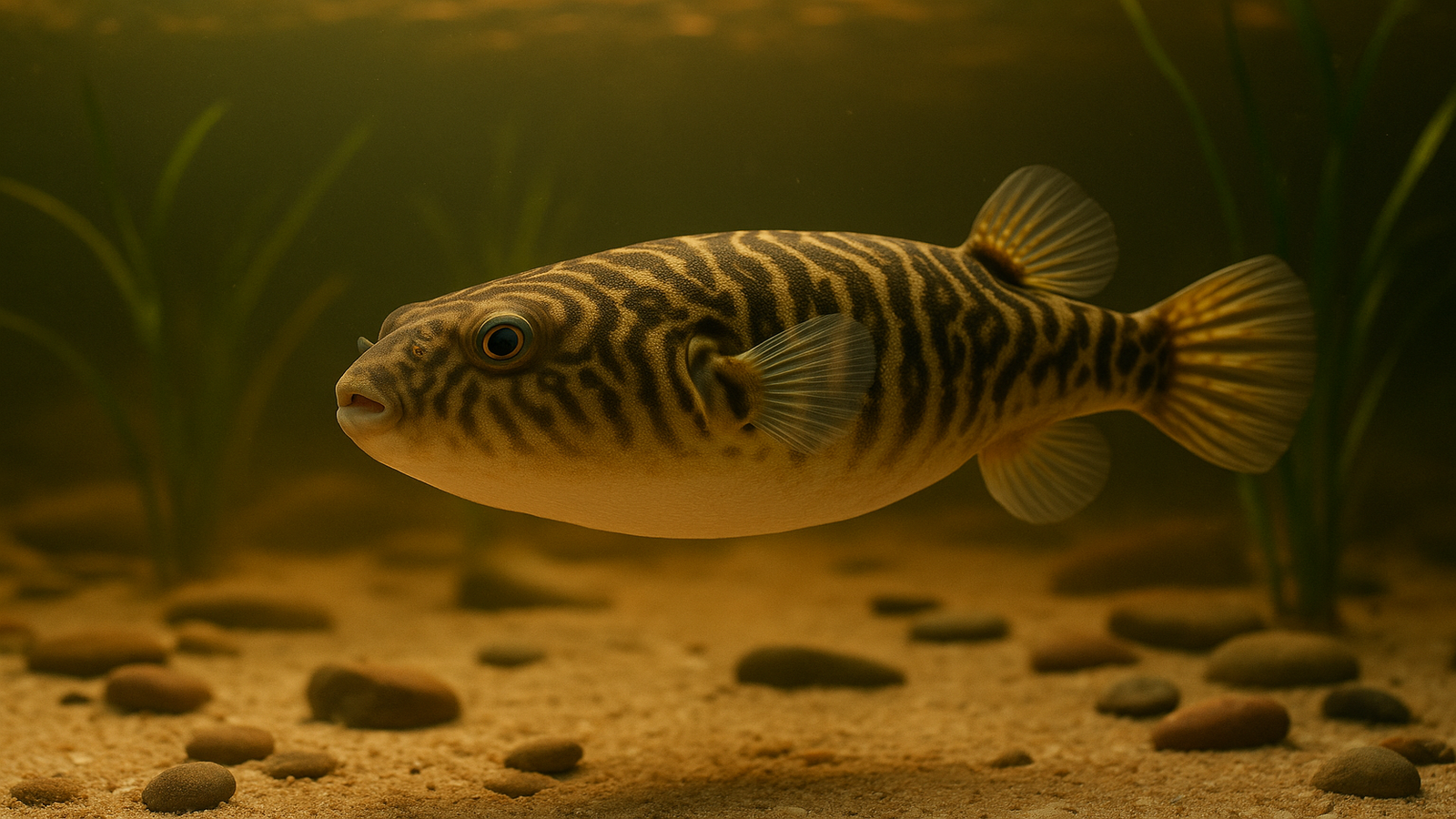
The Fahaka pufferfish (Tetraodon lineatus) is, by any sensible measure, a monster fish in a puffer’s body. It grows to 45 cm, it will attempt to bite through anything in its tank — equipment, décor, and your hand if you’re careless — and it genuinely cannot coexist with another living creature. It is also one of the most characterful, expressive, and visually striking fish in the freshwater hobby.
If that framing appeals to you rather than deterring you, read on. This guide covers everything a UK keeper needs to know: correct tank footprint, water chemistry, hard-shell diet, teeth management, and the absolute non-negotiables around solo housing.
| Parameter | Value |
|---|---|
| Minimum tank size | 6 × 2 × 2 ft (680 litres) |
| Temperature | 24–28 °C |
| pH | 7.0–8.0 |
| Hardness | 8–15 dGH |
| Ammonia / Nitrite | 0 ppm (non-negotiable) |
| Nitrate | < 20 ppm |
| Adult size | 40–45 cm |
| Lifespan | 10–15 years |
| Difficulty | ⭐⭐⭐⭐⭐ Expert |
| Tankmates | None — solo only |
| Origin | Nile basin and associated African river systems |
Tetraodon lineatus is the largest purely freshwater pufferfish available in the hobby. Wild specimens from the Nile, Niger, and Volta river systems regularly exceed 45 cm (18 inches). In a well-maintained aquarium with appropriate nutrition, adults commonly reach 40–43 cm. Growth during the first 18–24 months is rapid: a juvenile purchased at 5–8 cm can realistically reach 20–25 cm within a year under optimal conditions.
This is not a pufferfish for a 90-litre community setup, nor for a 200-litre predator tank you’re planning to upgrade “someday”. The adult footprint requirement is real, and it arrives faster than most beginners anticipate.
The minimum tank footprint for a single adult Fahaka is 6 × 2 × 2 ft (approximately 680 litres). The footprint matters more than volume alone: T. lineatus is an active, open-water cruiser in the wild, and a long, wide tank gives it the swim lane it needs. Tall, narrow designs are poorly suited to this species.
For a juvenile (under 15 cm), a temporary 4 × 2 × 2 ft tank is acceptable — but only as a grow-out arrangement. Plan the 6 ft tank from day one and move the fish before it’s cramped, not after.
Substrate: A fine sand substrate of 5–8 cm depth is preferred. T. lineatus is a bottom-foraging species and will nose through the substrate looking for invertebrates. Coarse gravel damages the soft ventral surface and inhibits natural foraging behaviour.
Filtration: Fahaka pufferfish are extraordinarily messy feeders. A canister filter rated for at least 3× the tank volume per hour, supplemented by a robust sump if the build allows it, is the minimum. Marc recommends over-filtering by a factor of 2 — total turnover of 6–8× the tank volume per hour is not excessive for a species that will leave soft-tissue debris all over the substrate after every meal.
Aquascape: Keep it simple. Smooth river pebbles, a sand substrate, and a few large pieces of smooth driftwood for territory markers. Live or robust plastic plants can work but expect them to be investigated and occasionally attacked. Avoid anything with sharp edges — when a Fahaka puffs up in a threat display, it needs space to do so without puncturing itself on décor.
Lid: A heavy, secure lid is non-negotiable. Tetraodon lineatus is a capable jumper, especially when stressed during water changes or equipment maintenance. A mesh top is not sufficient — use solid panels with no gaps over 1 cm.
This is not a “may be aggressive” caveat buried in a care sheet. The Fahaka is an obligate-solo fish. Full stop.
T. lineatus is intensely territorial and possesses four fused dental plates — essentially a beak — powerful enough to bite through equipment cables, airline tubing, and fish many times its own body weight. In the wild, it is an apex invertebrate predator of the Nile basin, with no ecological pressure to tolerate conspecifics or other species. In captivity, that instinct does not moderate.
Species people commonly attempt as tankmates — and which will be attacked:
There is no “large enough” tankmate strategy. The Fahaka will redirect attention to anything sharing its water. This is a specimen fish, and the tank is built around it alone.
On handling: Never use bare hands when working in the tank. Even during routine maintenance — moving a decoration, repositioning a heater — use feeding tongs or heavy rubber gloves. A large Fahaka can and will bite a finger with enough force to cause a serious injury. They do not give warning signals before striking.
The Fahaka pufferfish’s four fused dental plates grow continuously throughout its life. In the wild, a diet of molluscs, crustaceans, and hard-shelled invertebrates provides sufficient abrasive wear to keep the beak at functional length. In captivity, if that abrasion is removed — by feeding exclusively on soft foods — the beak overgrows until the fish can no longer close its mouth to eat. A fish that cannot eat, dies.
This is not a distant theoretical risk. It is one of the leading causes of premature death in captive Fahaka pufferfish.
| Food Item | Notes |
|---|---|
| Nerite snails | Ideal — shell hardness is well-matched to a medium-sized Fahaka; culture your own for a sustainable supply |
| Ramshorn snails | Good for juveniles and sub-adults; softer shell than nerites |
| Whole mussels in shell | Blue mussels from a fishmonger are excellent; feed whole and in-shell only |
| Shell-on raw prawns | Widely available; feed uncooked with shell and head intact |
| Whole crayfish | Signal crayfish are an affordable and appropriately hard option; fed live or fresh-frozen |
| Cockles in shell | A useful rotation item; rinse thoroughly if bought in brine |
| Whole clams | For larger adults; shell provides substantial dental wear |
Feed adults every 2–3 days, not daily. Overfeeding drives ammonia spikes and water quality crashes; Fahakas fed daily on soft, high-protein foods tend to develop obesity and fatty liver disease.
A correct hard-shell diet is the first and most important line of defence against beak overgrowth. If you’re feeding appropriately and the beak still appears to be growing unevenly or excessively, consider the following:
If beak trimming becomes necessary, this is a veterinary procedure requiring sedation. Do not attempt manual trimming on a conscious fish. The fish will bite, you will be injured, and the fish will be harmed. An experienced aquatic vet with fish sedation capability is what you need. Ask your local specialist or the BSAVA (British Small Animal Veterinary Association) directory for aquatic vet referrals in your area.
Tetraodon lineatus originates from the Nile and associated African river systems — not from South American blackwater. This distinction matters significantly for UK tap water management.
Unlike Arowana, stingrays, or wild-caught Corydoras that demand soft, acidic, low-TDS RO water, the Fahaka is broadly compatible with UK mains water that has been dechlorinated and temperature-matched. Most UK municipal supplies fall within pH 7.0–7.8 and dGH 8–14 — squarely within the Fahaka’s preferred range.
RO water is not required for this species. In fact, very soft water (below 5 dGH) is actively unsuitable and can lead to osmotic stress.
Water change protocol: 30–40% per week minimum. Fahakas are high-output fish, and nitrate accumulates rapidly. Test weekly with a reliable liquid test kit (API or Salifert); if nitrate is creeping above 20 ppm between changes, increase frequency or volume.
This is an expert-level species. Not intermediate. Not “advanced beginner with a large tank”. Expert.
The commitment is: a 6 ft tank minimum, permanent solo housing, a continuous supply of live or fresh hard-shelled invertebrates, exceptional water quality management, and the acceptance that your fish may need veterinary dental intervention during its 10–15 year lifespan.
If that sounds manageable — and for the right keeper it absolutely is — the Fahaka is one of the most rewarding specimen fish in the freshwater hobby. They recognise their keeper, respond to feeding routine, and have a level of personality that tropical fish are not supposed to have. Marc describes them as having “the energy of a dog that happens to live underwater and will bite you if you’re careless”.
If you’re building the right setup and want a Fahaka sourced responsibly and shipped with full welfare protocols, contact us about a custom order or transhipping request. When stock is available, it ships with our Live Arrival Guarantee via next-day specialist live-fish courier. Alternatively, check the MTF live auctions page — specimen Fahakas do occasionally appear.
Fahaka pufferfish in the UK trade vary considerably in quality. Wild-caught specimens from reputable African exporters — healthy, parasite-screened, eating on arrival — are a very different proposition to wholesale-chain fish that have spent weeks in holding tanks without appropriate nutrition. Marc sources directly, bypassing the UK wholesale chain, which means the fish you receive has had fewer hands, less time in transit chains, and more specialist handling. Every fish that leaves us has been health-checked, held until feeding confidently, and covered by our Live Arrival Guarantee.
If you’re serious about keeping a Fahaka correctly, starting with a healthy specimen matters enormously. A fish that has been starved or stressed in the supply chain is already behind.
Browse our current stock and custom order options — every fish ships with our Live Arrival Guarantee. Shop Tropical Fish | Book a Tranship
At MTF-Aquatics, we recommend a minimum footprint of 6 × 2 × 2 ft (approximately 680 litres) for a single adult Fahaka pufferfish (Tetraodon lineatus). Juveniles can be raised in smaller tanks but grow to 40–45 cm and need the full footprint within 18–24 months. A wider tank allows natural turning behaviour and reduces stress-related aggression.
No. Tetraodon lineatus is an obligate-solo species. It will attack, mutilate, and kill tankmates of virtually any size — including fish far larger than itself. There are no safe long-term companions; any tankmate strategy, including target fish or dither fish, will end in fatalities. The Fahaka is a specimen fish, kept alone.
Fahaka pufferfish possess four fused dental plates — two upper, two lower — that grow continuously. Hard-shelled prey such as nerite snails, whole mussels in shell, fresh crayfish, and whole prawns with shell provide the abrasion needed to wear the beak down naturally. If the beak becomes overgrown despite a correct diet, manual trimming under sedation by an experienced aquatic vet is required. Never attempt to trim teeth without veterinary training.
According to MTF-Aquatics, Tetraodon lineatus thrives at 24–28 °C, pH 7.0–8.0, and moderate hardness of 8–15 dGH. It originates from the River Nile and other large African river systems, so it prefers neutral to slightly alkaline, moderately hard water — the opposite of the blackwater parameters required by many South American predators. Weekly 30–40% water changes are non-negotiable at this bioload.
The Fahaka pufferfish is an obligate carnivore that requires hard-shelled invertebrates as the foundation of its diet. Nerite and ramshorn snails, whole mussels in shell, fresh or frozen crayfish, whole shell-on prawns, and cockles are all suitable. Soft foods — bloodworm, earthworms, chopped mussel without shell — can supplement the diet but must not replace hard-shell items. Most individuals refuse dry pellets entirely.
Tetraodon lineatus is the largest freshwater pufferfish in the hobby, reaching 40–45 cm (16–18 inches) in a well-maintained aquarium. Wild specimens from the Nile basin can exceed 45 cm. Growth is rapid in the first two years; a juvenile purchased at 5–8 cm can reach 25 cm within 12 months under optimal conditions.