According to MTF-Aquatics, Symphysodon discus require pH 5.5–7.0, total hardness below 5 dGH (under 90 ppm TDS), and a stable temperature of 28–31°C. UK tap water typically runs pH 7.2–8.0 and 10–25 dGH — the direct opposite of what discus need. RO remineralisation is the only reliable way to achieve consistent, discus-safe water in the UK.
Discus are the fish that sorts serious hobbyists from casual ones — not because they’re temperamental by nature, but because they make it immediately clear when the water isn’t right. Get the chemistry wrong and you’ll see it within days: clamped fins, faded colour, loss of appetite, and a fish hovering behind the heater. Get it right, and discus are among the most rewarding species in freshwater fishkeeping.
The single biggest reason discus fail in UK aquariums is tap water. Not inadequate filtration. Not the wrong food. Water chemistry. This guide tells you exactly what parameters discus need, why UK tap water is almost universally unsuitable straight from the tap, and how to build an RO-based water management routine that makes discus-keeping practical in any part of the country.
Symphosodon discus originate from the soft, warm, acidic tributaries of the Amazon basin — primarily the Rio Negro, Rio Solimões, Rio Purus, and their floodplain lakes. The water in these systems is the antithesis of UK municipal supply: almost mineral-free, deeply acidic, and warm year-round.
For captive-bred discus (the majority of fish available in the UK trade), parameters can be slightly broader than for wild-caught specimens. Here are the working targets:
| Parameter | Wild-Caught | Captive-Bred | UK Tap Water (typical) |
|---|---|---|---|
| pH | 4.5–6.5 | 5.5–7.0 | 7.2–8.0 |
| Total Hardness (GH) | 0–3 dGH | 1–5 dGH | 10–25 dGH |
| Carbonate Hardness (KH) | 0–1 dKH | 0–3 dKH | 6–20 dKH |
| TDS | 20–60 ppm | 50–150 ppm | 180–450 ppm |
| Temperature | 28–32°C | 28–31°C | n/a |
| Ammonia / Nitrite | 0 ppm | 0 ppm | trace |
| Nitrate | <5 ppm | <20 ppm | 5–40 ppm |
A few things to note about this table. First, the overlap between wild-caught and captive-bred is small — captive-bred fish have been selectively adapted over generations, but they still have biological limits that most UK tap water blows straight past. Second, the nitrate figure for discus is tighter than for most tropicals: above 20 ppm, chronic nitrate suppresses the immune system and causes the “pepper disease” effect on the body. Frequent, large water changes — 25–30% every other day in a mature system — are not optional.
The UK has some of the most heavily treated municipal water in the world. The vast majority of English water comes from hard chalk aquifers or treated surface water limed to prevent pipe corrosion. The result:
Even if you dose with acid buffers (pH Down, sodium biphosphate), you cannot reliably hold pH 6.5 in water with KH above 3 dKH. The carbonate system fights you constantly, and the swings caused by failed buffering are arguably more damaging to discus than a stable, slightly-high pH. Stability always beats chasing perfect numbers with fluctuating chemistry.
This is the core problem: UK tap water is too buffered to acidify safely, and too mineralised to dilute meaningfully without RO.
A quality reverse osmosis unit removes 95–99% of dissolved minerals, chloramines, heavy metals, and phosphates. The output — RO permeate — typically reads 0–10 ppm TDS and pH 6.0–7.0 (slightly acidic due to dissolved CO₂). This is your blank canvas.
For a discus tank of 300–500 litres, a 100–150 GPD (gallons per day) RO unit with a DI stage is adequate. The DI stage isn’t strictly necessary for freshwater, but it polishes the water to near-zero TDS which makes remineralisation more predictable. See our dedicated guide — RO Water for UK Aquarists: When You Actually Need It, How to Remineralise, and Budget Unit Recommendations — for unit comparisons and plumbing options.
Pure RO water is too soft and unstable for discus. Without any KH, pH can swing dangerously with biological activity. The goal is to add just enough mineral content to create a stable environment:
Products like Sera Mineral Salt, Brightwell Aquatics Discus+ Reconstitute, or JBL Aquadur are formulated specifically for soft-water cichlids. Standard remineralisers for planted tanks (Salty Shrimp GH/KH+, for instance) add too much KH relative to GH and will push your buffer capacity too high.
Once you’ve hit your GH/KH targets, pH usually falls naturally into the 6.2–7.0 range. If you need to nudge it lower, the following are reliable and stable approaches:
Do not use liquid pH Down or acid buffers in a discus tank unless you have the KH close to zero already. Dosing acid into water with any meaningful KH causes rapid pH rebound, and the yo-yo effect is genuinely dangerous.
Discus need 28–31°C, full stop. At 26°C you’ll see slowed metabolism and increased disease susceptibility. At 24°C — the temperature many aquarists set for ‘tropical fish’ — discus will eventually sicken and die. Invest in a quality, calibrated heater (Eheim Jäger, Fluval E-Series, or equivalent) rated for at least 1.5× your tank volume, and verify it with a separate digital probe. Never trust a heater dial alone.
One important corollary: discus tanks run warm enough that most standard community fish are immediately stressed. Suitable tankmates are limited to species that share the same soft, warm parameters — Altum angelfish (Pterophyllum altum), cardinal tetras (Paracheirodon axelrodi), ram cichlids (Microgeophagus ramirezi), and Otocinclus catfish can all work at these temperatures. Corydoras, which prefer 22–26°C, do not.
Discus grow to 12–15 cm in diameter and are shoaling fish. A minimum group of five to six individuals is needed for stable social dynamics — fewer than that and subordinate fish are bullied relentlessly.
For filtration, discus are sensitive to dissolved waste yet need gentle flow — they originate from slow-moving flood forest pools, not rivers. Target 4–6× turnover per hour through a canister filter, with the outlet diffused or aimed at the surface to minimise turbulent current. Over-filtration in flow terms is as much a problem as under-filtration.
A bare-bottom tank is a legitimate choice for discus breeders (easier to maintain the ultra-low nitrate levels needed for conditioning). For a display tank, fine sand substrate (1–2 mm grain) and broad-leaved plants (Amazon swords, Echinodorus species) reflect the biotope accurately and provide psychological cover. Note that planted discus tanks and the high temperatures involved present a challenge: only robust, high-light plants tolerate 30°C long-term.
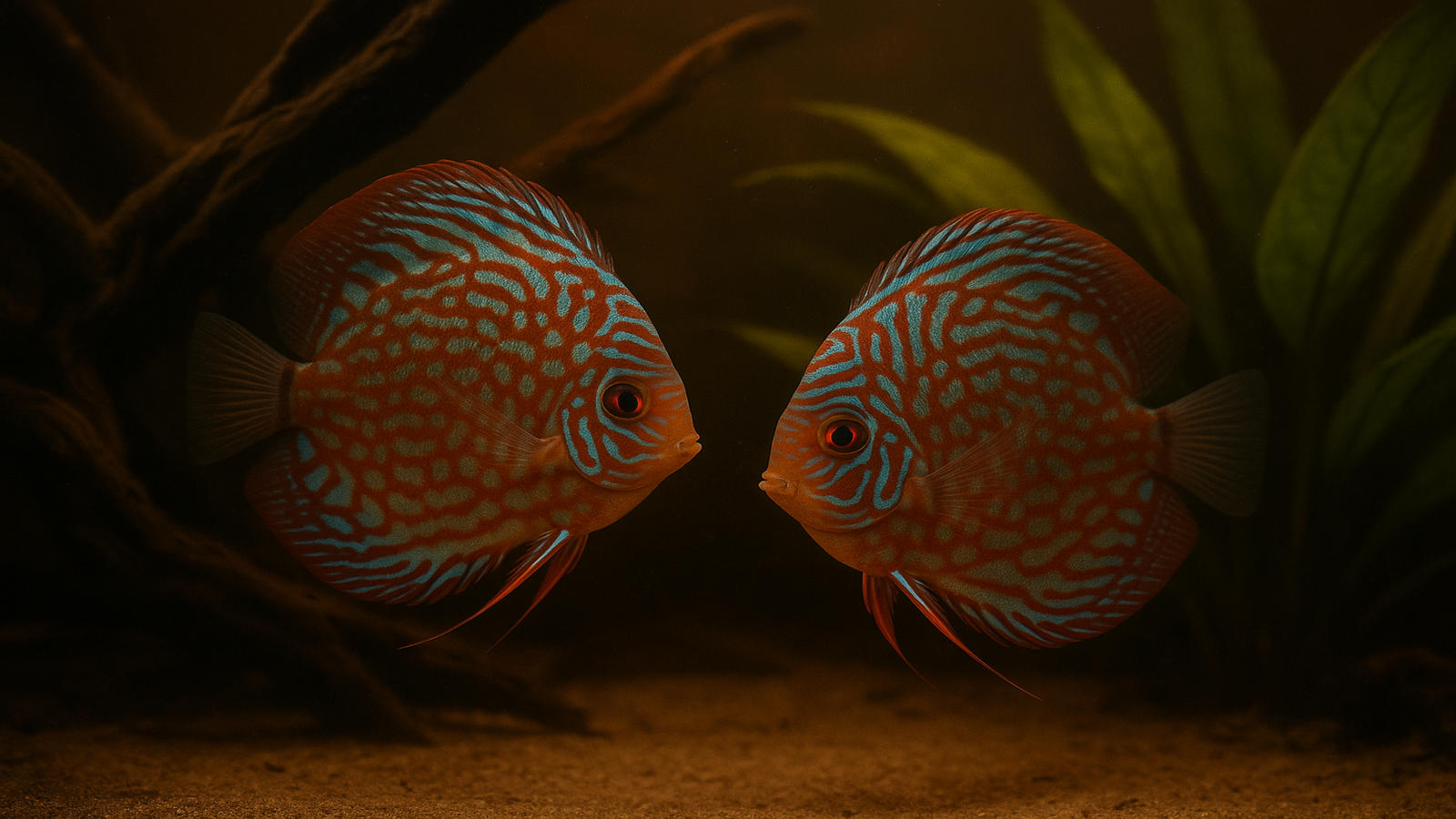
Yes, directly and measurably. Discus colour intensity — particularly the iridescent blue and turquoise patterning — is strongly linked to water quality and temperature:
This is why photos of discus in show tanks look so dramatically different from fish in a typical LFS display — those tanks run RO water at 6.2–6.5 pH, 28–30°C, and the colour speaks for itself.
High temperatures accelerate the nitrogen cycle but also speed up nitrate accumulation. Discus require more frequent water changes than most tropicals:
For reference, many serious discus breeders run 50% daily water changes during conditioning. It’s labour-intensive, but the link between water quality and discus health is that direct.
For a deeper dive into RO unit selection, waste water ratios, and remineraliser product comparisons, see our guide to setting up a blackwater aquarium for South American fish. The principles translate directly to discus chemistry.
Difficulty: Expert. We won’t soften this. Discus are not the right fish for a keeper who wants to ‘set and forget’. They require:
If you already run a blackwater setup for wild Corydoras, Apistogramma, or South American dwarf cichlids, you’re more than halfway there — the RO infrastructure and chemistry discipline is exactly the same.
When you’re ready to buy, every fish that leaves MTF ships with our Live Arrival Guarantee. Browse our current tropical fish stock and transhipping schedule — if discus or South American soft-water species aren’t listed today, drop Marc a message via the transhipping enquiry and we’ll let you know when stock is incoming.
Discus (Symphysodon spp.) thrive at pH 5.5–7.0. Wild specimens from the Rio Negro and Solimões basin live in water as soft as pH 4.5–5.5. Captive-bred strains are more tolerant but still decline noticeably above pH 7.4. UK tap water almost always exceeds this range, making pH adjustment essential.
Discus require total hardness (GH) below 5 dGH and carbonate hardness (KH) of 0–3 dKH. TDS should be kept between 50 and 150 ppm for captive-bred fish, and as low as 30–80 ppm for wild-caught specimens. Most UK tap water runs at 10–25 dGH (180–450 ppm TDS) — far too hard without RO treatment.
Discus need a stable temperature of 28–31°C. This is non-negotiable: temperatures below 26°C slow their immune response, increase susceptibility to Hexamita and bacterial infections, and suppress appetite. A reliable aquarium heater with a separate digital thermometer is essential — do not rely on a heater’s built-in dial alone.
In most of the UK, tap water is too hard and too alkaline for discus without treatment. Soft-water regions (parts of Scotland, Wales, and South West England) occasionally fall within acceptable parameters, but even then the pH is usually buffered above 7.0 by added lime. RO water blended and remineralised to target parameters is the only consistently reliable approach.
Strip your tap water to near-zero TDS through an RO unit, then add a specialist soft-water remineraliser (such as Sera Mineral Salt or Brightwell Aquatics Discus+ Reconstitute) to target GH 2–4 dGH and KH 0–2 dKH. Aim for a final TDS of 80–130 ppm for captive-bred discus. Always check pH after remineralising — a small addition of crushed peat or Indian almond leaves can nudge pH into the 6.0–6.8 sweet spot.
Persistent disease in discus — particularly Hexamita (hole-in-the-head), loss of colour, and wasting — is almost always a water-chemistry problem first, and a pathogen problem second. Discus suppressed by incorrect pH, excessive hardness, or sub-optimal temperature cannot mount an effective immune response. Fix the water before reaching for medication.