According to MTF-Aquatics, Datnioides microlepis (Siamese Tiger Fish) require a minimum 6 × 2 ft tank (approx. 550 litres) as adults, water kept at 26–30 °C, pH 6.5–7.5, and 2–8 dGH. They are intermediate-to-expert predators that reach 30–40 cm in captivity and should be kept with large, robust tank mates that cannot fit in their considerable gape.
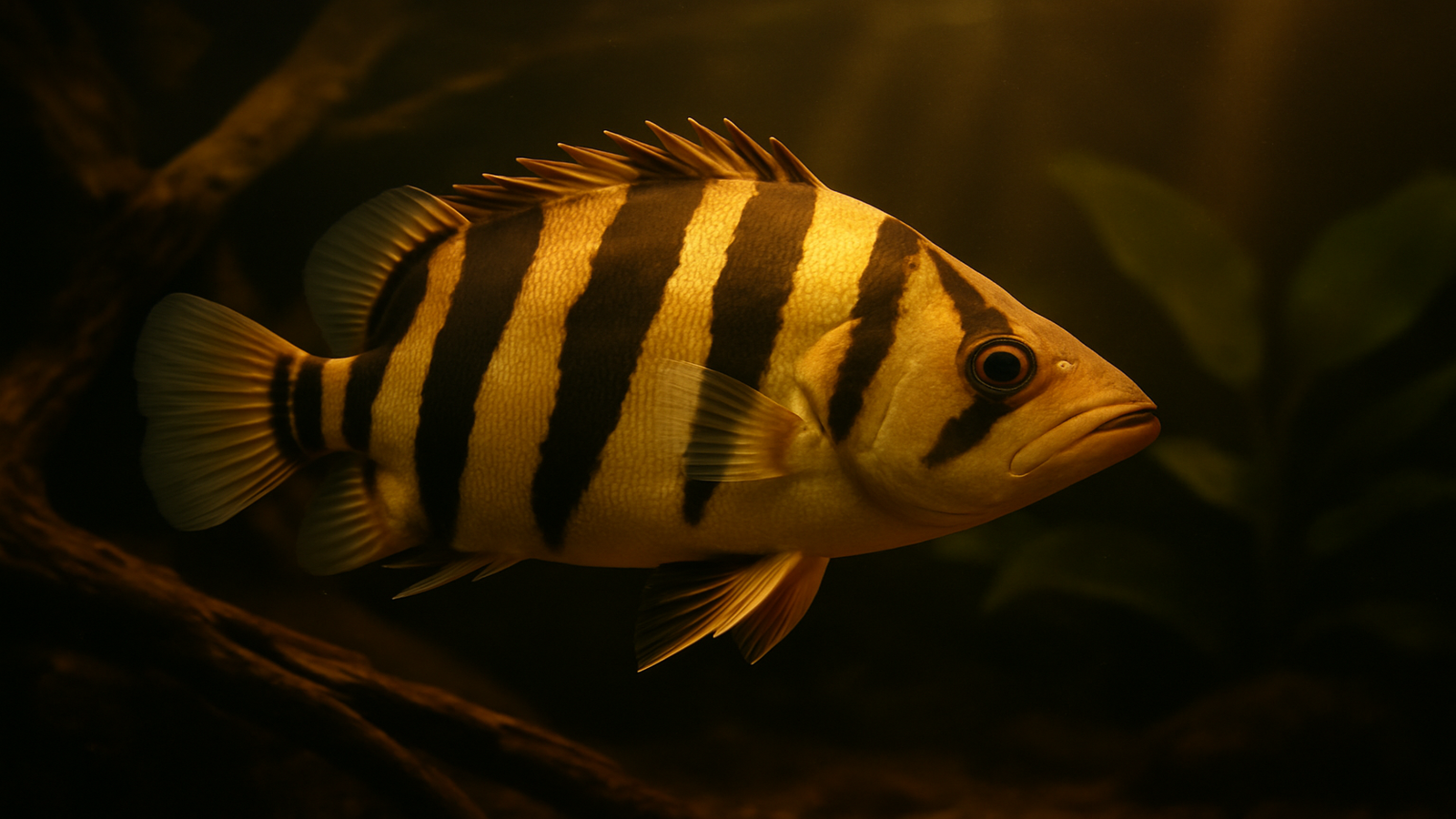
The Siamese Tiger Fish — Datnioides microlepis — is a species that stops conversations. Visitors who know nothing about the hobby will stand in front of the tank. Visitors who do know the hobby will want one immediately. That reaction is earned: the vertical black bars on a cream-gold body are as bold in person as they look in photographs, the fish holds itself with an almost theatrical stillness, and the occasional explosive dart across the tank reminds you exactly what kind of predator you are dealing with.
This is not a beginner fish. It needs a large, mature, well-filtered system, a patient owner willing to do the diet-weaning work, and tank mates chosen with care. Get those things right and you will be keeping one of the most visually commanding freshwater predators available to UK hobbyists. Get them wrong and you will have an expensive, stressed fish that refuses to feed.
This guide covers everything UK keepers need: species ID, water parameters, tank setup, the diet weaning process, growth timeline, tank mate compatibility, and how to source a healthy specimen.
Three Datnioides species appear in the UK trade, and they are not interchangeable:
| Species | Common Name | Bars | Water Type | Max Size |
|---|---|---|---|---|
| Datnioides microlepis | Indo Tiger / Siamese Tiger / 4-Bar Datnoid | 3–4 bold bars (variable) | Freshwater | 30–40 cm |
| Datnioides polota | Silver Tiger | 5–7 narrower bars | Freshwater to brackish | 30–40 cm |
| Datnioides campbelli | New Guinea Tiger / 5-Bar Datnoid | 5 bold bars | Freshwater | ~35 cm |
D. microlepis is the freshwater species most commonly encountered and, at MTF-Aquatics, the one Marc sources directly from Indonesia. It is identified by its thick-bodied, laterally compressed profile, the relatively few (three or four) wide black bars, and its preference for purely freshwater conditions throughout its life. Do not mistake it for D. polota — the Silver Tiger is a different setup with different long-term salinity requirements.
The “3-bar” versus “4-bar” terminology in the trade refers to bar count in D. microlepis: individuals with three bars instead of four are rarer and typically command a higher price, but both belong to the same species.
In the wild, D. microlepis inhabits the large, slow-moving river basins of Thailand, Cambodia, Laos, and Borneo — including the Chao Phraya and Mekong drainages. These are warm, slightly soft, neutral-to-slightly-acidic systems. UK tap water is rarely suitable without treatment.
| Parameter | Target Range | Notes |
|---|---|---|
| Temperature | 26–30 °C | 28 °C is the sweet spot; avoid drops below 24 °C |
| pH | 6.5–7.5 | Soft, slightly acidic preferred; alkaline tap water must be treated |
| Hardness | 2–8 dGH | Blend RO water with tap to hit target |
| Ammonia | 0 ppm | Zero tolerance — spike causes immediate feeding refusal |
| Nitrite | 0 ppm | As above |
| Nitrate | <20 ppm | Weekly water changes of 20–30% |
| Conductivity | 100–250 µS/cm | Moderate; avoid very hard or very mineralised tap |
UK tap water in most regions runs at pH 7.5–8.2 and 10–25 dGH — too hard and too alkaline. Blending RO water at roughly 50–70% RO to 30–50% tap, depending on your local supply, will typically hit the target range. Test before you fill.
Oxygenation matters. These fish come from large rivers with reasonable flow. A turnover of 8–10× the tank volume per hour through filtration and circulation pumps is appropriate. Sump setups work extremely well for this species — the increased water volume buffers against the inevitable ammonia spikes when feeding large carnivores.
In captivity, D. microlepis typically reaches 30–40 cm (12–16 inches) over three to five years. Growth is front-loaded — expect 10–12 cm in the first year under good conditions, slowing significantly after year two. Wild specimens in the Mekong and Chao Phraya can exceed 40 cm, but captive fish generally plateau a few centimetres below that.
Typical growth timeline:
| Age / Condition | Approximate Size |
|---|---|
| Import size (juvenile) | 8–12 cm (3–5 inches) |
| 12 months (fed well) | 18–22 cm |
| 24 months | 25–30 cm |
| 3–5 years (adult) | 30–40 cm |
Growth is noticeably suppressed in undersized tanks, with poor water quality, or when a fish is in feeding-refusal mode. A stunted Datnoid is a common outcome when keepers underestimate the eventual size at purchase.
Minimum tank size:
If you are housing a Datnoid alongside an Arowana or another large species, budget for 6 × 2.5 ft or larger. The footprint matters more than the height — D. microlepis is a mid-water hoverer, not a fish that uses vertical space extensively.
Decor and layout:
D. microlepis is a crepuscular ambush predator. In the wild it uses submerged wood, overhanging banks, and vegetation as cover while waiting for prey. Replicate this:
Filtration: Oversized external canister + sump or large external filter providing 8–10× turnover. The bioload from large frozen/fresh foods is significant. Add a circulation pump or wavemaker on low setting to create gentle mid-tank current.
This is where Datnoid keeping succeeds or fails. Wild-caught fish arrive eating live food — typically live river shrimp, small fish, or live earthworms. Your job is to wean them onto a sustainable, disease-free diet of frozen and prepared foods.
Stage 1 — First two weeks (quarantine and settling): Offer only live river shrimp or live earthworms. The goal is simply to confirm the fish is feeding. Do not attempt weaning during the first week. Keep the tank dim and minimise disturbance.
Stage 2 — Weeks 3–6 (introducing frozen): Once feeding reliably on live food, begin offering defrosted whole prawns, cockle, or whitebait alongside the live items. Use tongs — never your hand. Over several days, reduce the live component and increase the frozen.
Stage 3 — Weeks 6–12 (pellet introduction): Once the fish accepts frozen food readily, introduce sinking carnivore pellets — Hikari Massivore Delite works well for mid-sized Datnoids; the large pellet size suits fish over 20 cm. Introduce by soaking pellets in prawn juice and dropping them alongside frozen items. Some individuals accept pellets within two weeks; others take months. Patience is not optional.
Foods to feed: – Defrosted whole prawns, cockle, mussel, whitebait, lance fish – Hikari Massivore Delite (medium then large size as fish grows) – Earthworms (live or frozen)
Foods to avoid: – Feeder fish (goldfish, minnows) — disease risk, thiaminase issue, no nutritional advantage – Bloodworm as a staple — fine for juveniles, inadequate protein for adults – Beef heart — inappropriate fat profile for this species
Feeding frequency: Juveniles (under 15 cm): once daily. Sub-adults: every other day. Adults: 2–3 times per week. Datnoids are ambush predators, not grazers — overfeeding degrades water quality rapidly and is the primary cause of disease in this species.
The rule is straightforward: nothing that fits in the gape, nothing that will harass the Datnoid, nothing fragile. D. microlepis is not an active hunter of similar-sized fish, but it is an ambush predator and any fish small enough to swallow will eventually be swallowed — usually at night.
| Species | Compatibility | Notes |
|---|---|---|
| Other Datnioides microlepis (similar size) | ✅ Good | Dominant individual may outcompete at feeding; watch intake |
| Clown Loach (Chromobotia macracanthus), adult | ✅ Good | Robust, active; too large to be swallowed if kept at adult size |
| Royal Pleco (Pterygoplichthys / L190, L191) | ✅ Good | Bottom-dweller, no competition for midwater territory |
| Large Arowana (Scleropages / Osteoglossum spp.) | ⚠️ Possible | Tank must be large (8 ft+); Arowana can bully Datnoids at surface |
| Oscar (Astronotus ocellatus) | ⚠️ Caution | Boisterous; can stress Datnoid; not ideal long-term |
| Large cichlids (Flowerhorn, Dovii) | ❌ Avoid | Chronic aggression; Datnoid will refuse food |
| Any fish under 10 cm | ❌ Avoid | Will be eaten |
| Stingrays | ⚠️ Possible | Large system only; no stray feeding competition |
The worst outcome in a Datnoid community tank is a stressed fish that stops eating. A Datnoid in feeding refusal for more than three weeks begins to lose condition rapidly. If your tank mate combination is causing that, separate the animals immediately.
The UK high-street trade has been a poor source of Datnioides for years. The fish that appear in chain stores are often D. polota misidentified as D. microlepis, shipped through several wholesalers before reaching the shelf, frequently underfed, and occasionally carrying internal parasites.
MTF-Aquatics sources D. microlepis directly from Indonesian exporters, bypassing the UK wholesale chain entirely. Marc hand-selects animals on his live import schedules — fish arrive holding weight, with confirmed feeding history, and are held in quarantine before despatch. The MTF transhipping service also allows customers to co-import specific animals from source directly, which is how serious collectors acquire wild-caught specimens of confirmed bar count and provenance.
When evaluating a Datnioides at any retailer, look for: – Clear, unclouded eyes (not sunken) – No white lesions, ulcers, or fungal patches on the body – Erect fins — clamped fins are a stress/disease indicator – Active, alert hovering posture — a fish lying on the bottom or listing to one side is unwell – Confirmed feeding history — ask what the fish is eating and when it last fed
A healthy 4–6 inch D. microlepis with confirmed feeding is worth considerably more than a cheap, unfed fish you will spend six weeks coaxing to eat before losing.
The most common problems in Datnoid keeping are preventable:
Feeding refusal — almost always environmental (water parameters out of range, lighting too bright, bullying tank mates, ammonia spike). Resolve the cause before trying to force feed.
White spot / Ich (Ichthyophthirius multifiliis) — this species is sensitive to temperature fluctuation. Maintain a stable 28 °C. Treat at the first sign of white spots with a raised temperature (30 °C) and appropriate treatment; remove carbon from filter during treatment.
Internal parasites — a risk in wild-caught fish. New arrivals should be quarantined for a minimum of four weeks. Hollow belly in a fish that appears to be feeding is a flag for internal worms.
Fin damage — from tank mates, not from the Datnoid itself. Review your community immediately if you see torn fins.
Difficulty rating: Intermediate–Expert
This fish rewards keepers who are precise about water chemistry, patient about diet weaning, and honest about tank size. It is not a starter predator. If you are new to large carnivorous fish and want a more forgiving entry point, the Bichir care guide covers a species that is more tolerant of suboptimal conditions.
If you are ready for D. microlepis — or if you already have the right setup and want to understand this fish fully — it is one of the most rewarding species in the freshwater hobby. Few fish command presence the way a healthy, settled Datnoid does.
Browse our current Datnioides stock — every fish ships with our Live Arrival Guarantee. Want a specific size or bar count? Book a tranship and we will source it from Indonesia directly.
At MTF-Aquatics, we recommend a minimum footprint of 6 × 2 ft (approximately 550 litres) for a single adult Datnioides microlepis. Juveniles under 15 cm can be grown on in a 4 × 2 ft (approx. 240 litres) setup, but you should plan for the adult size from day one. Insufficient horizontal swimming space causes chronic stress and suppresses feeding.
In captivity, Datnioides microlepis typically reach 30–40 cm (12–16 inches) over three to five years when fed well. Wild specimens in the Chao Phraya and Mekong systems can exceed 40 cm, but aquarium-kept fish usually plateau slightly below that. Growth is fastest in the first two years — expect 10–12 cm per year under good conditions.
Datnioides microlepis are obligate carnivores. Wild fish eat small fish, prawns, and invertebrates. In the aquarium, start juveniles on live or frozen bloodworm, live river shrimp, and defrosted cockle. The goal is to wean onto high-protein carnivore pellets (such as Hikari Massivore Delite) and frozen foods like whitebait, mussels, and prawns within four to six weeks. Feeder fish should be avoided — they carry disease and provide no dietary advantage over frozen alternatives.
According to MTF-Aquatics, suitable tank mates are large, robust, non-aggressive species that cannot fit in the Datnoid’s gape — think adult Clown Loach (Chromobotia macracanthus), large Plecostomus (e.g. L190/L191), and similarly sized Arowana in a large enough system. Avoid fin-nipping species, boisterous cichlids, and any fish small enough to be swallowed. Other Datnoids of the same size can be kept together, though dominant individuals may outcompete weaker ones at feeding time.
At MTF-Aquatics, we keep Datnioides microlepis at 26–30 °C, pH 6.5–7.5, hardness 2–8 dGH, and ammonia/nitrite at 0 ppm. They originate from the large, slow-moving river systems of Thailand, Cambodia, and Borneo — slightly soft, warm, and well-oxygenated water replicates their natural conditions best. UK tap water is usually too hard and too alkaline; blending RO water is strongly recommended to hit the lower end of the pH range.
No — they are distinct species. Datnioides microlepis (Indo Tiger / Four-Bar Datnoid) is a freshwater species from Indochina and Borneo with a cream-gold body and typically four strong black bars. Datnioides polota (Silver Tiger) tolerates and sometimes requires brackish conditions as adults. Datnioides campbelli (New Guinea Tiger) has a narrower, more elongated body. At MTF-Aquatics, we source D. microlepis as a true freshwater specimen directly from Indonesian exporters.