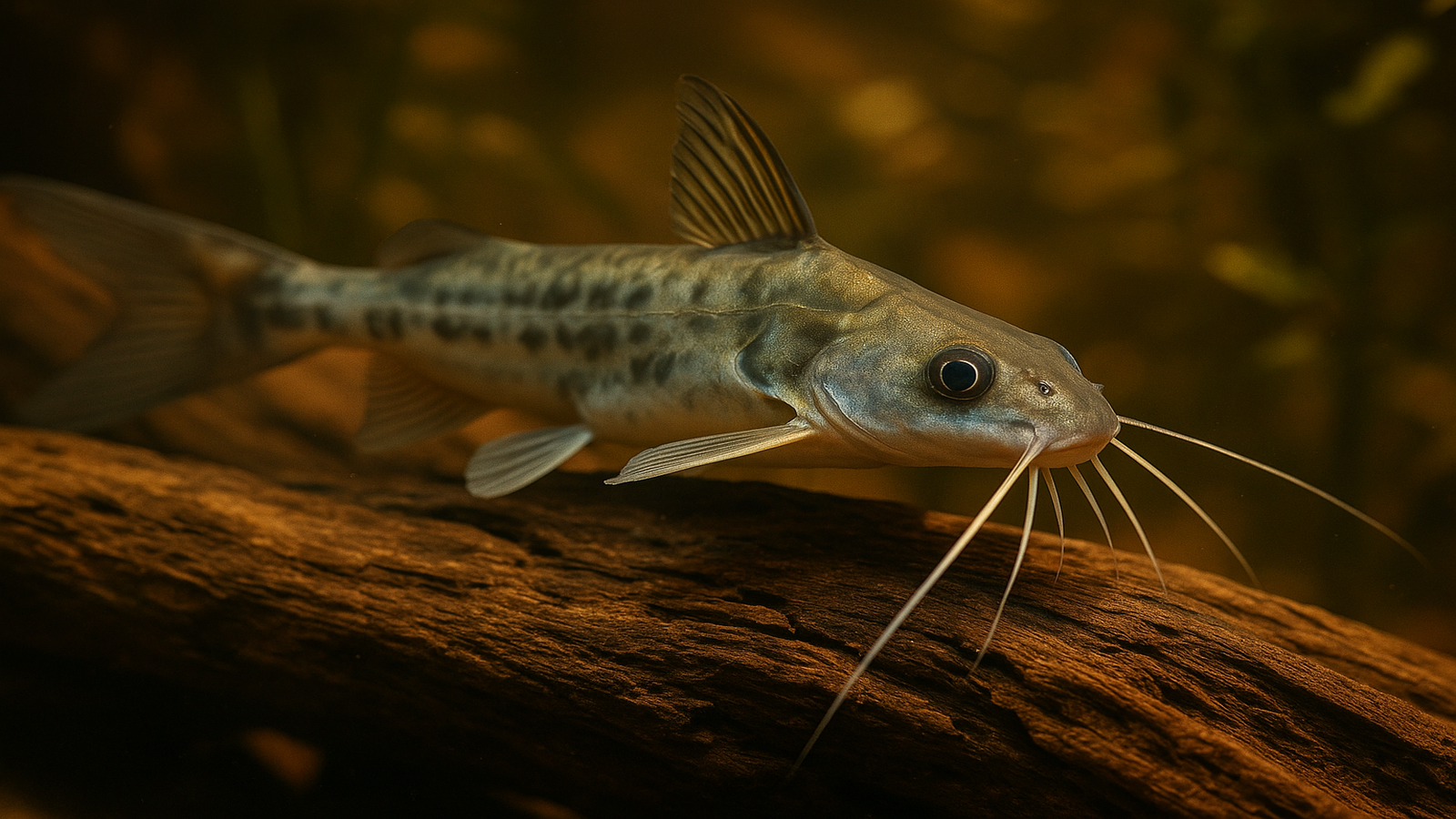
Bloch’s Catfish (Pimelodus blochii) is a medium-to-large pimelodid from South America that remains surprisingly underrepresented in the hobby given its striking appearance and active nature. Reaching a maximum total length of around 30 cm, this is not a fish for modest community set-ups — it demands space, decent filtration, and tankmates capable of holding their own. That said, for the experienced aquarist with an appropriately scaled display, P. blochii is a rewarding and genuinely engaging species. It is crepuscular to nocturnal by preference but will become increasingly bold during daylight hours once settled. MTF currently carries stock sourced via direct import, backed by our Live Arrival Guarantee.
Pimelodus blochii is distributed across multiple major South American river systems, including the Amazon, Orinoco, and associated tributaries. It inhabits main river channels and larger tributaries, typically over sand or fine gravel substrates with moderate to strong current. The water in these environments is often turbid, slightly soft to moderately hard, and well-oxygenated. Submerged wood, undercut banks, and root structures provide daytime refuge. Understanding this origin is key to replicating conditions that allow the species to thrive rather than merely survive.
Filtration must be robust. As a large, active omnivore with a significant bioload, P. blochii requires a mature, high-capacity filter — a canister rated well above the tank volume, ideally supplemented with powerheads to replicate the moderate current of its riverine habitat. Weekly water changes of 30–40% are advisable. This species is sensitive to dissolved waste accumulation and will show barbel erosion and increased susceptibility to bacterial infection if water quality deteriorates.
Pimelodus blochii is an opportunistic omnivore and straightforward to feed in captivity. It accepts a wide range of sinking foods readily: quality sinking catfish pellets and wafers should form the dietary backbone, supplemented with frozen or live bloodworm, earthworms, mussel, prawn, and white fish fillet. It will also consume any slower tankmates it can swallow whole — this is not aggression but simply foraging behaviour, and it must factor into compatibility decisions. Feed primarily in the evening or shortly after lights-out to align with the fish’s natural activity peak and to ensure it receives adequate nutrition before faster midwater species intercept food. Avoid prolonged reliance on feeder fish, which carry disease risk and offer poor nutritional balance.
Compatibility requires careful thought. P. blochii is not aggressive toward fish it cannot eat, but its size, activity level, and boisterous feeding behaviour make it entirely unsuitable with small or delicate species. Suitable tankmates include large South American cichlids (oscars, severums, larger geophagus), similarly sized pimelodids, robust plecos, and large characins such as silver dollars or silver banding. Avoid anything that fits within a 30 cm mouth — a useful rule of thumb is that any fish shorter than half the catfish’s body length is at serious risk. P. blochii is typically described as a schooling species in the wild, and while solitary specimens can settle well, keeping two or three together generally produces more confident, less skittish behaviour. Ensure the tank footprint supports this without creating territorial pressure on other residents.
The most common health issue in pimelodids is barbel erosion, almost always caused by sharp substrate, poor water quality, or both. Inspect the barbels weekly — healthy barbels should be long, intact, and mobile. Any shortening or reddening at the tips warrants an immediate review of substrate and water parameters. Like many scaleless or smooth-bodied catfish, P. blochii is sensitive to medications containing copper and formalin; always use half-dose treatments and remove the fish to a hospital tank where possible. Ich is occasionally introduced at import but responds well to heat treatment (raising temperature to 30°C over 48 hours) combined with appropriate medication at adjusted dose. Ensure excellent aeration if raising temperature, as oxygen solubility decreases significantly at higher temperatures.
Browse our current stock — every fish ships with our Live Arrival Guarantee. Shop Tropical Fish | Book a Tranship
Browse our current stock — every fish ships with our Live Arrival Guarantee.
Shop Tropical FishBook a Tranship