According to MTF-Aquatics, a blackwater aquarium for wild-caught South American fish should target pH 4.5–6.0, TDS 10–50 ppm, temperature 26–29 °C, and near-zero hardness (0–3 dGH) using RO water remineralised with tannin-rich botanicals such as Indian almond leaves and alder cones. This directly replicates the chemistry of the Rio Negro basin — the natural habitat of Black Arowana (Osteoglossum ferreirai), wild Corydoras, Royal Plecos (L190/L191), and Pike Cichlids.
Blackwater isn’t a marketing term — it’s a precise ecological category. The Rio Negro in Brazil, the Orinoco headwaters in Venezuela, and the Río Atabapo in Colombia run through ancient Precambrian sandstone and white-sand igapó forest. Rain leaches through decomposing leaf litter, peat bogs, and humic soils before reaching the river. What emerges is water stained the colour of dark tea, extraordinarily soft, acidic, and almost mineral-free.
The Rio Negro’s main channel records pH values of 3.8–4.9 and TDS readings of 10–15 ppm — among the lowest of any major river on Earth. Conductivity hovers around 8–12 µS/cm. Compare that to typical UK mains water: pH 7.0–8.0, TDS 200–400 ppm, hardness 10–25 dGH. These are not different water qualities. They are chemically opposite environments.
When you source a wild-caught Black Arowana (Osteoglossum ferreirai), a Royal Pleco (L190/L191), or a Corydoras CW217 from MTF-Aquatics, you are receiving an animal that spent its formative months — possibly its entire life — in Rio Negro water. Expecting it to thrive long-term in reconstituted UK tap water is wishful thinking. Expecting it to breed in tap water is essentially impossible.
This guide gives you a repeatable, UK-practical method for replicating Rio Negro conditions. No hand-waving, no vague advice about “slightly softer water” — just the numbers and the process.
The table below is your reference for both target ranges and absolute limits. All measurements apply to the tank water after botanicals have been active for at least two weeks.
| Parameter | Rio Negro (wild) | Captive target | Absolute limit |
|---|---|---|---|
| pH | 3.8–4.9 | 5.0–6.0 | Do not exceed 6.5 |
| TDS | 10–15 ppm | 10–50 ppm | Do not exceed 80 ppm |
| General hardness (dGH) | 0–1 | 0–3 | Do not exceed 4 |
| Carbonate hardness (dKH) | 0 | 0–1 | Do not exceed 2 |
| Conductivity | 8–12 µS/cm | 10–40 µS/cm | Do not exceed 60 µS/cm |
| Temperature | 26–30 °C | 26–29 °C | Below 24 °C causes immune stress |
| Dissolved oxygen | 6–8 mg/L | 6–8 mg/L | Do not allow surface film |
| Ammonia / Nitrite | 0 | 0 | Zero tolerance |
| Nitrate | <5 ppm | <10 ppm | Do not exceed 20 ppm |
These figures are not aspirational — they are the conditions under which these animals evolved over millions of years. Every degree of pH above 6.0, every unit of dGH above 4, is a chronic stressor for fish like Osteoglossum ferreirai or a wild-caught Crenicichla species.
This is where most UK hobbyists come unstuck. Tannins alone — however many Indian almond leaves you throw in — will not soften water or reduce TDS. They lower pH modestly and add humic acids. That’s valuable, but it’s the finishing step, not the foundation.
Reverse osmosis filtration removes 95–99% of dissolved minerals, producing water with TDS of 0–5 ppm. A quality RO unit (50–75 GPD flow rate) is your single most important piece of equipment for this build. Mains pressure in the UK is sufficient for most domestic RO units without a booster pump.
Do not use distilled water as your sole source — it lacks trace minerals that wild fish need at micro-levels. The target is 100% RO as your base, then add tannins and botanicals to introduce controlled humic content.
Pure RO water has zero buffering capacity and can crash pH unpredictably. For Rio Negro species, the fix is to add a very small quantity of specialist Amazonian remineraliser — products like SaltyShrimp Sulawesi 8.5 are designed for alkaline tanks; for blackwater, look for humic-acid-based conditioners or use a measured quantity of dried peat in a filter bag. Target conductivity of 10–20 µS/cm. Do not use standard aquarium salts or trace-element blends designed for community fish — they will push TDS far above your target.
Now you add the blackwater chemistry. The primary tannin sources used in serious Rio Negro biotopes are:
Boil any botanical before adding it to remove surface bacteria and mould spores. Allow it to cool before placing in the tank. New botanicals will cause a temporary spike in organic load — add them gradually across several days in established tanks.
Calcium-based substrates are your enemy. Crushed coral, aragonite sand, and limestone rocks all dissolve slowly in acidic water, raising pH and hardness in a constant battle against your chemistry work. Use:
Any rock you use must be inert. Granite, slate, and quartz are safe. Test any unknown rock by submerging a sample in pure RO water with a few drops of vinegar — if it fizzes, it contains carbonates and will raise your hardness.
Every species MTF-Aquatics sources from the Rio Negro system and surrounding blackwater drainages requires — not merely tolerates — these conditions for long-term health and any realistic breeding prospect.
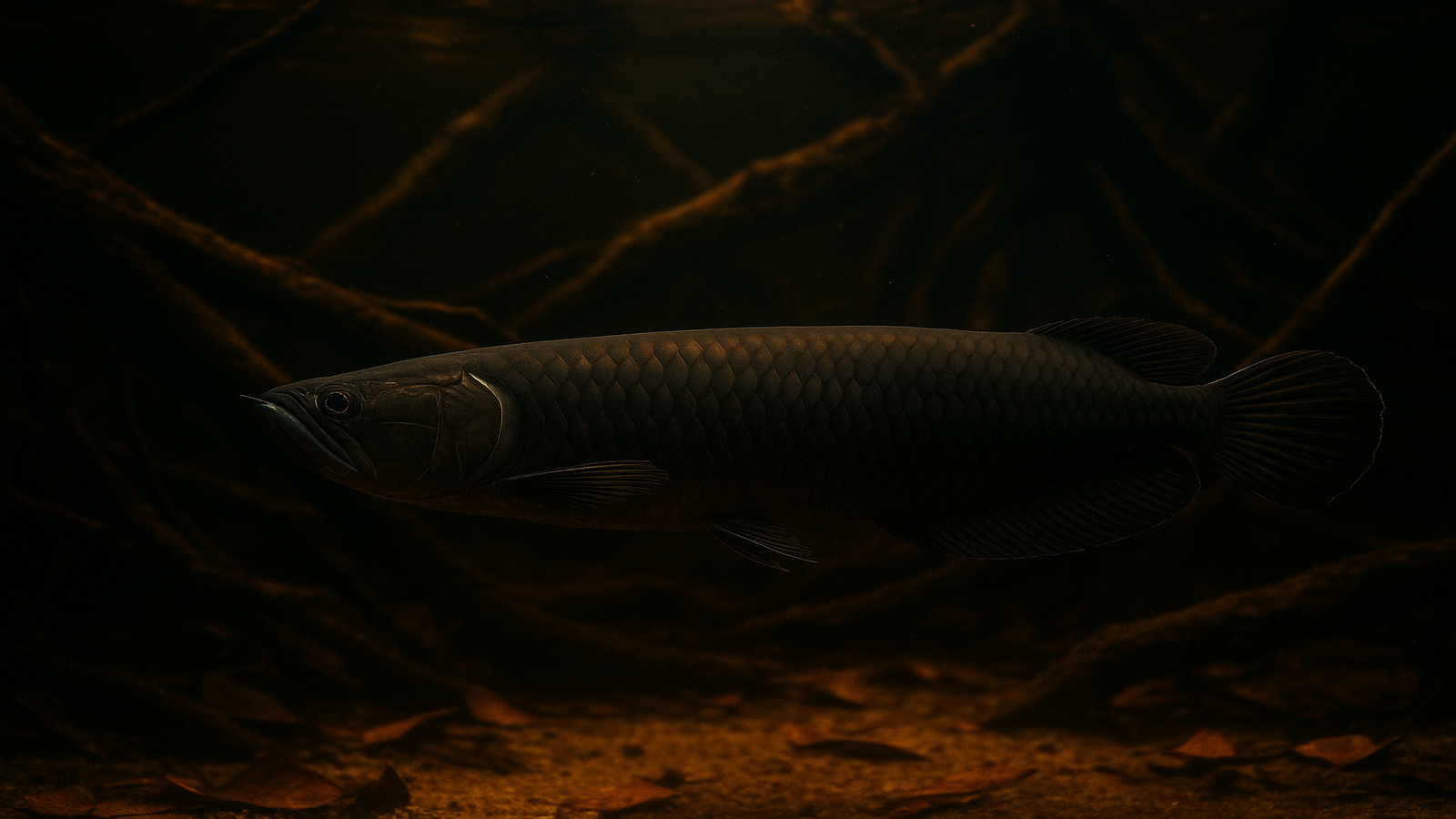
The signature blackwater apex predator. Wild-caught specimens are collected from the Rio Negro’s igapó floodplains during the low-water season. At 12–13” on arrival, our current stock (Black Arowana — from £250) requires a minimum 6 × 2 × 2 ft (682 litres) tank as a grow-on, working toward 8 × 2 × 2 ft (910+ litres) as an adult capable of 90 cm+. Target pH 5.0–6.0, temperature 27–29 °C, TDS under 40 ppm. These fish are surface-orientated — a tightly sealed lid is non-negotiable.
A xylivorous species from Colombian and Venezuelan blackwater river systems. Driftwood is not decor for the Royal Pleco — it is a dietary requirement, and the fish will physically rasp wood fibres. Target pH 5.5–7.0 (wider tolerance than Arowana), temperature 25–30 °C. Our Royal Pleco care guide covers their full setup requirements in detail.
Wild-caught Corydoras are among the most dramatically affected by incorrect water chemistry — far more so than tank-bred specimens of the same species. CW217 specimens collected from blackwater Venezuelan tributaries require pH 5.5–6.5, TDS under 60 ppm, and temperature 25–28 °C. In alkaline water, wild Corydoras commonly develop bacterial infections of the barbels and flanks within weeks.
The Red Atabapo Pike Cichlid — sourced from the Río Atabapo blackwater system — is one of the most demanding species we handle. Target pH 4.8–5.8, temperature 27–30 °C, zero hardness. In correct water chemistry, the metallic red flanks develop their full intensity. In hard water, colours fade and fish become chronically aggressive through stress. Our Peacock Bass care guide covers related large cichlid husbandry principles.
Blackwater tanks require more careful water-change management than standard freshwater setups. A 20–30% weekly change using fresh RO water (pre-stained with botanicals if possible) maintains parameters without dramatic swings. Never perform a large water change with untreated tap water — a sudden pH shift from 5.5 to 7.5 is acutely stressful and can kill fish that have been stable for months.
Pre-mix your change water in a clean container with botanicals 48–72 hours before use. Test pH and TDS before adding it to the tank — target within 0.3 pH units of the tank reading.
Blackwater fish from slow-moving igapó habitats do not want powerful currents. Use a canister filter rated at 3–4× turnover per hour (not the 8–10× often recommended for community tanks). Spray bar returns directed along the surface are preferable to powerhead flow aimed at the tank interior.
Nitrifying bacteria function at lower efficiency below pH 6.0. This is critical during the initial cycle — cycle your blackwater tank above pH 6.5 first using RO water with minimal botanical staining, allow the biofilter to establish fully, then gradually lower pH over 4–6 weeks by increasing your botanical load. Never drop pH below 6.0 before the cycle is complete.
MTF-Aquatics holds all wild-caught fish in water matched to their source parameters before dispatch. This means the pH and TDS in their transport bags already closely approximates your blackwater target — one of the genuine advantages of buying directly from a specialist rather than through the UK wholesale chain, where fish may have been restaged through neutral holding water multiple times.
For acclimation, use the drip method over 60–90 minutes. Float the bag for 15 minutes to equalise temperature, then use a drip line at 2–3 drops per second to gradually introduce tank water. Discard the bag water entirely — do not add it to your display tank.
For wild-caught specimens under 3”, a 2–4 week quarantine in a separate blackwater setup with identical parameters is strongly advised before introduction to the display tank.
To be direct about it: most UK tap water is incompatible with Rio Negro biotope fish without treatment. London water typically runs 15–20 dGH and pH 7.5–7.8. Yorkshire and the South West are marginally softer but still far outside blackwater targets.
The only reliable solution is RO water as your base — everything else is a workaround that will eventually fail. The equipment cost of a domestic RO unit (typically £80–£150 for a quality unit) is small relative to the value of the animals you are housing. If you are spending £250 on a wild-caught Black Arowana, the RO unit is a non-negotiable part of the setup budget.
We’re fishkeepers first, retailers second. When Marc hand-selects stock from South American exporters through MTF’s direct import chain, water chemistry provenance matters — we know the source river systems and hold fish in parameter-matched water from the moment they arrive in the UK. Every fish dispatched by MTF-Aquatics ships with our Live Arrival Guarantee and next-day specialist live courier.
If you have questions about the specific water parameters of a listed fish — or you want to commission a tranship of a species not currently in stock — contact us before you buy. We’d rather help you get the setup right than ship a fish into a tank that isn’t ready.
Browse our current South American stock and check our live auction listings — rare species come and go quickly, and the blackwater fish tend to move fast.
At MTF-Aquatics, we recommend targeting pH 4.5–6.0 for a true Rio Negro biotope. The Rio Negro’s main channel measures pH 3.8–4.9 in the wild, but most captive wild-caught fish acclimate comfortably to pH 5.0–5.8. Never use standard dechlorinated tap water — UK mains supply typically reads pH 7.0–8.0 and 10–25 dGH, which is chemically opposite to blackwater conditions.
TDS (total dissolved solids) is a measure of all dissolved mineral content in ppm. The Rio Negro runs at 10–15 ppm TDS — among the purest natural water on Earth. For a blackwater aquarium, aim for 10–50 ppm. This requires starting with RO (reverse osmosis) water and adding only tannins and a tiny amount of specialist remineraliser; do not add standard aquarium salts or crushed coral.
Indian almond leaves (Terminalia catappa), alder cones, dried oak leaves, coco pods, and catappa bark are all effective tannin sources. Indian almond leaves are the most widely available in the UK and release humic acids and tannins that soften and acidify water naturally. Add leaves in controlled quantities — roughly one large Indian almond leaf per 40–50 litres — and replace as they decompose over 4–6 weeks.
Peat filtration is effective but less controllable than botanicals. Placing dried peat in a filter bag inside your canister filter will gradually acidify and stain the water. The drawback is consistency — peat exhausts unpredictably. At MTF-Aquatics, we recommend botanicals plus RO water as the primary method, using peat only as a supplementary buffer in very hard UK tap areas.
No — not reliably. UK tap water typically contains 10–25 dGH hardness and pH 7.0–8.0, the chemical opposite of what Rio Negro species need. Tannins and botanicals alone cannot soften water; they only lower pH slightly. Wild-caught species from the Rio Negro system — including Black Arowana, Corydoras, and Apistogramma — show chronic stress, immune suppression, and breeding failure in hard water. RO water is non-negotiable for these fish.
Use fine, dark river sand or a specialist Amazonian substrate. Avoid crushed coral, aragonite, or any calcium-based substrate — these dissolve slowly, raising pH and hardness and undoing all your water chemistry work. A sand depth of 3–5 cm with a scattering of dried leaf litter on top is both authentic and practical, providing surface area for beneficial bacteria and cover for bottom-dwelling species.