According to MTF-Aquatics, a quarantine period of 4–6 weeks is essential before introducing any new fish to an established aquarium. Proper aquarium quarantine new fish protocols isolate pathogens like ich, velvet, and gill flukes that can otherwise infect your entire display tank. Most UK hobbyists skip this critical welfare step, but it is the single most effective disease prevention measure available to any fishkeeper.
You’ve just won a stunning rare specimen at an online UK aquarium auction. The courier delivers it safely, the fish arrives alive and appears healthy. So you release it straight into your display tank — and within days, white spots appear across your gills and fins. Then your existing fish start showing signs too. What you’ve encountered is the single most overlooked welfare and biosecurity step in the UK hobby: proper aquarium quarantine new fish protocols.
Fewer than 5% of UK hobbyists operate a formal aquarium quarantine new fish system before introducing new livestock to an established tank. This statistic matters because new fish — whether from an auction, a transhipper, or even a local breeder — carry latent pathogens: Ichthyophthirius multifiliis (ich), velvet (Oodinium), columnaris, internal parasites, and gill flukes. These pathogens are often invisible at the point of purchase, incubating silently during shipping and acclimation.
They become visible only when stress from transport, water change shock, or crowding triggers an outbreak. By then, your entire display tank is exposed. At MTF-Aquatics, we hand-select every fish we auction and hold each specimen through acclimation before sale — but we cannot quarantine for your specific display setup, pH, and hardness. That responsibility rests with you. This guide explains why aquarium quarantine new fish is non-negotiable, how long it needs to take, how to set it up, and how to recognise disease signals that mean immediate intervention is needed.
When you purchase a fish from an online auction, a transhipper, or even a reputable breeder, that specimen has experienced transport stress: temperature fluctuations, bag time (typically 12–24 hours for UK courier delivery), exposure to crowded conditions, and water quality swings. Transport stress suppresses the immune system. In this immunocompromised state, latent infections that the fish was harbouring asymptomatically become active.
Ichthyophthirius multifiliis (ich) is the most common culprit. The parasite sits dormant on a fish’s skin and gills, triggered into active infection by stress. Oodinium (velvet), columnaris, and internal parasites operate similarly. A fish can be medicated, recovered, and passed as “healthy” by a seller, but still be carrying parasite cysts that will re-emerge under stress. Proper aquarium quarantine new fish practice isolates the new specimen away from your display population, allowing these infections to reveal themselves in a controlled environment where you can treat them without risking your established tank.
Furthermore, an aquarium quarantine new fish period provides a behavioural observation window. A fish that seems shy or lethargic in the dealer’s system may have specific water chemistry or feeding needs that are not immediately obvious. Quarantine allows you to dial in the right parameters, learn the fish’s feeding preferences, and confirm it is genuinely healthy before integration.
The standard recommendation in UK fishkeeping guidance is a minimum of 4–6 weeks. This timeline is not arbitrary.
Ichthyophthirius multifiliis has a temperature-dependent life cycle. At 26–28°C, the parasite can complete a full reproductive cycle (from trophont stage through theront transmission) in approximately 7–10 days. However, not all trophonts are visible at the same time, and eggs can persist in the substrate. A single fish can shed multiple “waves” of parasites over a 2–3 week period, meaning you need to observe long enough to catch all waves.
Furthermore, secondary bacterial or fungal infections (columnaris, fin rot) triggered by parasitic damage can take 2–3 weeks to manifest fully. That’s why aquarium quarantine new fish requires 4–6 weeks minimum. A 2-week minimum is sometimes cited in casual hobby guidance, but this is insufficient for comprehensive disease clearance. At 26°C, you may miss a second or third generation of ich, or catch only the early stages of a velvet outbreak. Four to six weeks at stable temperature allows the full incubation and resolution of nearly all common pathogens.
Note on temperature: If you quarantine at a lower temperature (24–25°C), parasite cycles slow, and you may need 6–8 weeks instead. Conversely, some aquarists use elevated temperature (28–30°C) deliberately to accelerate parasite cycles and compress the quarantine window to 3 weeks — but this is advanced practice and requires close daily observation.
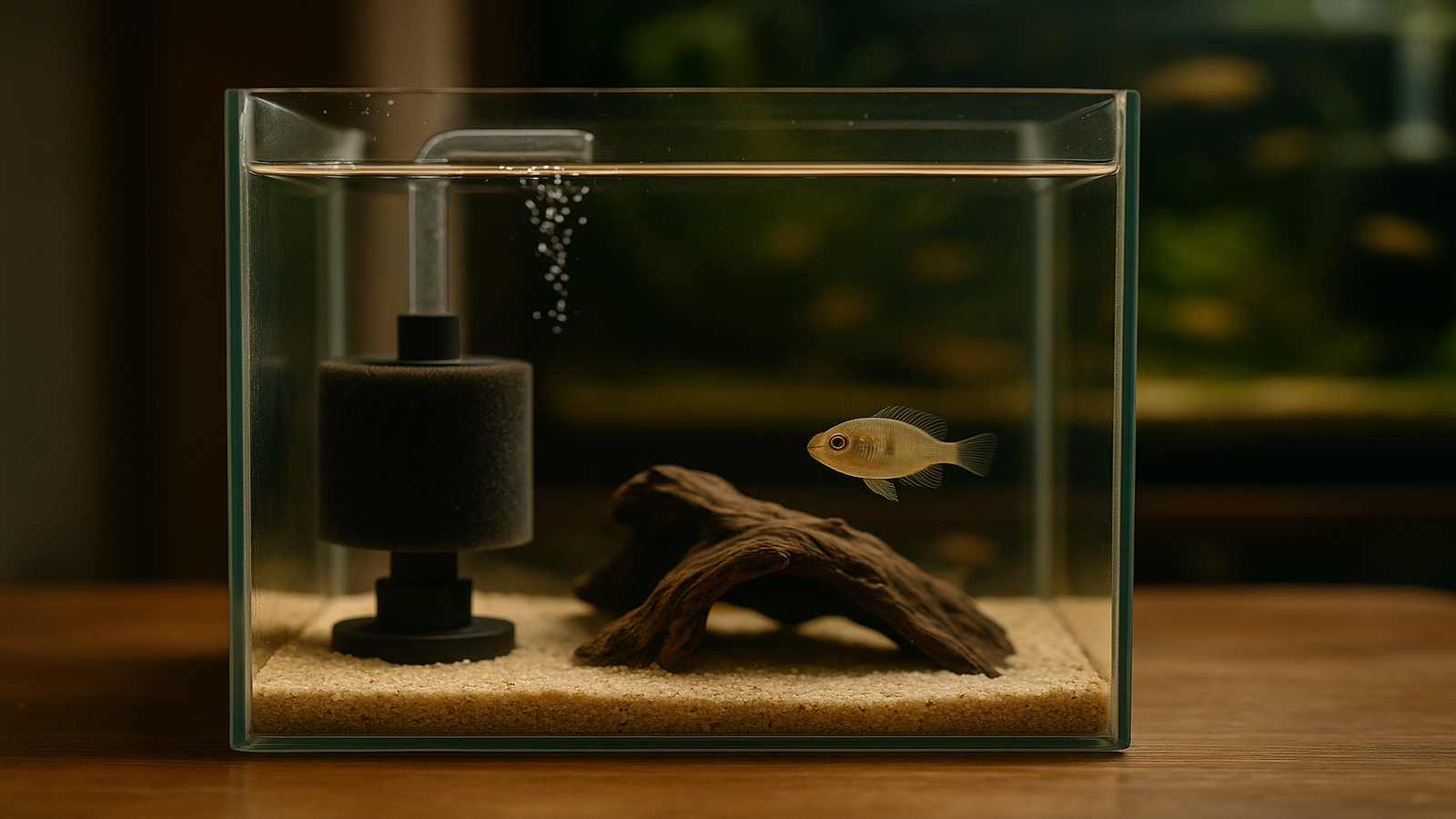
An effective quarantine setup does not need to be elaborate, but it must be cycled and stable. Here are the essentials for successful aquarium quarantine new fish systems:
| Parameter | Target |
|---|---|
| Tank Size | 20–40L (sponge-filter suitable) for small–medium fish; larger predators need proportionally larger volumes |
| Substrate | Fine sand or bare bottom; avoid gravel (traps waste, complicates cleaning) |
| Filtration | Sponge filter powered by a separate air pump (creates biological stability without strong current) |
| Décor | 1–2 pieces of driftwood or PVC pipe; fish need refuge and psychological comfort |
| Lighting | Gentle; low light (8–10 hrs/day) reduces stress and slows parasite reproduction slightly |
| Temperature | Match your display tank or the fish’s species requirement (typically 26–28°C for tropical fish) |
| Water Changes | 25–50% every 2–3 days; maintain parameter consistency with your display system |
Critical: Aquarium quarantine new fish tanks must be established (cycled) before the fish arrives. If you cycle immediately after introducing the new fish, ammonia and nitrite spikes will compound transport stress and mask disease signals. Ideally, set up the quarantine 1–2 weeks before your auction win arrives.
Equipment segregation: All nets, siphons, and tools used in the quarantine tank must remain separate from those in your display tank. Any cross-contamination will defeat the entire purpose of aquarium quarantine new fish practice. Keep a dedicated sponge filter, airline tubing, and feeding container in the quarantine area only.
During the 4–6 week quarantine period, observe your fish daily for these disease indicators:
Ich (white spot): Tiny white spots (salt-grain size) appear on fins and body; fish rubs against décor. Early detection (within 3–5 days of appearance) allows swift treatment with salt dips, heat acceleration, or medication. Left untreated, ich is fatal in 7–10 days, making aquarium quarantine new fish the only truly preventive approach.
Velvet (Oodinium): Subtle dusty coating on gills and body; fish may gasp at the surface or show clamped fins. Often mistaken for poor colour. Requires immediate treatment with high-temperature hold (30°C+) or dedicated velvet medication.
Columnaris (mouth fungus): Whitish erosion around the mouth or gill margins; typically secondary to fin damage or poor water quality. Treat with antibiotic-medicated food or salt bath.
Internal parasites: Signs are less visible: thinness despite feeding, faded colour, clamped fins, or occasional stringy faeces. These may not become evident until 3–4 weeks into quarantine. Observation of feeding behaviour and body condition is key.
Gill flukes: Rapid gill movement, clamping, or gasping without visible spots. These are harder to diagnose without microscopy but respond to salt baths or formalin dips (consult species-specific guidance).
If you spot any of these signs during aquarium quarantine new fish observation, isolate the fish further if possible (use a breeding net within the quarantine tank), perform 50% water change immediately, and treat according to the diagnosed condition.
1. Skipping the quarantine entirely. The “my fish looks healthy, I’ll add it to the display” approach has a 30–40% failure rate within 2 weeks. Is that risk worth saving 4 weeks and a £20–40L tank investment?
2. Cross-contaminating equipment. One shared net between quarantine and display tanks undoes all biosecurity. Keep tools separate, or disinfect thoroughly (bleach dip, 1:10 ratio, 2 minutes, rinse well) between uses.
3. Overfeeding. Stressed, newly transported fish have reduced appetite. Overfeeding degrades water quality and masks appetite loss (a disease signal). Feed once daily, only what is consumed in 2–3 minutes.
4. Neglecting water changes. Quarantine tanks without established biological load (yet) need frequent 25–50% changes to maintain ammonia and nitrite near zero. Perform these every 2–3 days.
5. Mismatched water parameters. If your display tank is pH 6.5 and your aquarium quarantine new fish tank is pH 8.0, the fish will be perpetually stressed and more susceptible to disease. Quarantine water must match your target display chemistry.
6. Too-cool temperatures. If you keep quarantine at 22°C to save heating costs, disease cycles slow and you may need 8+ weeks, defeating the purpose. Maintain 26–28°C consistently.
After 4–6 weeks of observation with zero disease signs, your fish is ready for integration. Even so, do not move it directly into your display tank:
First, perform gradual water acclimation. Float the quarantine tank bag in your display tank for 15–20 minutes to equalize temperature. Then drip small amounts of display water into the quarantine bag over 30 minutes to gradually shift the fish’s chemistry. This prevents osmotic shock from pH or hardness differences.
Next, time the introduction carefully. Add the fish to the display tank in the evening, when the existing population is less active and aggressive. Turn off the lights for the first few hours to reduce stress.
Observe overnight for signs of bullying or stress in the first 24 hours. If a new pleco is being harassed by territorial cichlids, remove it to the quarantine for a further week and try again. Finally, resume normal feeding once the fish is accustomed to the display (usually 24–48 hours). Feed at your standard schedule.
Aquarium quarantine new fish is complete once the specimen is established in your display system. You now have biosecurity and the confidence that your new addition won’t introduce a disease outbreak.
Not without full disinfection. Any use introduces a different pathogen load and microbiome. Drain completely, scrub with hot water and a 1:10 bleach dip, rinse meticulously, and re-cycle before the next fish. Ideally, keep the quarantine dedicated to this single purpose.
You have three options: set up a small 20–30L system in a spare room or utility area; use a large breeding net (40–60L capacity) within your display tank as a separate water volume; or accept the risk and introduce fish directly. Most hobbyists who’ve experienced tank wipeouts switch to quarantine after.
No. Preventive medication masks early disease signs, promotes antimicrobial resistance, and adds chemical stress that is itself immunosuppressive. Quarantine works through observation and isolation, not chemical blankets.
Wild-caught fish (particularly Corydoras, loaches, and small cichlids from Africa and Asia) are more susceptible than captive-bred varieties. Delicate species like Discus and wild-caught Altum Angelfish are also high-risk. Hardy domestic-bred species like Guppies are lower risk but should still be quarantined.
Yes, absolutely. You have no visibility into that fish’s history, tank conditions, or health status. Hobbyist-to-hobbyist transfers are a major vector for disease introduction in the community. Quarantine is the only safeguard.
After 4–6 weeks with zero visible signs of disease (no spots, gasping, erosion, or unusual behaviour), the fish is quarantine-clear. Even then, use gradual water acclimation and add the fish in the evening to minimise stress during the final transition.