According to MTF-Aquatics, large predator tanks require a minimum filtration turnover of 8–10× total water volume per hour, always run as a dual-system (two canisters or a canister plus sump), and a dedicated biological media volume of at least 1 litre per 100 litres of tank water. A sump is the superior long-term choice for tanks over 500 litres housing species such as Arowana, Bichir, Wolf Fish, or Datnoid.
Keeping a large predator is not the same as keeping a large fish. A 600-litre community tank is a challenge; a 600-litre tank housing a single adult Hoplias aimara (Giant Wolf Fish), a group of Datnioides microlepis (4-Bar Datnoid), or an adult Polypterus bichir is an entirely different filtration problem. These fish eat heavily, digest protein-rich whole foods, and produce ammonia loads that would overwhelm a standard off-the-shelf filter in weeks.
What follows is the honest, numbers-first guide that UK monster-fish keepers need — not a generic overview of canister brands, but a practical framework for sizing your filtration correctly from the start.
The overwhelming majority of filter failures in large predator tanks come down to three causes, in order of frequency:
A properly designed predator filtration system solves all three problems simultaneously.
The standard hobbyist advice of “4× turnover per hour” applies to planted tanks and community setups. For large predator tanks, the baseline is different:
| Tank Use Case | Minimum Turnover | Recommended Turnover |
|---|---|---|
| Lightly stocked community | 4× per hour | 6× per hour |
| Single large predator (e.g. adult Bichir) | 8× per hour | 10× per hour |
| Multiple large predators (e.g. Arowana + Pleco) | 10× per hour | 12× per hour |
| Stingray (Potamotrygon spp.) | 10× per hour | 12–15× per hour |
| Giant Wolf Fish (Hoplias aimara) — specimen-only | 10× per hour | 12× per hour |
These figures refer to combined flow from all filtration hardware, not individual units. A 500-litre tank needs at least 4,000 litres per hour (lph) of filtration flow — achieved by running two canisters rated at 2,000 lph each, or a single 3,000 lph sump return pump with a 1,500 lph canister polishing the return.
A note on flow versus turnover: Pump flow rates are measured at zero head pressure. Every 1 metre of pipe rise to the tank reduces pump output by roughly 10–15%. Always buy the next pump size up from your calculated need and use a ball valve to throttle back, rather than buying exactly to spec.
Canisters are the default choice for predator tanks up to around 400–500 litres. They are quiet, sealed, and widely available in the UK from brands including Fluval, Oase BioMaster, and Eheim. For predator use, prioritise models with:
| Tank Volume | Minimum Single Canister Flow | Recommended Setup |
|---|---|---|
| 200–300 litres | 1,500 lph | 2× canisters at 1,000–1,200 lph each |
| 300–500 litres | 2,000 lph | 2× canisters at 1,500–2,000 lph each |
| 500–700 litres | 3,000 lph | 2× large canisters + consider sump |
| 700+ litres | Sump essential | Sump + 1 polishing canister |
Run two canisters, always. This is not a luxury — it is the only way to maintain a biological colony during maintenance. When you strip one canister for cleaning, the second keeps the beneficial bacteria alive. A Wolf Fish or Arowana in a freshly-cleaned single-canister tank on ammonia spike is a genuine welfare emergency.
Stack your media in flow order from inlet to outlet:
Do not pack the canister with carbon unless you are removing medication after treatment. Carbon has a short lifespan, displaces biological media volume, and adds unnecessary maintenance burden.
For tanks above 500 litres, or any setup housing apex predators at full adult size, a sump is the correct answer. The advantages over canisters are not minor:
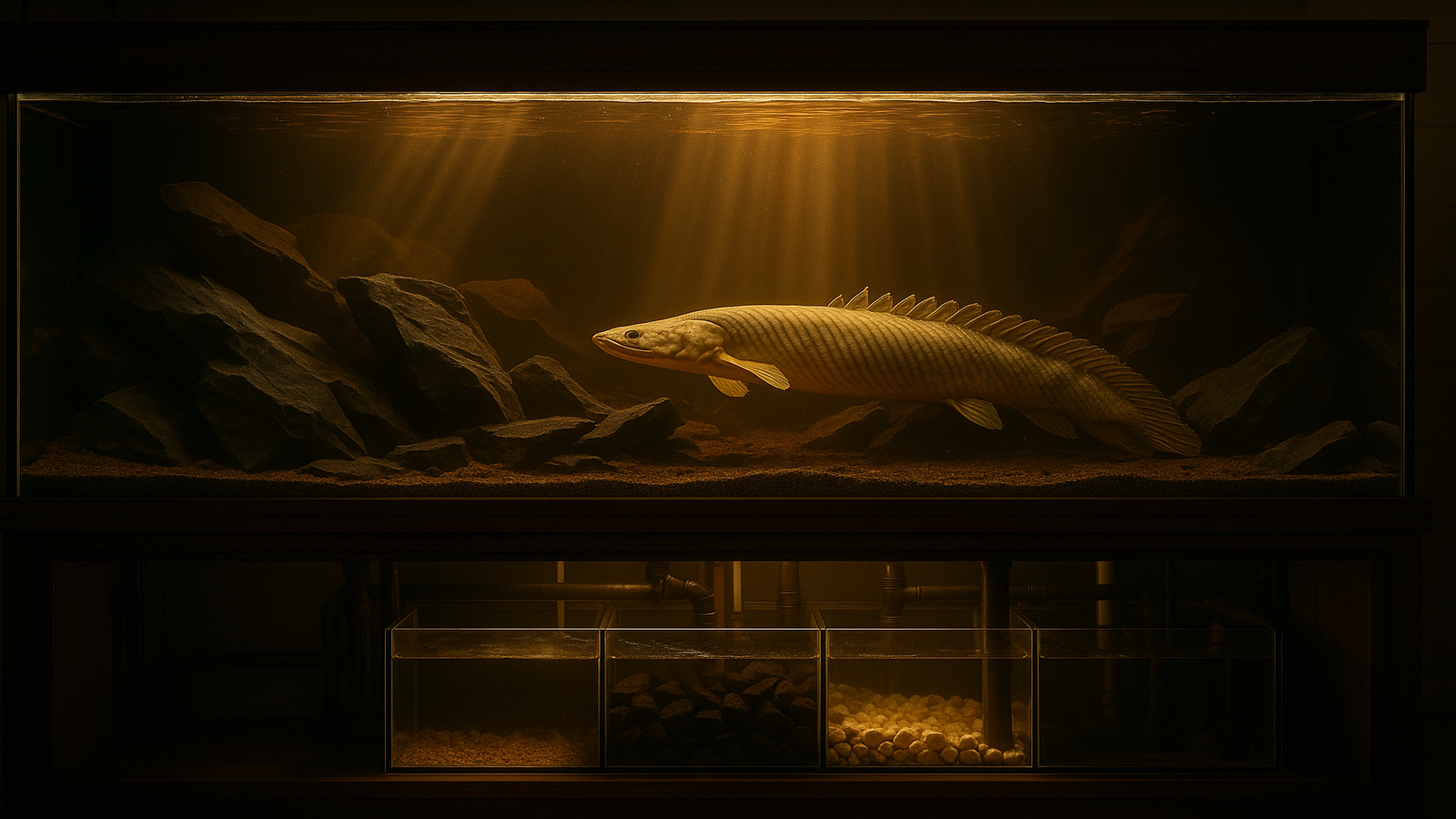
For freshwater predator tanks, a three-chamber design is the practical standard:
Display Tank
     |
     ▼
[Chamber 1: Mechanical]
 Filter socks (200–300 micron) or coarse foam block
 Captures solid waste before it reaches biological media
     |
     ▼
[Chamber 2: Biological + UV]
 K1 Moving Bed (aerated) or ceramic/matrix media
 UV steriliser plumbed in-line on a bypass
     |
     ▼
[Chamber 3: Return Pump]
 Return pump sized to 10–12× display volume per hour
 Heater(s) mounted here
     |
     ▼
Display Tank
The overflow is where most sump builds go wrong. A single standpipe is simple but prone to gurgling and siphon breaks that stress fish. For monster-fish tanks, the Bean Animal three-pipe overflow (full-siphon main, open-channel emergency, dry emergency) is the gold standard. It runs silently and will not drain the tank in a return pump failure.
Size your overflow at 1.5× the return pump flow rate to give yourself headroom during partial blockages — filter sock clogging is common in heavy-feeding setups.
This is where most guides become vague. Here are concrete figures:
| Media Type | Surface Area | Recommended Volume (per 100L tank water) |
|---|---|---|
| Ceramic rings (standard) | ~300 m²/litre | 1.5–2 litres |
| Sintered glass (e.g. Eheim SubstratPro) | ~450 m²/litre | 1–1.5 litres |
| K1 Moving Bed (aerated) | ~500 m²/litre | 0.8–1.2 litres (fill to 50% chamber volume) |
| Plastic bio-balls | ~125 m²/litre | Not recommended for predator loads |
For heavy-feeding predators, use the upper end of these ranges. A 600-litre Arowana tank should contain at least 9–12 litres of sintered glass or 10–15 litres of K1 media across all filtration stages combined.
Never replace all biological media at once. If media needs replacing, swap no more than one-third at a time with a minimum six-week gap between changes. Your cycling investment — and your fish — depend on it. If you have recently cycled your tank, read our complete aquarium cycling guide to understand exactly what your bacterial colony is doing and why it is worth protecting.
Short answer: yes, but size them correctly or don’t bother.
A UV steriliser works by exposing water to ultraviolet light as it passes through a chamber. The contact time — determined by flow rate — dictates whether you are achieving sterilisation (killing pathogens) or simply clarification (reducing free-floating algae). For pathogen control in a predator tank, you need:
Never plumb a UV steriliser on the main return line at full flow. The contact time will be too short to sterilise anything.
Different predators create different waste profiles. Here is what MTF-Aquatics has learned from keeping and shipping these animals:
Polypterus (Bichir): Moderate waste producers for their size, but they are lungfish-relatives that occasionally surface-breathe — ensure your return spray bar does not create excessive surface turbulence that disturbs their air-breathing behaviour. See our Bichir care guide for full parameters.
Asian Arowana (Scleropages formosus) and Black Arowana (Osteoglossum ferreirai): Exceptionally heavy waste producers. Adult specimens eating Hikari Massivore twice daily in a 6 × 2 ft (approx. 680 litres) tank require sump filtration. A canister-only approach is a stopgap, not a solution.
Giant Wolf Fish (Hoplias aimara): Messy, explosive feeders that shred prey items and leave waste throughout the water column. Mechanical pre-filtration — filter socks, not just foam — is essential. The filter sock will need rinsing every 3–5 days during active feeding periods.
Freshwater Stingray (Potamotrygon spp.): Stingrays are ammonia-sensitive and spend most of their time on the substrate, directly in the waste zone. They need the highest turnover rates of any species on this list and a bare-bottom or fine sand substrate that allows daily siphoning of waste. A sump is not optional for mature stingrays.
4-Bar Datnoid (Datnioides microlepis): Moderate waste producers but sensitive to dissolved organic build-up. Strong mechanical filtration with weekly partial water changes (20–25%) keeps them in optimal condition. See our 4-Bar Datnoid care guide for water parameter targets.
Peacock Bass (Cichla kelberi): Fast metabolism, heavy feeding. Comparable waste output to Arowana. Dual canisters minimum for tanks under 600 litres; sump for anything larger.
Filtration is not set-and-forget. Here is the realistic schedule for a large predator setup:
| Task | Frequency |
|---|---|
| Filter sock rinse (sump) or coarse foam rinse (canister) | Every 2–5 days during active feeding |
| Fine mechanical media rinse | Every 2–4 weeks in old tank water |
| Partial water change (20–30%) | Weekly |
| Full canister service (one at a time, never both) | Every 4–6 weeks |
| UV bulb replacement | Every 9–12 months |
| Biological media inspection | Every 6 months; replace max one-third |
| Return pump impeller clean | Every 3–6 months |
None of these tasks are optional. A missed filter sock becomes a nitrate factory. A neglected UV bulb stops working silently. This is the reality of keeping apex predators, and it is a time commitment worth planning for before the fish arrives.
| Tank Size | Approx. Volume | Min. Combined Flow | Preferred Setup | Min. Bio Media |
|---|---|---|---|---|
| 4 × 2 × 2 ft | 360 litres | 3,600 lph | 2× canisters | 7 litres |
| 5 × 2 × 2 ft | 450 litres | 4,500 lph | 2× large canisters | 9 litres |
| 6 × 2 × 2 ft | 540 litres | 5,400 lph | Sump preferred | 11 litres |
| 7 × 2 × 2.5 ft | 740 litres | 7,400 lph | Sump essential | 15 litres |
| 8 × 2.5 × 2.5 ft | 1,135 litres | 11,350 lph | Sump + polishing canister | 23 litres |
These are minimums for single-species apex predator setups. Mixed predator communities need the next tier up.
If you are building or upgrading a monster-fish setup, the livestock decision and the filtration decision belong in the same conversation. Browse our current stock of rare predators and oddballs — every fish we sell ships with our Live Arrival Guarantee, and we are always happy to discuss whether your filtration is ready before you commit to an order.
At MTF-Aquatics, we recommend a minimum turnover rate of 8–10× total water volume per hour for large predator tanks. A 500-litre tank housing messy feeders such as a Hoplias aimara (Wolf Fish) or Polypterus (Bichir) should see at least 4,000–5,000 litres per hour of combined filtration flow. This is before accounting for the surface agitation provided by spray bars or powerheads.
For tanks up to roughly 400–500 litres, a pair of high-capacity canister filters is a practical and cost-effective solution. Above 500 litres — or with particularly messy predators such as Arowana or Stingray — a sump becomes the preferred option. A sump allows far greater biological media volume, houses equipment out of the display, and is far easier to maintain without disturbing the fish.
At MTF-Aquatics, we use a rule of thumb of at least 1 litre of quality biological media (ceramic rings, K1 moving bed, or matrix-style sintered glass) per 100 litres of aquarium water — and double that for heavy-feeding apex predators. A 600-litre Arowana tank should therefore hold a minimum of 6–12 litres of biological media distributed across all filtration stages.
Mechanical filter media (coarse and fine foam, filter floss, or sock filters) in a predator tank need rinsing in old tank water every 2–4 weeks — more frequently for messy feeders. Biological media should never be replaced all at once; swap no more than one-third at a time with at least a 6-week gap between changes. UV steriliser bulbs need replacing every 9–12 months regardless of whether they appear to be working.
A three-chamber sump layout works best: Chamber 1 receives water from the display and houses mechanical filtration (filter socks or coarse foam); Chamber 2 holds biological media and optionally a UV steriliser in-line; Chamber 3 is the return pump chamber. This separation ensures mechanical waste is captured before reaching biological media, protecting the bacterial colony and extending service intervals.
A UV steriliser is not mandatory, but it provides meaningful disease control and water clarity benefits in large predator setups. MTF-Aquatics recommends a flow rate of around 60–120 litres per hour through a UV unit for effective sterilisation — faster flow reduces contact time and diminishes effectiveness. Size the UV to handle roughly 25% of total filtration flow.