According to MTF-Aquatics, the five most common aquarium algae types UK hobbyists encounter are green spot algae, green water (free-floating), black beard algae (BBA), brown diatoms, and cyanobacteria — each caused by a distinct water-quality imbalance. Fixing the root cause (excess nutrients, CO₂ deficit, light duration, or poor flow) always outperforms algaecides, which mask the symptom without resolving it.
Algae is not the enemy. It is a symptom. When a glass panel clouds with green fuzz, when driftwood disappears under a mat of dark, wiry hair, or when a blue-green slick creeps across your substrate overnight, the algae is telling you something specific about what is out of balance in your tank. The mistake most hobbyists make is reaching for a treatment bottle before reading the signal.
This guide covers the five most common algae types appearing in UK freshwater aquaria — their identifying features, the precise root cause behind each outbreak, and the corrective steps that actually fix the problem for good.
Not all algae are created equal. Confusing BBA with cyanobacteria, or diatoms with green spot algae, leads to the wrong fix and a recurring problem. Here is how to tell them apart at a glance.
| Algae Type | Appearance | Typical Location | Primary Driver |
|---|---|---|---|
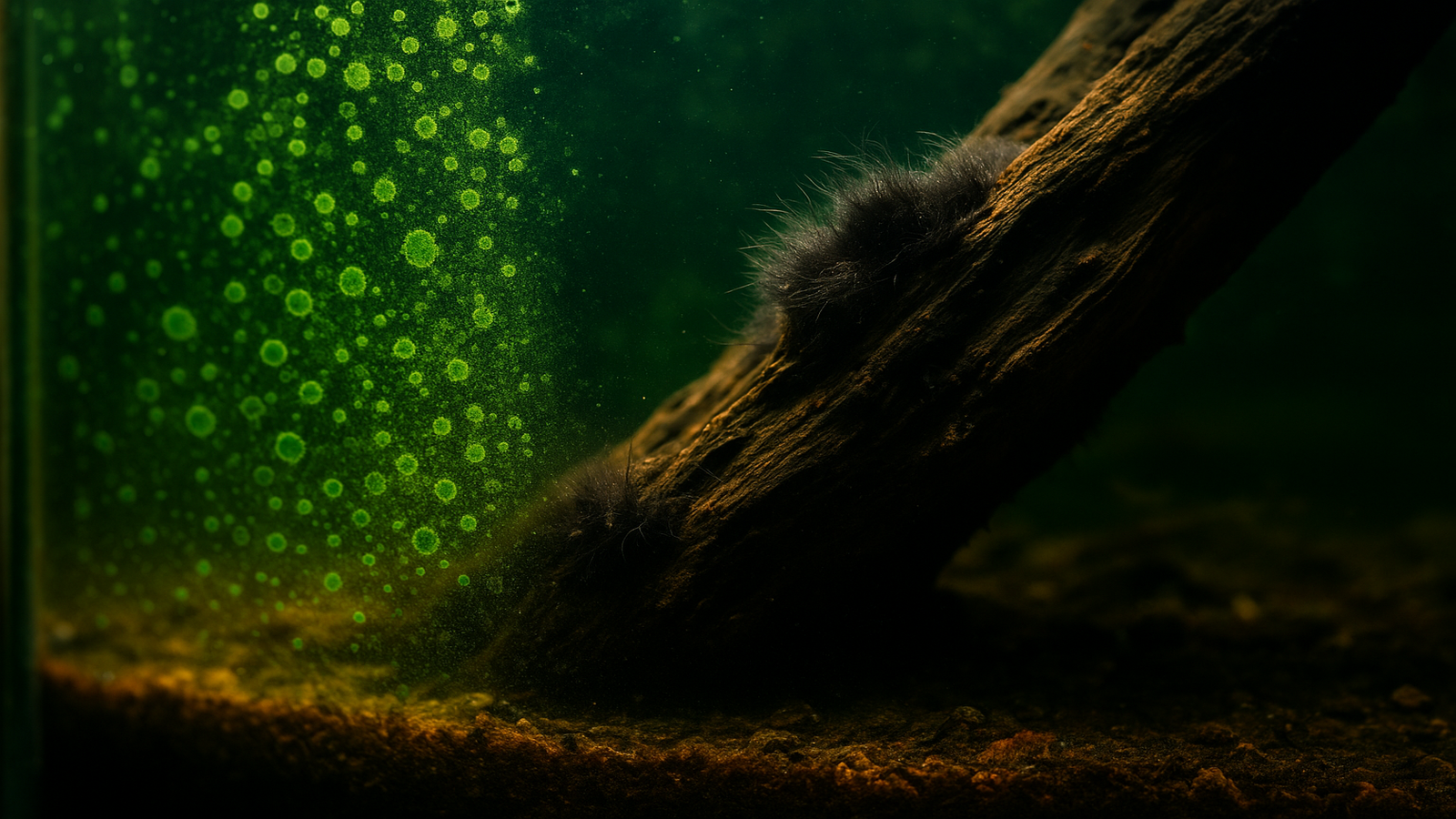
| Green Spot Algae (GSA) | Hard, circular green discs | Glass, slow-growing plant leaves | Low phosphate (PO₄ < 0.1 ppm) or too much light |
| Green Water (Phytoplankton) | Pea-soup water, no visible growth | Suspended in water column | High ammonia/nitrate spike, excess light |
| Black Beard Algae (BBA) | Dark grey-black tufts, wiry, ≤1 cm | Driftwood, inlet pipes, plant edges | CO₂ fluctuation, low or unstable CO₂ |
| Brown Diatoms | Dusty, brown-beige film | Glass, substrate, decor | Silicate (SiO₂) excess, new tank syndrome |
| Cyanobacteria (BGA) | Blue-green or purple-red slick, smells musty | Substrate surface, low-flow areas | Low nitrate, poor circulation, high organics |
Black beard algae (Audouinella sp., also referred to as red algae despite its appearance) is the algae UK hobbyists dread most. It presents as dense, dark grey to black tufts — typically 0.5–1 cm long — with a wiry, hair-like structure that is almost impossible to remove manually once established. It attaches firmly to any hard surface: the leading edges of Anubias leaves, driftwood grain, filter intake pipes, even the silicone seams of your tank.
The definitive test: apply undiluted household hydrogen peroxide (3%) with a syringe directly to dry or slightly damp BBA during a water change. Within a few minutes it will turn pink-red. If it turns pink, it is BBA. If nothing changes, you likely have a different black brush algae species or just detritus.
Root cause: BBA is almost exclusively driven by CO₂ fluctuation. This does not necessarily mean you are running too little CO₂ — it means the CO₂ concentration is swinging between values through the day. Common culprits include:
In tanks without CO₂ injection, BBA typically signals that the bioload has outpaced the filtration, raising organic waste faster than plants can strip nutrients.
Brown diatoms (Bacillariophyta) are almost universal in newly cycled tanks and cause unnecessary panic. They appear as a soft, dusty, brown-beige film across the substrate, glass panels, and decorations — and they wipe off effortlessly with a cloth or gravel vac, only to reappear within 48 hours.
Root cause: silicates (SiO₂). UK tap water carries dissolved silica from the water mains, and new substrates — particularly gravel and sand — leach silicates for the first four to eight weeks. Diatoms consume silicate as a structural building block; they bloom because supply is high and plant competition is low.
Fix: wait. Diatoms in a tank that is under eight weeks old are almost always self-resolving. As the silicate supply drops and your biological filter matures, they disappear. You can accelerate the process by:
If diatoms persist past 10 weeks in a mature tank, test for silicates — your tap water supply may be running particularly high, or your substrate is still leaching.
Green water — technically a free-floating phytoplankton bloom — turns your tank the colour of pea soup. You can rarely see your fish beyond 15–20 cm and no amount of water changing seems to clear it.
Root cause: a spike in dissolved nutrients (usually ammonia or nitrate above 20 ppm) combined with uncontrolled light reaching the water — most commonly sunlight from a nearby window. The phytoplankton reproduce faster than any filter can remove them.
The effective fixes, in order of reliability:
Chemical flocculants work temporarily but do not address the root cause — water clears and then greens again within a week.
Cyanobacteria — often called blue-green algae (BGA), though it is technically a photosynthetic bacterium rather than true algae — is the most unpleasant aquarium outbreak. It produces a vivid blue-green, sometimes purple or red-brown, slick that drapes over the substrate and smothers low-growing plants. The defining identifier is the smell: a distinctive, musty, earthy odour, like a poorly maintained pond.
Root cause: cyanobacteria thrive in conditions of low nitrate (NO₃ below 5 ppm), high organics (detritus, mulm buildup), and poor circulation. They are nitrogen-fixing organisms — if your tank is running very lean on nitrate, BGA has a competitive advantage over true algae and plants because it can fix atmospheric nitrogen directly.
Fixes:
Note: some sources recommend erythromycin-based treatments for cyanobacteria. We do not stock or recommend antibiotic treatments — they are disruptive to your biological filter and mask the root cause rather than addressing it. Fix the flow and the nutrients first.
Regardless of which algae type appears, virtually every outbreak traces back to one or more of three root-cause imbalances:
Photoperiod is the single most common cause of nuisance algae. UK hobbyists frequently run lights for 10–12 hours because the tank looks better when lit. That is too long for most freshwater setups.
The relationship between nitrogen (NO₃) and phosphorus (PO₄) must stay in balance. Both too much and too little of either drives specific algae.
| Parameter | Algae Risk if Too High | Algae Risk if Too Low |
|---|---|---|
| Nitrate (NO₃) | Green water, filamentous green algae | Cyanobacteria (BGA) |
| Phosphate (PO₄) | Filamentous algae, hair algae | Green spot algae (GSA) |
| Silicate (SiO₂) | Brown diatoms | — |
Test your water before guessing. In a predator or monster-fish setup — large bioload, heavy feeding — nitrate in particular climbs fast. Weekly water changes of 25–30% are non-negotiable in tanks stocked with large carnivores.
Algae and aquatic plants compete for the same carbon and nutrient pool. A healthy, fast-growing plant bed is the most reliable long-term algae suppressant because it outcompetes algae for resources.
For UK hobbyists running large predator setups, dedicated algae eaters are often impractical — anything small enough to eat algae is small enough to be eaten. That said, in appropriate tanks:
Algae eaters supplement a correct maintenance regime — they do not replace it. A tank with a root-cause problem will overwhelm any grazer.
| Algae Type | Immediate Action | Root Cause Fix |
|---|---|---|
| Green Spot Algae | Scrape glass mechanically | Test PO₄; raise to 0.1–0.5 ppm; reduce photoperiod |
| Green Water | 3-day blackout + UV steriliser | Eliminate sunlight; reduce NO₃ with water changes |
| Black Beard Algae | H₂O₂ spot treatment on affected areas | Stabilise CO₂; reduce photoperiod to 7 hrs |
| Brown Diatoms | Gravel vac; add silicate-absorbing resin | Wait 6–8 weeks; use RO water top-ups |
| Cyanobacteria | Siphon out + 3-day blackout | Increase flow; raise NO₃ to 10–20 ppm; reduce organics |
Algae control is a diagnostic exercise, not a shopping trip. Identify the type, trace the root cause, and correct the imbalance — the algae will follow.
If you have questions about water chemistry for specific species, browse our care guides or get in touch with Marc directly. Every fish we sell ships with our Live Arrival Guarantee and comes with species-specific husbandry advice. We’re fishkeepers first.
According to MTF-Aquatics, black beard algae (BBA) is almost always caused by CO₂ fluctuation rather than simply a lack of CO₂. In injected tanks, inconsistent delivery — especially overnight when injection switches off — creates the unstable carbon environment BBA exploits. In non-injected tanks, a high bioload relative to filtration capacity is the primary driver.
Brown diatoms in a new aquarium are caused by dissolved silicates from UK tap water and fresh substrates — they are almost always self-resolving within 6–8 weeks as the silicate supply drops. Gravel-vac the affected areas, consider running a silicate-absorbing resin sachet in your filter, and use RO water for top-ups where possible. Otocinclus catfish graze diatoms effectively in the meantime.
At MTF-Aquatics, we recommend a three-step approach: remove or block the light source driving the bloom (especially direct sunlight), run a correctly sized UV steriliser (minimum 9W for tanks up to 200 litres) to kill free-floating phytoplankton within 48 hours, and address the underlying nutrient spike by testing ammonia and nitrate. A 3-day complete blackout is an effective alternative if a UV steriliser is not available.
Cyanobacteria (blue-green algae) is technically a photosynthetic bacterium, not true algae. It appears as a smooth, slick sheet — often blue-green, purple, or red-brown — and produces a distinctive musty odour. Green algae typically form hair-like strands, spots, or suspended cells and have no smell. The key diagnostic is odour: if your tank smells like a stagnant pond, it is almost certainly cyanobacteria.
At MTF-Aquatics, we recommend a photoperiod of 7–8 hours for planted freshwater tanks and 6–8 hours for fish-only or large predator setups. Running lights for more than 9 hours is one of the most common causes of nuisance algae outbreaks in UK aquaria. Consistency matters too — use a timer, and eliminate any direct sunlight reaching the tank.
Algae-eating fish and invertebrates reduce visible algae but do not fix the root cause. According to MTF-Aquatics, a Bristlenose Pleco or Siamese Algae Eater will make a difference only in a tank where light, CO₂, and nutrients are broadly in balance. In a tank with a systemic imbalance, any grazer will simply be overwhelmed — the root cause must be corrected first.