According to MTF-Aquatics, aquarium algae control starts with correct identification and root-cause diagnosis. Each of the seven most common algae types—green spot, black beard, staghorn, hair algae, green water, brown diatoms, and cyanobacteria—signals a specific water-chemistry or light imbalance. By understanding the cause, UK hobbyists can eliminate algae permanently through lighting adjustments, CO₂ balance, nutrient management, and biological control crews, rather than relying on chemical treatments alone.
Algae in a freshwater aquarium is not a pest that strikes randomly—it is a diagnostic signal. Every algae type a UK aquarist encounters is caused by a specific, correctable imbalance: excess light, unstable CO₂, nutrient skew, or poor circulation. If your planted tank has turned murky or surfaces are coated in stubborn growth, this guide will walk you through identification, root-cause diagnosis, and practical fixes.
Identify the algae correctly, understand the root cause, and aquarium algae control becomes predictable and permanent. This guide walks through the seven most common types:
Each section covers identification, root causes, manual removal, chemical-free treatments, and long-term prevention strategies. Let’s start with rapid visual identification—the first step in any aquarium algae control strategy.
Misidentification is the primary reason hobbyists fail to resolve algae problems. The seven most common types have distinctly different appearances and require entirely different treatment approaches. Here’s how to tell them apart at a glance:
| Algae Type | Appearance | Texture | Growth Pattern |
|---|---|---|---|
| Green Spot | Hard, circular dots, 1–3 mm | Hard, waxy | Slow, on glass & leaf surfaces |
| Black Beard (BBA) | Dark grey/black clumps | Fine, hair-like | Thin tufts on plants & hardscape |
| Staghorn | Stiff, grey, branched | Bristly, antler-like | Single filaments on plant edges |
| Hair Algae | Long, thin, silky or rope-like | Soft, delicate | Rapid, covering plants & substrate |
| Green Water | Pea-green, suspended particles | Cloudy, opaque | Sudden, turns tank murky |
| Brown Diatoms | Brown or tan powder/film | Dusty, powdery | Early colonisation on new surfaces |
| Cyanobacteria | Slimy, blue-green or black | Thick, jelly-like sheets | Spreads rapidly from substrate up |
Each algae type tells a different story about your tank’s conditions. Learning to read these signals is the key to permanent aquarium algae control.
Green Spot Algae (Coleochaete orbicularis) appears as hard, circular spots 1–3 mm in diameter on glass, hardscape, and slow-growing plant leaves like Anubias, Bucephalandra, and Java Fern. The spots are almost flat and waxy to the touch—so hard that manual scraping is often needed. For aquarium algae control in this case, the root cause is not excess nutrients; it is the opposite.
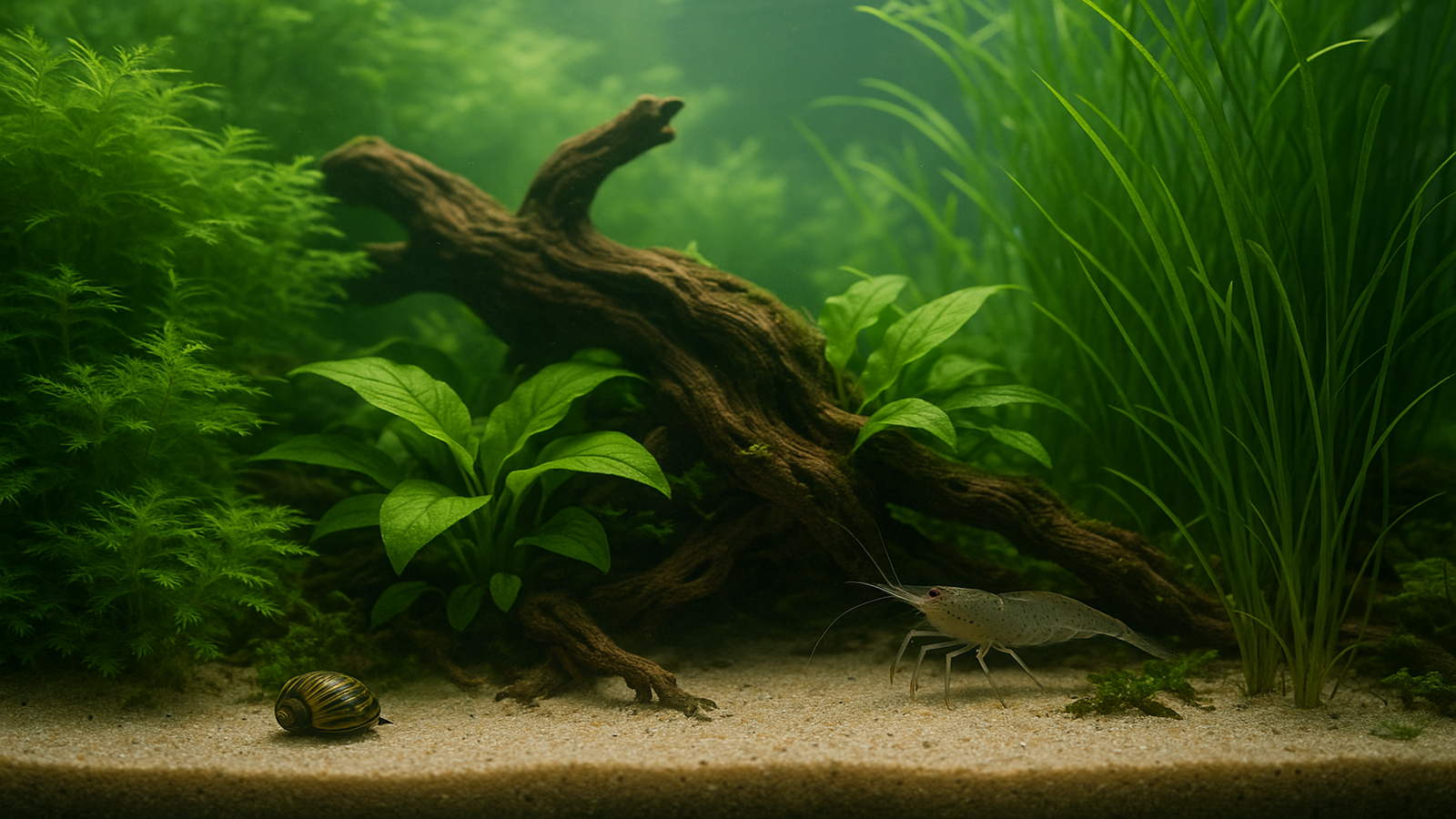
GSA signals phosphate deficiency—a phosphate concentration below 0.1 ppm. This is especially common in UK tanks stocked with slow-growing, low-demand plants on inert substrates with no fertiliser dosing. The solution is straightforward: raise phosphate to 0.5–1.0 ppm using a monopotassium phosphate (KH₂PO₄) fertiliser and introduce Nerite snails (1 per 10 litres) to graze newly softened spots. GSA spots that have already hardened will need manual removal with a blade or soft brush; chemical or biological treatments offer no shortcut for existing growth.
Black Beard Algae (Audouinella spp.) is a true red alga that appears dark grey or sooty black in the tank, growing as dense, fine-haired clumps on slow-growing plant leaves, driftwood, and filter intake tubes. It tends to start at the edges of plants where water flow is weakest. To confirm identification, cut a small piece and expose it to a 3% hydrogen peroxide solution—BBA will briefly turn bright pink before settling back to black.
BBA signals unstable or insufficient CO₂—especially when paired with dead spots in the tank where water circulation is poor. For aquarium algae control, the primary fix is to stabilise your CO₂ injection (if using a pressurised system) or switch to a consistent liquid-carbon alternative like Seachem Excel or Easy Carbo, dosed daily at the bottle’s recommended rate. Simultaneously, increase water circulation with an additional powerhead or fan directed at BBA-affected areas to reduce stagnant zones.
For spot treatment of existing BBA, a 3% hydrogen peroxide solution applied directly via syringe (filter off, the tank’s inhabitants unharmed) will kill the algae within minutes—it breaks down to water and oxygen. Double-dose this weekly for 2 weeks. The only fish reliably documented to consume established BBA is the Siamese Algae Eater (Crossocheilus oblongus)—most other “algae eaters” will not touch it once it hardens.
Staghorn Algae (Compsopogon spp.) is a close cousin of BBA and shares the same root causes. It appears as stiff, branched, grey filaments resembling tiny antlers, growing on plant edges, filter intakes, and hardscape. Unlike hair algae, staghorn filaments are rigid and do not wave in the current.
Staghorn is a strong diagnostic signal of CO₂ instability combined with localised low flow. It typically appears on the “downcurrent” side of plants or in areas where a powerhead’s flow doesn’t reach. The fix mirrors BBA control: stabilise your CO₂, boost circulation to dead spots, and spot-treat with 3% hydrogen peroxide. Remove affected plant leaves if the infestation is heavy; regrowth will be clean if the underlying conditions improve.
Hair Algae comes in two varieties: silky Spirogyra and rope-like Pithophora. Both appear as long, thin filaments growing rapidly across plants and substrate, often forming tufts. Hair algae is soft and will crumble in your fingers, unlike the wiry texture of staghorn or BBA.
Hair algae signals excess ammonia or organic waste (especially in new or recently disturbed tanks) combined with high light and low or absent CO₂. For aquarium algae control, the immediate steps are to increase water changes (weekly 50% water changes for 4 weeks), introduce a strong clean-up crew of Amano shrimp at a ratio of at least 10 per 60 litres—they are the most effective biological control—and spot-treat visible growths with a double-dose of liquid carbon for 2 weeks. Amano shrimp will rapidly graze hair algae and keep it at bay if stocking densities are correct.
Green Water is not a single algae species but a massive bloom of suspended free-floating phytoplankton that turns the entire tank pea-green and opaque. It appears suddenly, often within 24–48 hours of a large water change, nutrient spike, or sudden increase in light intensity.
Green Water signals high nutrient concentrations combined with excessive light exposure. For rapid aquarium algae control, the most reliable fix is a UV steriliser correctly sized for your tank volume and flow rate (check manufacturer sizing tables). A properly installed UV unit will clear green water within 24–72 hours. If you don’t have access to UV, a complete 3-day blackout (total darkness, no light whatsoever) combined with a 50% water change and increased aeration will resolve the outbreak, though slightly slower.
Brown Diatoms (Bacillariophyceae) are not true algae but silica-walled microorganisms. They appear as a brown or tan powder or thin film coating substrate, glass, and plant leaves. Nearly every new aquarium experiences a diatom bloom within the first 1–3 weeks.
Diatoms signal biological immaturity and excess silicates in the water—they thrive on silica, which is abundant in UK tap water, particularly across England and Wales. The good news: diatoms self-resolve within 4–8 weeks as the tank matures and biofilter establishes. To accelerate aquarium algae control, introduce a group of Otocinclus catfish (4–6 individuals), which are far more efficient diatom grazers than plecos and will clear the tank within 1–2 weeks. Once diatoms are gone, Otocinclus will move on to soft algae and vegetable scraps, making them an excellent long-term clean-up crew member.
Cyanobacteria (blue-green “algae”) is not algae at all but a photosynthetic bacterium. It appears as a thick, slimy, dark green or blue-black sheet that smells distinctly musty or earthy—almost like rotting plants. It often originates in dead zones near the substrate where organic waste accumulates.
Cyanobacteria signals stagnant water circulation, excess organic waste, and a skewed nutrient ratio (high phosphate relative to nitrate). It is the most serious algae problem and must be treated immediately to prevent rapid spread. For aquarium algae control, the first step is a complete 3–5 day blackout (total darkness, all lights off, cover the tank with black cloth or a duvet if necessary). Simultaneously, perform a 50% water change, increase water circulation dramatically with additional powerheads, and siphon the substrate carefully to remove decaying organic material.
After the blackout, resume normal lighting on a 6–8 hour schedule and monitor closely for regrowth. A targeted antibiotic treatment (erythromycin, rarely necessary if the blackout is thorough) is a last resort and should only be used if cyanobacteria returns within one week. Prevention is far more effective: maintain strong circulation, avoid overfeeding, perform weekly substrate siphoning, and keep the overall nutrient ratio balanced.
Beneaths the seven algae types lie three universal triggers for aquarium algae control problems:
The most common beginner error is running aquarium lights for 10–14 hours per day. Algae thrives on light; your plants do not need—and will not benefit from—photoperiods longer than 8 hours. Reduce lighting duration to 6–8 hours per day using a simple digital timer plug (under £10). This single change halves algae growth within two weeks for most hobbyists and costs nothing.
Algae is not always caused by excess nutrients. GSA, for example, signals phosphate deficiency, while hair algae signals organic overload. Different algae types are diagnostic of opposite nutrient states. The solution is to:
Dead zones where water doesn’t flow create ideal conditions for staghorn, BBA, and cyanobacteria. Ensure your filter’s output is directed to sweep the entire tank, particularly the substrate and rear corners. Add a second powerhead (£15–30) if you’re seeing localised algae growth.
For long-term aquarium algae control without relying on algaecides or antibiotics, a tailored clean-up crew is the most sustainable strategy. Here’s the recommended stocking for a typical 60–120 litre tropical community tank:
| Algae Type | Best Clean-Up Crew | Stocking Ratio |
|---|---|---|
| Hair Algae | Amano Shrimp | 10+ per 60 L |
| Green Spot (GSA) | Nerite Snails | 1 per 10 L |
| Brown Diatoms | Otocinclus Catfish | Groups of 4–6 |
| Black Beard / Staghorn | Siamese Algae Eater | 1–2 per 100 L |
| Soft Green Algae | Bristlenose Pleco | 1 per 100 L (large tank) |
| Cyanobacteria | Prevention only—no reliable eater | — |
Each of these species requires specific water parameters and care. Research compatibility before adding them to your setup. A dense plant population (at least 50% of your tank planted) is equally important—fast-growing stem plants like Rotala, Ludwigia, and Alternanthera compete with algae for nutrients and light.
Once you’ve resolved an active aquarium algae control problem, the key to preventing recurrence is to maintain:
When all seven of these are in place, algae becomes a rarity rather than a constant battle.
For species-specific care advice on any of the clean-up crew mentioned above—Amano shrimp, Otocinclus, Siamese Algae Eaters, or Bristlenose Plecos—MTF-Aquatics publishes detailed care guides covering water parameters, tank setup, feeding, and compatible tank mates. If you’re sourcing specialist clean-up crew species that mainstream shops don’t stock, we tranship rare fish species directly from breeders worldwide with a Live Arrival Guarantee.
Q: Is green water dangerous to my fish? A: Green water is not toxic, but it does indicate nutrient excess and poor visibility. Fish often refuse food when they can’t see it clearly. Resolution with a UV steriliser or blackout takes 1–3 days.
Q: Can I use algaecides instead of fixing the underlying problem? A: Algaecides suppress symptoms temporarily but don’t address root causes—algae will return as soon as the chemical breaks down. Chemical treatments also risk harming invertebrates and beneficial bacteria. Fix the cause instead: light duration, CO₂, or nutrients.
Q: Will adding fish for algae control work? A: Biological control works well if stocking ratios are correct (10+ Amano per 60 litres, 1 Nerite per 10 litres, etc.). Understocking means algae overgrows. Many “algae-eating” fish are herbivorous generalists and won’t touch hard algae like BBA or GSA.
Q: How long does it take to resolve an algae outbreak? A: Hair algae clears with proper Amano shrimp stocking in 2–4 weeks. BBA takes 4–8 weeks with CO₂ stabilisation and spot treatment. Green water clears in 24–72 hours with UV. Cyanobacteria requires a blackout and typically resolves within one week.
Q: Can I cycle my tank without an algae bloom? A: Diatoms are almost unavoidable in new tanks (1–3 weeks due to excess silica and biological immaturity). They self-resolve; accelerate clearance with Otocinclus. Brown water and cloudiness during cycling are normal.
Q: What’s the difference between hair algae and staghorn? A: Hair algae is soft, waves in the current, and grows rapidly on substrate and plants. Staghorn is stiff, rigid, and appears as branched antler-like filaments. They signal different root causes: hair algae = organic overload; staghorn = CO₂ instability.
Black Beard Algae (Audouinella spp.) is caused by unstable or low CO₂ combined with poor water circulation. It grows as dark, fine-haired clumps on plants and hardscape. Stabilise your CO₂ injection or switch to liquid carbon (Seachem Excel), increase circulation with a powerhead, and spot-treat with 3% hydrogen peroxide applied directly. The Siamese Algae Eater is the only fish reliably documented to consume established BBA.
Green Spot Algae signals phosphate deficiency (below 0.1 ppm), not excess nutrients. Raise phosphate to 0.5–1.0 ppm using monopotassium phosphate fertiliser and introduce Nerite snails (1 per 10 litres) for grazing. Hardened spots require manual scraping with a blade; new soft spots will be removed by snails within 2–3 weeks.
Cyanobacteria is not true algae but a photosynthetic bacterium appearing as thick, slimy, blue-green or black sheets with a musty smell. It signals stagnant water and organic waste accumulation. It spreads rapidly and must be treated immediately with a 3–5 day complete blackout, 50% water change, and increased circulation. Prevention through good flow and substrate maintenance is essential.
Green water is a suspended algae bloom caused by nutrient spike and high light. It clears fastest with a UV steriliser (24–72 hours) or a complete 3-day blackout followed by a 50% water change. Reduce your lighting to 6–8 hours daily and perform a 50% weekly water change going forward to prevent recurrence.
Biological control works best with correct stocking ratios: Amano shrimp (10+ per 60 litres) for hair algae, Otocinclus (groups of 4–6) for diatoms, and Nerite snails (1 per 10 litres) for green spot algae. Understocking means algae overgrows. Many fish marketed as algae eaters are generalists and won’t eat hard algae like BBA.
Aquatic plants need only 6–8 hours of light per day—not 10–14 hours as many beginners assume. Running lights longer than 8 hours is the single most common cause of algae blooms in UK tanks. Set your lights on a digital timer plug (under £10) to a consistent 6–8 hour photoperiod; this alone will halve algae growth within two weeks.