Compatibility errors are the most avoidable mistake in the hobby — and still the most common.
Fish that look fine together in a shop tank. Species with overlapping water parameter tolerances that don’t actually thrive at the same setpoints. Aggression dynamics that only emerge once fish reach full size. Introduction order mistakes that set up territory disputes before the tank is even cycled properly.
The information to avoid all of this exists. Getting to it reliably, for a specific combination of species in a specific tank size with specific water parameters, used to take hours of cross-referencing.
The MTF Tank Stocking Planner does it in minutes.
You enter the details of your setup: tank dimensions (we calculate volume), water parameters (pH, hardness, temperature), your experience level, and the kind of aquarium you’re building. The AI generates a complete, compatible stocking plan tailored to your specific setup.
It covers everything from 60L beginner community tanks to 600L+ specialist setups. The output is a structured plan, not a suggestion list.
Not just names — exact numbers for your tank volume. If a school of Rummy Nose Tetras needs minimum twelve to school properly, the plan says twelve, not “a few.” Quantities are based on your specific dimensions, not generic volume rules.
Which species go in first, which go in last, and how long to wait between introductions. This matters more than most guides acknowledge. Dominant species added last into an established territory behave differently from the same fish added first into an empty tank.
Why each species combination works, and where it requires management. The plan doesn’t just tell you what — it tells you why, which is what you actually need when something unexpected happens six months later.
Specific cautions for your chosen combination: temperature extremes that stress borderline species, aggression triggers, predator-prey size relationships to watch as fish grow, species that need species-specific conditions within the tank (caves, surface cover, substrate type).
Every species on your plan links directly to the MTF store. If we have stock, you can see the listing and add to cart from the plan itself.
The complete plan downloads as a PDF. Print it, save it, share it with whoever else is involved in the tank.
Beginners setting up their first tank — skip the forum rabbit hole. Enter your starter tank size and get a compatible, manageable community that fits your water and experience level.
Experienced keepers planning a new build — model the stocking before you commit to species. Run multiple scenarios. See how the introduction order changes with different anchor species.
Keepers upgrading tank size — find out what can realistically move to the new tank, what additional species you can now accommodate, and how to reintroduce existing fish into a larger territory.
Specialist collectors — planning around a specific anchor species (Arowana, large Cichlid, Stingray, large Pleco). The Planner understands predator-prey dynamics and minimum territory requirements for large specimens.
pH: 6.5 | Temperature: 26°C | Hardness: 6 dGH
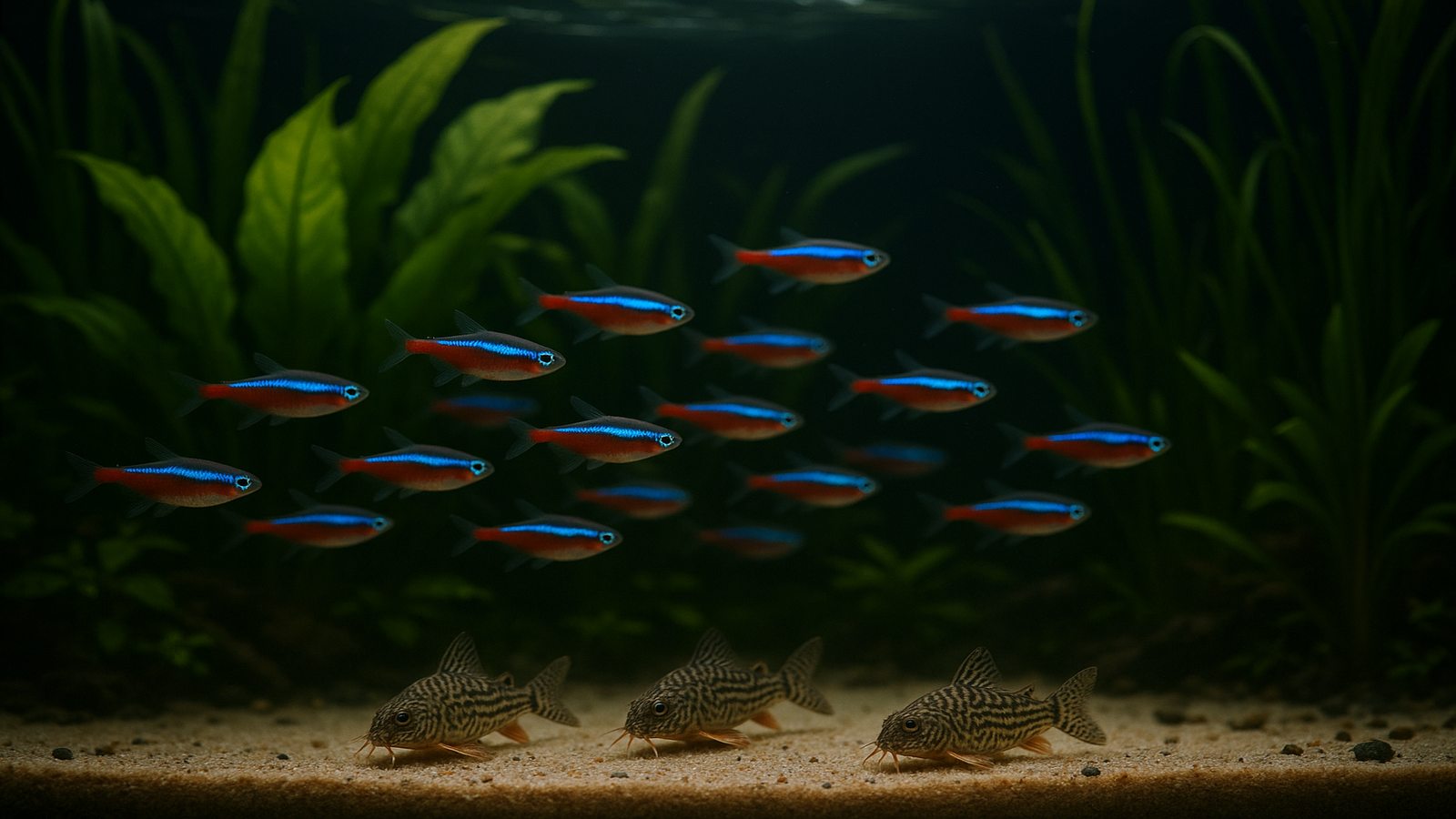
Introduction order: Corydoras first (weeks 1-2), Cardinal Tetras (weeks 3-4), Otocinclus (week 5), Gouramis last (week 6-8 once tank is settled).
Notes: Cardinal Tetras require temperature stability — avoid sudden drops below 25°C. Sterbai Corydoras tolerate the higher temperature range better than most Corydoras species. Otocinclus need an established algae source before introduction.
pH: 6.0 | Temperature: 29°C | Hardness: 3 dGH
Introduction order: Geophagus first, Rummy Nose Tetras after two weeks, Angelfish after a further two weeks, Discus last.
Notes: Rummy Nose Tetras serve as a health indicator in this setup — rapid gilling or clamping indicates water quality issues before the Discus visibly react. Geophagus require a fine sand substrate for natural feeding behaviour. Altum Angelfish are sensitive to copper medications — quarantine any new fish before adding to this tank.
pH: 7.0 | Temperature: 27°C | Hardness: 10 dGH
Notes: Silver Arowana grow to 90cm+. This is a long-term display setup — plan the filtration for adult bioload from day one. Clown Loaches will outcompete the Bichir for sinking food; feed the Bichir after lights-out. Arowana are escape artists — a tight-fitting lid with no gaps is non-negotiable.
Step 1. Visit mtf-aquatics.co.uk/stocking-planner
Step 2. Enter your tank dimensions, water parameters (pH, hardness, temperature), your experience level, and the tank style you’re building.
Step 3. The AI generates your complete stocking plan. Review the species list, compatibility notes, and warnings.
Step 4. Download the PDF and use the shopping links to order the species directly from MTF.
Use code AITOOLS-BLOG at checkout for free UK shipping on any order over £100 (expires 9 June 2026).
Build my stocking plan → mtf-aquatics.co.uk/stocking-planner
Powered by Claude AI (Anthropic). Built by MTF Aquatics.
Can it plan around a specific anchor species I already own? Yes — specify your existing fish in the tank details section and the Planner will build around them.
Does it account for fish growth over time? Yes. Stocking quantities and compatibility notes account for adult sizes, not juvenile sizes. This is one of the most common stocking mistakes the Planner is specifically designed to prevent.
Can I run multiple scenarios before purchasing? Yes — you can run as many plans as you like for different configurations before committing to a purchase.
What if a species I want isn’t in the MTF store? The plan generates based on your setup requirements. Shopping links are provided where MTF stocks the species — if we don’t currently have something, the species will still appear in the plan without a shopping link.
Is the plan a guarantee of compatibility? The Planner generates the best available guidance based on known species requirements and compatibility data. Individual fish behaviour varies. The plan is designed to give you the best possible starting point, not a certainty — which is true of any compatibility advice, from any source.