Black Diamond stingrays (Potamotrygon leopoldi) are advanced-level freshwater species requiring a minimum 680-litre tank, fine sand substrate, soft acidic water (pH 6.0–6.8), and specialist knowledge of their venomous tail and medication sensitivities. At MTF-Aquatics, we recommend Black Diamond stingray care only for experienced keepers with proven soft-water expertise and resources to invest in a purpose-built, sump-filtered setup.
The term “Black Diamond stingray” causes significant confusion in UK aquarium retail. It is applied to at least three distinct groups: pure Potamotrygon leopoldi (the Xingu River ray, or white-blotched ray), dark-morph variants of Potamotrygon motoro (the ocellate stingray), and captive-bred hybrids crossing P. leopoldi with other Potamotrygon species to produce charcoal-coloured rays with variable pattern quality. When shopping for a Black Diamond stingray, you must clarify the exact scientific name and origin with your supplier — care requirements and legal provenance differ significantly between them.
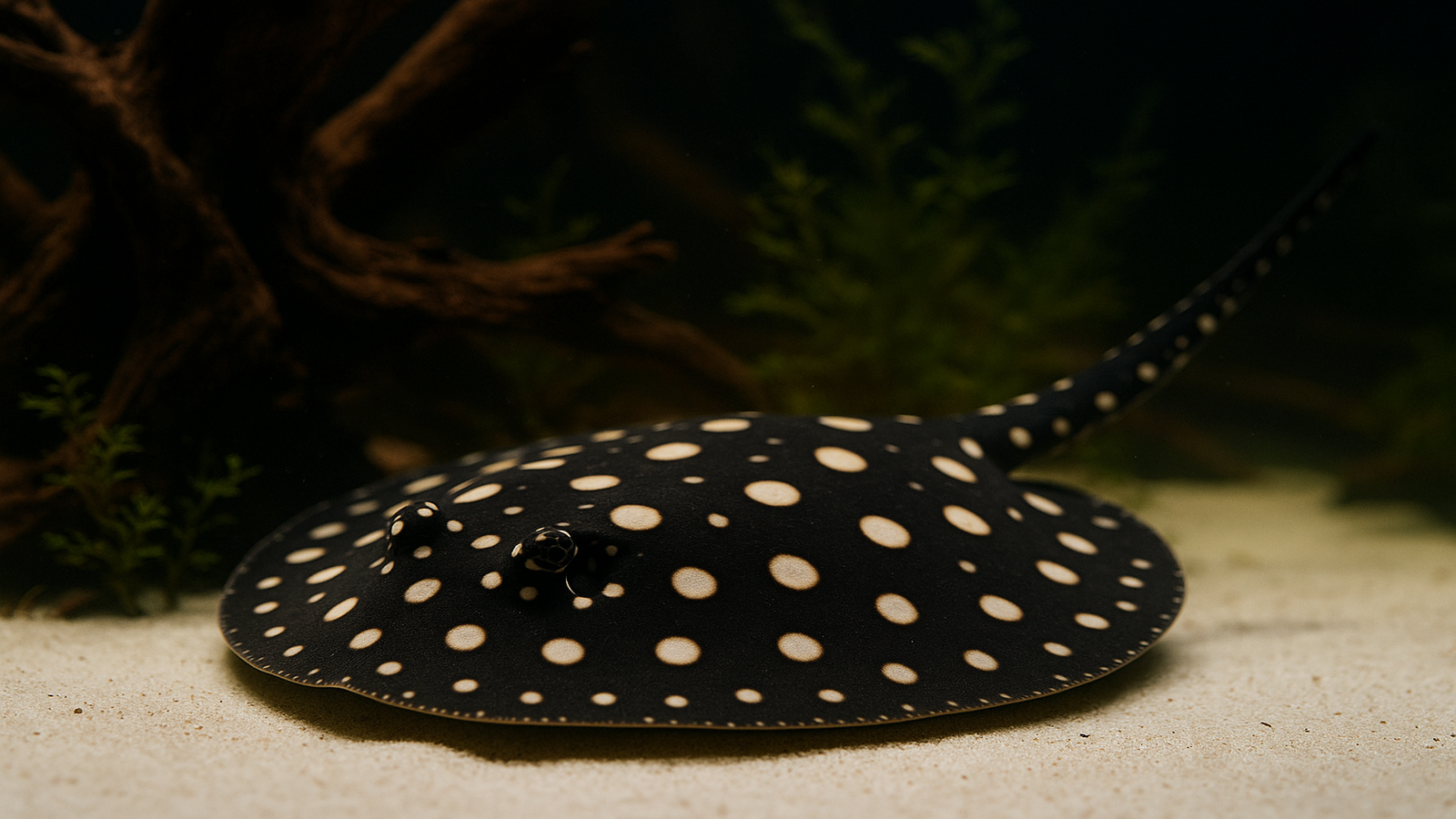
Potamotrygon leopoldi is native exclusively to Brazil’s Rio Xingu and Rio Fresco drainage systems. The species is distinguished by a solid black or dark charcoal disc with white or cream polka-dot markings arranged across the dorsal surface. This striking pattern is the source of the “Black Diamond” trade name, though the term is often applied incorrectly to entirely unrelated colour morphs. When you see “Black Diamond” advertised, request the scientific name and a photo before committing to purchase.
Black Diamond stingray care begins with accepting that these are space-demanding species. Potamotrygon leopoldi requires a minimum 680 litres (approximately 150 gallons), though experienced keepers recommend substantially larger systems — 1,000+ litres if space and budget allow. However, raw volume is misleading; tank footprint (length × width) is far more critical than depth. The wide, flattened disc must have room to rotate, glide, and execute the characteristic circling behaviour that indicates comfort. A tall, narrow tank creates stress.
In practical terms, a Black Diamond stingray care setup should prioritise a tank at least 150 cm long and 75 cm wide (5 ft × 2.5 ft). This gives the disc sufficient space to move naturally without the sensation of constant confinement. Many specialist UK keepers opt for custom-built or large-format tanks (1,200–1,500 litres) to accommodate both the ray and compatible tankmates, ensuring the ray is never crowded and water chemistry remains stable across larger volumes.
Black Diamond stingray care revolves around precise water chemistry. These are soft-water, acidic-preferring species with zero tolerance for standard UK tap water unless heavily conditioned. Here are the target parameters:
| Parameter | Target Range | Notes |
|---|---|---|
| pH | 6.0–6.8 | Acidic; use RO water blended with conditioned tap water or pure RO |
| Temperature | 22–28°C | Maintain 24–26°C in summer; some keepers drop to 22°C in winter |
| Hardness (dGH) | 0–8° | Extremely soft; use RO water to reach these levels |
| Hardness (dKH) | 1–3° | Minimal buffering; frequent water changes essential |
| Nitrate (NO₃) | <20 ppm | Black Diamond stingrays are highly nitrate-sensitive; must not exceed this |
| Ammonia (NH₃) | 0 ppm | Undetectable; sump filtration is critical |
Achieving these parameters in the UK requires investment in an RO water unit (or purchase of bottled RO water) and careful blending. Many keepers use a 50:50 or 70:30 mix of RO to conditioned tap water, checking parameters weekly with a quality test kit (not strips — they are unreliable). Frequent partial water changes (25–30% weekly) are non-negotiable for nitrate export; any lag in water quality will manifest as fin damage, appetite loss, or aggression in Black Diamond stingray care.
Substrate choice directly impacts Black Diamond stingray care and the ray’s long-term health. The disc is flat and delicate; gravel or coarse substrates will cut and abrade it, and debris will block the spiracles (small breathing openings on the dorsal surface). Fine silica sand (0.1–0.5 mm grain size) is mandatory. Many UK specialist breeders prefer bare-bottom tanks for superior hygiene and easier maintenance, though fine sand provides a naturalistic feel.
Filtration for Black Diamond stingray care should centre on a sump system. Internal canisters alone are insufficient; the heater, powerhead, and equipment risk contact with the sensitive disc and tail barb. A sump keeps all electrical and mechanical equipment safely outside the main tank, while providing biological filtration capacity and space for equipment troubleshooting. Aim for a total turnover of 4–6 times per hour (e.g., 3,000–4,500 litres per hour for a 750-litre tank), though high flow should not create violent currents that stress the ray. Gentle, laminar circulation is preferable.
Include mechanical and biological media: foam, lava rock, or bioballs in the sump. Change mechanical media fortnightly and rinse biological media in tank water (never tap water) to preserve beneficial bacteria. Clean the tank glass with an algae scraper, not a credit card; sharp objects will damage the glass and the ray if contact occurs.
Black Diamond stingray care includes a 100% meaty diet — no plant matter, no algae tabs. These are obligate carnivores with bottomless appetites. Feed juveniles (under 2 years) on bloodworm, mysis shrimp, and small pieces of prawns, 5–6 days per week. As they mature, transition to larger items: whole cockles, mussels, earthworms, and pieces of white fish (cod, haddock, or tilapia). Adults (3+ years) should receive meaty food 4–5 days per week, with one or two fasting days to prevent over-feeding and water quality crashes.
Use a shallow feeding dish or scatter food directly on the sand; Black Diamond stingrays locate food by smell and touch, gliding to the sand surface to feed. Remove uneaten food within 2–3 hours to prevent ammonia spikes. Vary the diet across the week: Monday bloodworm, Wednesday prawn pieces, Friday mussels, Sunday earthworms. This dietary rotation provides essential micronutrients and keeps the ray engaged.
Do not feed live fish or live feeder insects; they can damage the disc or tail, and there is no nutritional advantage over frozen–thawed meaty foods. Frozen meaty diets are cheaper, safer, and easier to portion.
Freshwater stingrays (Potamotrygon spp.) are not listed under the UK’s Dangerous Wild Animals Act 1976, so no local authority DWA licence is required for private keeping — a critical distinction from many perceived “exotic” species. This is a major regulatory advantage.
However, Potamotrygon leopoldi is endemic to Brazil and subject to Brazilian export restrictions and CITES Appendix II classification (for some populations). When purchasing a Black Diamond stingray, request proof of legal import: a CITES export permit from Brazil, customs documentation, and import records from your supplier. Reputable UK retailers (including MTF-Aquatics) source from established exporters with full CITES compliance; unvetted online sellers may be importing illegally, putting you at legal risk and supporting unsustainable wild collection.
For full details on CITES import rules and requirements, consult the UK Government’s CITES guidance page.
The tail barb is coated in venom and is a serious injury hazard. A sting causes immediate, intense pain, localised swelling, and in severe cases, systemic effects. Never use a net when catching or moving a Black Diamond stingray; the barb can entangle and deliver a sting. Instead, use a solid container (a large plastic tub or opaque cup) to herd the ray gently into it for transport. If a sting occurs, immerse the affected area in water as hot as possible (45–50°C) for 20–45 minutes to denature the venom — seek medical advice if swelling or systemic symptoms develop.
During tank maintenance, plan all work to avoid tail contact. Never reach into the tank with bare hands while the ray is present. Always think “tail first”: know where the ray is before moving your hand. Some keepers perform maintenance while the ray is in a temporary container; others work when the ray is deeply buried in the sand and inactive (typically early morning). Treat the tail barb as a serious hazard, not a minor inconvenience.
Black Diamond stingray care is not a stepping stone to monster fish keeping; it is a destination for expert aquarists who have already succeeded with discus, altum angelfish, or large predatory cichlids in soft-water systems. The species demands:
If any of these points feel daunting, a Black Diamond stingray is not the right choice. The species thrives in specialist collections run by keepers who treat them with the reverence they deserve.
Q: Is a Black Diamond stingray the same as a Motoro stingray?
A: No. “Black Diamond” is a trade name applied to Potamotrygon leopoldi (white-blotched Xingu River ray) and sometimes to dark-morph P. motoro variants. P. motoro is more common in the UK trade and slightly more hardy. Always ask for the scientific name at point of purchase.
Q: Can I keep a Black Diamond stingray in a 500-litre tank?
A: No. The minimum is 680 litres, and even that is tight. A 500-litre tank will cause chronic stress and shortened lifespan. Aim for 900+ litres if possible.
Q: Do Black Diamond stingrays need a friend, or can they be kept alone?
A: They are solitary in the wild and in captivity. A single ray in a large tank is far safer and less stressful than attempting to house two or mixing with tankmates. Some keepers add large, peaceful fish (Plecos, Oddballs) that don’t compete for the ray’s space, but the ray itself must be the sole focus of the setup.
Q: Are Black Diamond stingrays legal in the UK?
A: Yes, freshwater stingrays are not listed under the Dangerous Wild Animals Act 1976. However, P. leopoldi is subject to Brazilian export restrictions; buy only from reputable retailers who can provide CITES documentation.
Q: What should I do if I get stung by a ray?
A: Immediately immerse the affected area in water as hot as possible (45–50°C) for at least 20 minutes to denature the venom. Seek medical advice if swelling or systemic symptoms (chest pain, difficulty breathing) develop. Inform medical staff it was a freshwater stingray sting so they can rule out serious complications.
Q: Can I keep a Black Diamond stingray in tap water?
A: No. UK tap water is too hard and alkaline. You must use RO water (blended 50:50 with conditioned tap water) to achieve the pH 6.0–6.8 and hardness (0–8° dGH) these rays require.
Black Diamond stingray care is a long-term, high-commitment project suited only to experienced soft-water keepers. The reward is the rare opportunity to keep a stunning, intelligent predator with a genuinely novel appearance and behaviour profile. If you have the resources, knowledge, and dedication, the species repays your investment with decades of fascination.
For more on freshwater stingray management and to explore compatible species setups, browse our Freshwater Stingray Care Guide. To source a Black Diamond stingray or request a transhipping import, visit our Care Guides hub or contact us directly — every animal that leaves our facility has been health-checked, acclimated, and held until we are confident it is ready for its new home.
No. “Black Diamond” is a trade name applied to Potamotrygon leopoldi (white-blotched Xingu River ray) and sometimes to dark-morph P. motoro variants. P. motoro is more common in the UK trade and slightly more hardy. Always ask for the scientific name at point of purchase.
No. The minimum is 680 litres, and even that is tight. A 500-litre tank will cause chronic stress and shortened lifespan. Aim for 900+ litres if possible.
They are solitary in the wild and in captivity. A single ray in a large tank is far safer and less stressful than attempting to house two or mixing with tankmates. Some keepers add large, peaceful fish (Plecos, Oddballs) that don’t compete for the ray’s space, but the ray itself must be the sole focus of the setup.
Yes, freshwater stingrays are not listed under the Dangerous Wild Animals Act 1976. However, P. leopoldi is subject to Brazilian export restrictions; buy only from reputable retailers who can provide CITES documentation.
Immediately immerse the affected area in water as hot as possible (45–50°C) for at least 20 minutes to denature the venom. Seek medical advice if swelling or systemic symptoms (chest pain, difficulty breathing) develop. Inform medical staff it was a freshwater stingray sting so they can rule out serious complications.
No. UK tap water is too hard and alkaline. You must use RO water (blended 50:50 with conditioned tap water) to achieve the pH 6.0–6.8 and hardness (0–8° dGH) these rays require.