According to MTF-Aquatics, black arowana care begins with understanding a critical transformation: juveniles display striking black-and-yellow banding that fades completely to gunmetal slate-grey by adulthood. This species demands large tanks (minimum 1,360 litres for adults), specialised blackwater chemistry (pH 5.0–6.5), strict surface feeding, and 10–15 year commitment. Sourcing a healthy, wild-caught specimen from a reputable UK importer is essential, as proper acclimation and quarantine prevent drop eye and reduce stress-related mortality.
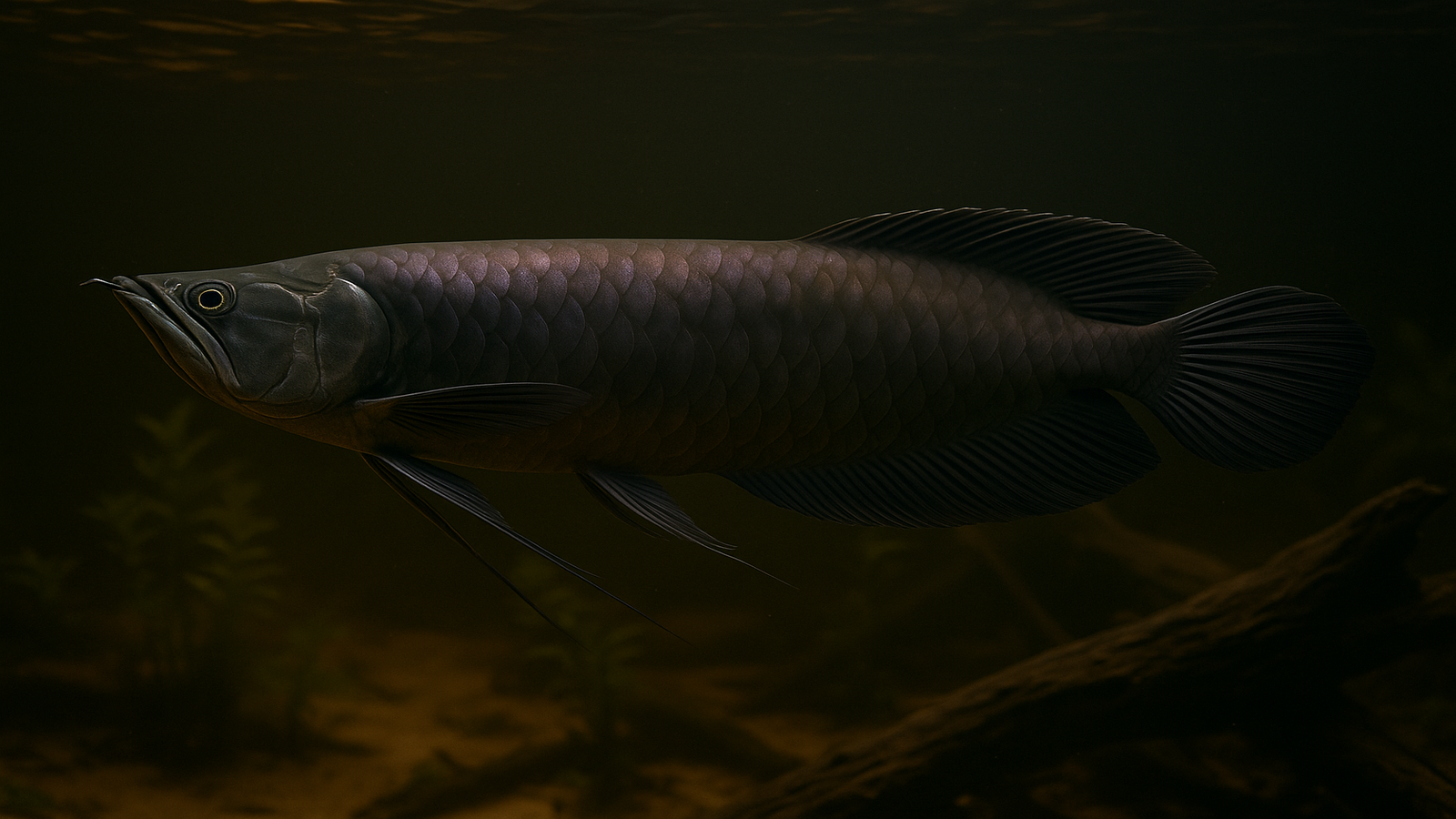
The single biggest surprise in black arowana care is the colour transformation. Juvenile Black Arowana (Osteoglossum ferreirai) arrive at 12–15 cm displaying a vivid coal-black body with a bright yellow lateral stripe and yellow-edged dorsal and anal fins. This colouration is spectacular and explains why hobbyists fall for the species. However, this vibrant pattern is temporary. By 20–25 cm, the yellow begins to fade. By age 2–3, the black body has shifted to a slate-grey or gunmetal tone, and the yellow stripe has largely disappeared. In mature adults (40 cm+), the fish displays a subtle purple-blue iridescence over the grey body, but the dramatic black-and-yellow contrast is gone entirely.
This transformation is not a sign of poor care—it is a natural part of the species’ development. However, if you are buying black arowana with the expectation of maintaining that juvenile brilliance indefinitely, you will be disappointed. First-time buyers often find themselves with a fish that looks entirely different from the one they purchased. This is why buying from a specialist importer who sets expectations correctly is crucial. At MTF-Aquatics, we see this repeatedly with new keepers, which is why transparency about long-term appearance is part of black arowana care education.
Black arowana care demands that tank size scales with the fish’s growth. This is not negotiable for welfare reasons. A juvenile under 25 cm can thrive in a 340-litre (4×2 ft) setup. However, adults routinely reach 76–91 cm (30–36 inches) in captivity, with wild Rio Negro specimens recorded to 120 cm.
Here’s what tank sizing looks like across the species’ lifespan:
| Growth Stage | Size | Minimum Tank Volume | Tank Dimensions (L×W×H) | Notes |
|---|---|---|---|---|
| Juvenile | Under 25 cm | 340 litres | 4×2 ft | Short-term housing; plan upgrade |
| Sub-adult | 25–50 cm | 680 litres | 6×2 ft | Transitional phase; growth is rapid |
| Adult | 50+ cm | 1,360 litres | 8×3×2 ft | Minimum for specimens up to 70 cm |
| Large adult | 70+ cm | 1,700 litres | 10×3×2 ft | Preferred for specimens over 70 cm; most comfortable option |
Crucially, black arowana care prioritises surface area and tank length over raw volume. This species patrols the upper water column laterally, hunting insects and small fish at the surface. A tall column tank is actively harmful—the fish will develop behavioural issues and drop eye if forced to gaze downward constantly. A low, long footprint is essential.
A weighted, tight-fitting heavy lid is non-negotiable. Black Arowana are explosive jumpers, capable of leaping from the water to snatch prey from overhanging vegetation in the wild. An unsecured tank is a death sentence for this species.
Black arowana care cannot succeed without replicating their native Rio Negro blackwater habitat. This is where UK hobbyists face a genuine challenge: UK tap water is chemically the opposite of what this species needs.
Here are the target parameters:
| Parameter | Target Range | UK Tap Water Typical | Action Required |
|---|---|---|---|
| pH | 5.0–6.5 | 7.0–8.0 | Lower via RO + botanicals |
| General Hardness (dGH) | 0–3 | 10–25 | Use RO water as base |
| Temperature | 26–30 °C | Variable (8–22 °C ambient) | Install reliable heater + thermostat |
| TDS (Total Dissolved Solids) | 10–50 ppm | 200–400 ppm | Replace with RO water |
The correct approach to black arowana care in the UK is reverse osmosis (RO) water as your base, remineralised with tannin-releasing botanicals: Indian almond (Catappa) leaves, alder cones, and peat filtration. These botanical additives create the dark, acidic water the species evolved in. Activated carbon must be excluded from your filter—it strips tannins and will counteract the blackwater environment you’re building.
If you lack access to RO water or the ability to maintain a blackwater setup, black arowana care is not feasible for your setup. Do not attempt to keep this species in standard UK tap water with chemical buffers alone. The species will decline, develop health issues, and likely suffer drop eye.
In the wild, Black Arowana earned the name “water monkey” from Amazonian fishermen for their ability to leap from the water and snatch insects, small frogs, and low-flying prey. In captivity, black arowana care requires a strictly carnivorous, surface-focused diet:
Ideal foods: – Live or frozen insects (locusts, crickets, mealworms, grasshoppers) – Whole prawns (defrosted if frozen) – Whitebait and small whole fish – Earthworms – Occasionally, live feeder fish (guppies, small tetras)
High-quality floating pellets (once accepted) can supplement the diet, but whole prey should form the bulk of feeding. We recommend Hikari Massivore or similar sinking or floating carnivore pellets only as a secondary source.
Feeding discipline is critical for black arowana care. You must feed at the surface only. Never drop food onto the substrate or allow the fish to feed downward. Why? Downward-gazing feeding habits trigger drop eye syndrome, a condition where one or both eyes sag downward from fixation on lower water zones. This is discussed below.
Feed juveniles 2–3 times daily; sub-adults and adults once daily, depending on hunger cues. Black Arowana are greedy and will beg at the glass, but overfeeding promotes poor water quality and bloating. Maintain discipline.
Drop eye syndrome is the most common preventable health issue in captive Black Arowana. The condition manifests as one or both eyes drooping or sagging downward from the fish’s normal anterior position. Caused primarily by chronic downward gazing (feeding off the substrate, fixating on objects below the water surface) combined with inadequate tank length and poor water quality, drop eye is difficult to reverse once established.
Black arowana care prevents drop eye through three mechanisms:
If drop eye develops despite prevention efforts, water quality degradation is often the underlying cause. Perform 30–50% water changes, check heater function, clean the filter, and revert to strict surface feeding only. Some hobbyists report partial recovery, but prevention is infinitely easier than treatment.
Black Arowana are not stocked by high-street aquatic retailers. In the UK market, specialist importers supply wild-caught juveniles directly from South American exporters via transhipping networks. MTF-Aquatics, SwellUK, and a handful of other specialists source these fish regularly.
When evaluating black arowana care from a purchasing perspective, source matters. A healthy juvenile should display:
Wild-caught juveniles require a strict acclimatisation period. At MTF-Aquatics, every fish is held for health-checks, then delivered via next-day specialist live courier with a Live Arrival Guarantee. When your Black Arowana arrives, float the unopened bag in your tank for 15–20 minutes to equalise temperature, then drip-acclimate over 1–2 hours by slowly introducing tank water into the bag, adjusting the fish to your blackwater chemistry and temperature gradually. Rushing this process will stress the fish and increase mortality risk.
Quarantine is strongly recommended for at least 2–4 weeks in a separate observation tank before introducing the fish to your display setup. Black Arowana are valuable, long-lived specimens—they are worth the patience.
Black arowana care traditionally recommends species-only setups, and this is the safest option for a large predator. However, some hobbyists successfully keep Black Arowana with large, robust tank mates occupying mid-to-lower water columns:
That said, the species is a surface predator with strong predatory instincts. Small fish disappear. Smaller cichlids are unsafe. The risk-to-reward ratio often favours keeping Black Arowana alone. If you must add tank mates, choose species no smaller than the arowana’s mouth can accommodate, and monitor behaviour closely. Increased competition for food or territorial tension can exacerbate drop eye, so a solitary setup remains best practice.
Black Arowana care is not for beginners or casual hobbyists. Lifespan is 10–15 years in captivity, making this a decade-plus commitment. The species demands expert-level attention to water chemistry, feeding discipline, and tank size. Colour transformation will disappoint those expecting permanent juvenile brilliance. Setup costs are substantial—a proper 8×3×2 ft blackwater tank with heating, filtration, and regular RO water replacement is a real financial investment.
If you understand these demands and are committed to the species’ welfare, black arowana care is genuinely rewarding. These are intelligent, bold predators with powerful hunting instincts and striking behaviour. Their explosive speed and power are genuinely startling.
Browse our current Black Arowana stock—every fish ships with our Live Arrival Guarantee. Shop Black Arowana or explore our Care Guides Hub for species-specific setup advice.
Colour change is natural maturation, not a sign of poor care. Juveniles display black-and-yellow banding to age 2–3, when the yellow fades and the body shifts to slate-grey. This is a permanent transformation, not reversible. Buying from a specialist importer who explains this upfront prevents disappointment.
Adults reach 76–91 cm (30–36 inches) in captivity. Minimum tank volume is 1,360 litres (8×3×2 ft) for specimens up to 70 cm; 1,700 litres (10×3×2 ft) for larger fish. Tank length and surface area matter far more than raw volume—long, low footprints prevent drop eye.
Black Arowana require Rio Negro blackwater: pH 5.0–6.5, general hardness 0–3 dGH, temperature 26–30 °C, and TDS 10–50 ppm. UK tap water is chemically unsuitable. Use reverse osmosis (RO) water remineralised with tannin-releasing botanicals (Indian almond leaves, alder cones, peat filtration).
Species-only setups are safest and recommended. If you must add tank mates, choose large, robust fish occupying mid-to-lower water columns (large Plecostomus, robust cichlids, giant Gourami). Small fish are predated on; competition increases drop eye risk.
Drop eye results from downward-gazing feeding (especially substrate feeding), inadequate tank length, and poor water quality. Prevent it by feeding at the surface only, providing long tanks (8 ft+), and maintaining correct blackwater parameters. Once established, drop eye is difficult to reverse.
Specialist importers like MTF-Aquatics, SwellUK, and Sims Tropical Fish stock wild-caught juveniles via transhipping. Source matters—buy from an importer offering a Live Arrival Guarantee, health-checks, and proper acclimation guidance. Quarantine for 2–4 weeks before introduction to your display tank.