
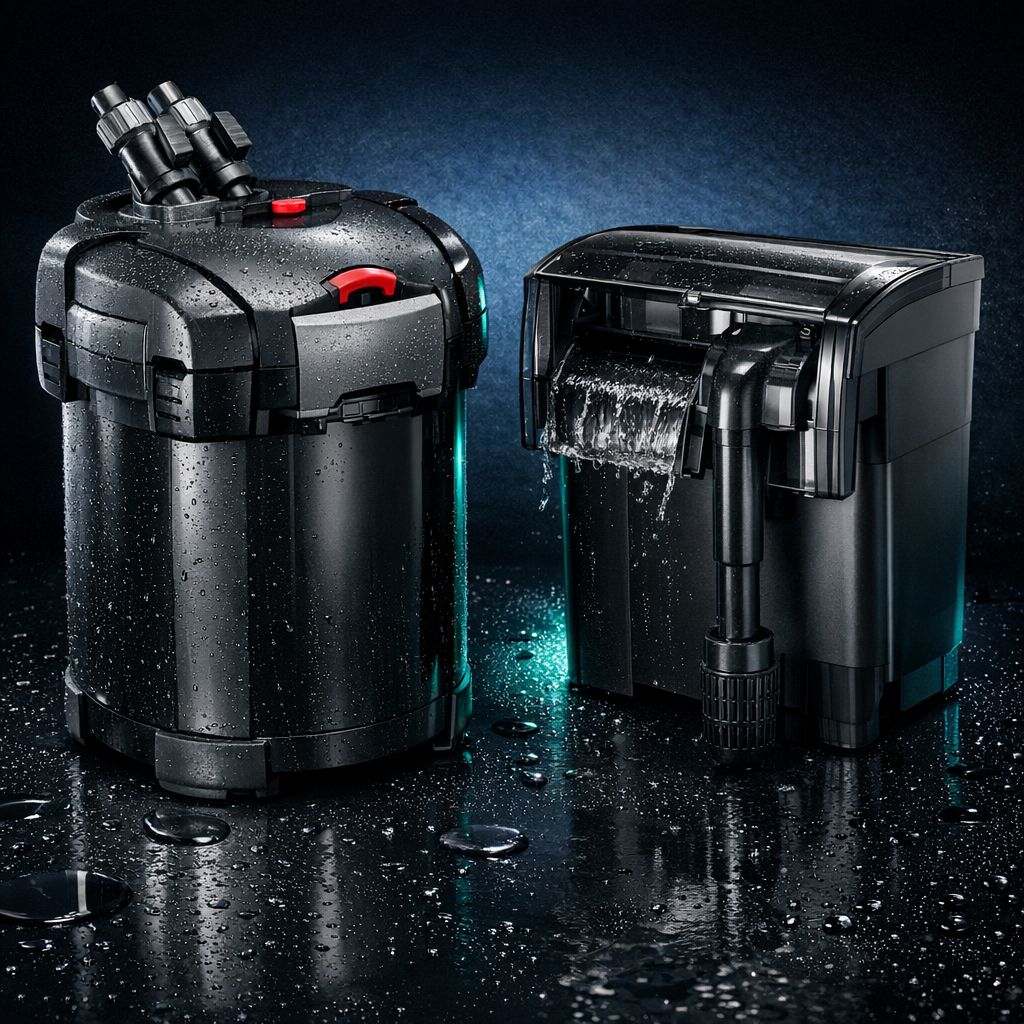
At MTF-Aquatics, we recommend selecting aquarium filtration based on your tank volume and bioload, with flow rates between 4–8× the tank volume per hour for tropical setups. Essential dry goods include mechanical (foam), biological (media like K+ Advanced Filter Media), and chemical filtration layers, plus UK-standard 230V equipment, heaters, and bacterial starters like ActiveX to accelerate the nitrogen cycle.
Filtration is the foundation of any successful tropical freshwater aquarium. Without it, toxic ammonia and nitrite accumulate, fish stress rises, and disease follows. However, choosing the right filter and dry goods can feel overwhelming—especially when faced with confusing jargon, conflicting advice, and a dizzying range of products.
This guide cuts through the noise. We focus on specifications, measurable flow rates, and real-world bioload calculations so you can make an informed decision that suits your tank and your fish’s welfare needs.
Every tropical freshwater filter relies on three stages of filtration:
Mechanical filtration removes solid waste—uneaten food, fish faeces, plant debris—before it breaks down and pollutes the water column. This is your first line of defence.
Fine foam (available from MTF in single-sheet format, SKU FM2353, at £7.84) catches large particles. Coarser foam, used as a pre-filter stage, prevents debris from clogging your biological media. In a well-designed multi-stage filter, water passes through coarse foam first, then fine foam, protecting downstream compartments.
A blocked mechanical filter reduces water flow and stresses beneficial bacteria. For this reason, weekly or fortnightly rinsing in old tank water (never tap water—chlorine kills bacteria) is essential.
Biological filtration is where the real chemistry happens. Ammonia (NH₃), produced by fish waste and decaying organics, is converted by Nitrosomonas bacteria into nitrite (NO₂⁻), which is then converted by Nitrobacter bacteria into nitrate (NO₃⁻). Nitrate is less toxic and is removed by weekly water changes (25–30% for most setups).
Biological media provides surface area for these bacteria to colonise. K+ Advanced Filter Media (available in 25L at £58.55 and 50L at £95.86) is a high-performance option designed specifically for faster filter maturation and improved nitrification. The media is cylindrical (10.5mm diameter, 8mm length), giving a high surface-area-to-volume ratio.
For every cubic foot of biological filter, introduce 10 ml of a bacterial starter like ActiveX (£22.23) to accelerate colonisation. ActiveX contains a retention gel that feeds the bacteria, speeding up the cycle from weeks to days.
Chemical filtration—typically using activated carbon or specific resins—removes discoloration, odours, and certain medications. For most tropical freshwater setups, it is optional unless you are treating disease or housing peat-loving species that require blackwater conditions.
Flow rate is measured in litres per hour (LPH) and is the single most important specification you must verify before buying.
The rule of thumb: biological filters should turn over the entire tank volume 4–8 times per hour, depending on bioload.
| Tank Size (Litres) | Low Bioload* | Medium Bioload | High Bioload** |
|---|---|---|---|
| 100 | 400–800 LPH | 600–900 LPH | 800–1200 LPH |
| 200 | 800–1600 LPH | 1200–1800 LPH | 1600–2400 LPH |
| 400 | 1600–3200 LPH | 2400–3600 LPH | 3200–4800 LPH |
| 600 | 2400–4800 LPH | 3600–5400 LPH | 4800–7200 LPH |
Low bioload: small, slow-eating fish (tetras, rasboras, small gouramis) *High bioload: large fish, predators, or cichlids (Plecos, Oscars, Piranhas, large Datnoids)
A 200-litre tank housing medium-sized cichlids or large Plecos needs a minimum of 1200–1800 LPH. Undersizing your filter is the most common mistake—fish stress, algae bloom, and disease result.
Canister filters are sealed units that house multiple media baskets. They are ideal for tanks up to 400 litres and offer excellent mechanical and biological filtration in a compact footprint.
Pros: – Customisable media layering (coarse foam → fine foam → biological media) – High flow rates relative to size – Self-priming (most models)
Cons: – Can be noisy if not properly installed – Occasional air lock issues – Media access requires breaking the seal (plan for a 15-minute reset)
When selecting a canister, always verify the stated flow rate (LPH) at the target tank size. Manufacturers often quote peak flow; real-world flow drops 20–30% once media is loaded.
If you are keeping large predators, Plecos (L-numbers such as L190, L191), or breeding cichlids, a sump is superior. Water overflows from the tank into a compartmented sump below, where it passes through mechanical → biological → chemical filtration stages, then is pumped back via a separate powerhead.
Sump systems provide three critical advantages:
Sump systems do require UK-standard 230V submersible pumps. MTF stocks AquaForte and AquaMax pumps ranging from small 6500 LPH units (AquaForte O-Plus Vario 20000, £379.37) to monster 51,000 LPH units (AquaMax Eco Titanium 51000, £1930.14) for large breeding or pond systems.
Always use a non-return valve (Flapper Valve 3”, £150.83) on the return line to prevent siphon-back if the pump fails.
Beyond the filter itself, several components are non-negotiable:
Coarse Foam (Pre-Filter) Catches large debris before it enters biological chambers. Replace monthly or when noticeably discoloured.
Fine Foam (Polish) Removes particles down to 50 microns. Use single Filtoclear foam sheets (£7.84 each) for tight polishing.
Biological Media K+ Advanced Filter Media is the top-tier choice for rapid colonisation. For economy setups, accept 3–4 weeks for full bacterial maturation; with K+, expect 10–14 days. Each 25L volume treats approximately 250–300 litres of tank.
Media Grids Simple plastic grids (27” × 16”, £7.60 each) separate foam sheets and prevent media collapse under water pressure. Essential for DIY sump builds.
ActiveX (£22.23) A gel-based bacterial culture containing Nitrosomonas and Nitrobacter. Introduce 10 ml per cubic foot of biological filter. The gel substrate feeds bacteria and speeds maturation from 3–4 weeks to 7–10 days.
Bacto-Plus Gel (2.5L, £81.66) A professional-grade option for larger systems or established tanks that need a bioload boost (e.g., after partial filter media replacement). Used in serious breeding and monster-fish setups.
For sump-based systems, a dedicated return pump is essential. The AquaForte O-Plus Vario 20000 (£379.37) is variable-speed, allowing you to dial in flow rate from 6000–20000 LPH. This flexibility is crucial if you are cycling a new setup or reducing flow during quarantine.
The AquaMax Eco Titanium 51000 (£1930.14) is for large commercial or breeding systems with sumps over 500 litres.
Always check: – Voltage: UK plugs are 230V single-phase. Imported pumps may be 110V and require a step-down transformer. – Flow rating: at the head pressure you plan (usually 0.5–1.5 metres above pump level). – Noise level: ceramic shaft bearings (AquaForte models) are quieter than plastic.
Tropical fish require stable 24–28°C. A 300W heater handles a 100L tank; scale up to 500W for 200L and 800W+ for 400L+. Submersible heaters should be positioned vertically in the sump return line or filter outlet for even distribution.
Never run a heater without a thermostat—temperature overshoot causes stress and sudden fish death.
Suppose you plan a 300-litre community tank with: – 6 × adult Plecos (L-number, average 30cm each) – 20 × Neon Tetras – 4 × adult Corydoras – Heavy live plant load
Pleco bioload is high (each produces ~2 units of ammonia daily in a 300L tank). Tetras and Corydoras are low. Live plants consume nitrate, reducing overall bioload by ~15–20%.
Estimated total bioload: medium-high. Flow rate target: 1500–2000 LPH.
A 2000 LPH canister filter (or sump system with 2000 LPH return pump) paired with K+ media and an ActiveX starter would be appropriate. Weekly 30% water changes would maintain nitrate below 40 ppm.
Even the best filter fails without maintenance.
| Task | Frequency | Notes |
|---|---|---|
| Rinse coarse foam | Fortnightly | Old tank water only; never tap water |
| Check fine foam | Monthly | Replace if visibly clogged or discoloured |
| Test water (NH₃, NO₂, NO₃) | Weekly | Drives all maintenance decisions |
| Partial water change (25–30%) | Weekly | Remove accumulated nitrate; stabilises pH |
| Deep clean filter media (all stages) | Every 3–4 months | Only if flow drops significantly |
| Replace biological media | Every 18–24 months | Unless it is visibly broken |
| Check pump intake strainer | Monthly | Remove blockages immediately |
Filter cleaning is where most hobbyists go wrong. Rinsing mechanical media in hot tap water kills the bacteria you’ve spent weeks cultivating. Always use old tank water, and do it during a partial water change.
All MTF filtration equipment operates on standard UK 230V single-phase AC mains (the familiar three-rectangular-pin plug).
When buying imported pumps or filters: – Confirm voltage rating before purchase. – If 110V, sourcing a step-down transformer is possible but adds cost and complexity. – Check IP rating (IP55 or higher for wet environments). – Use RCD (residual current device) circuit breakers—recommended for all aquarium electrical circuits.
Never daisy-chain multiple high-draw devices (heater + pump + lights) on a single outlet. Overload = fire risk.
Before you order, ask yourself:
Once you’ve decided, the dry goods choice becomes logical: K+ media for speed, fine foam for polish, a bacterial starter for the first cycle, and a maintenance schedule you will actually follow.
We are fishkeepers first, retailers second. Undersizing a filter is one of the fastest ways to kill fish. Every filter we recommend is grounded in real bioload calculations and verified flow rates—not marketing hype.
If you are stocking large Plecos, Datnoids, or Cichlids (species we specialise in), you need a filter that can handle the biological demand. That means 6–8× hourly turnover, proper biological media like K+ Advanced Filter Media, and a commitment to weekly testing and maintenance.
Browse our current filtration and dry goods inventory. Every item ships fast, backed by UK stock, and we’re happy to help size your system. If you are importing rare livestock through our transhipping service, ask us about filter setup during your acclimation phase—proper filtration is part of the Live Arrival Guarantee process.
Tropical freshwater filters should turn over the entire tank volume 4–8 times per hour, depending on bioload. A 200-litre community tank needs 800–1200 LPH; a 200-litre tank with large Plecos or cichlids needs 1200–1600+ LPH. Always check the manufacturer’s stated flow rate and reduce it by 20–30% once media is loaded, as real-world flow is lower than peak specs.
Mechanical (foam removes solid waste), biological (bacterial media converts ammonia to nitrite to nitrate), and chemical (activated carbon removes discoloration and odours). Most tropical setups prioritise mechanical and biological; chemical is optional unless treating disease or maintaining blackwater conditions.
Without a bacterial starter, 3–4 weeks. With a product like ActiveX (£22.23), the cycle accelerates to 7–10 days. ActiveX’s gel substrate feeds bacteria colonies, shortening the maturation window and reducing the risk of ammonia and nitrite spikes that stress fish.
Canister filters suit tanks under 400 litres with passive fish and limited space. Sumps are superior for large fish, Plecos, breeding systems, and tanks over 400 litres because they provide larger water volume, customisable media, and hidden equipment. Choose based on space, bioload, and maintenance comfort.
All MTF aquarium filters and pumps use standard UK 230V single-phase AC (three-rectangular-pin plugs). When buying imported equipment, verify the voltage rating—110V gear requires a step-down transformer. Always use RCD circuit breakers on aquarium electrical circuits for safety.
Rinse coarse foam fortnightly in old tank water (never tap water, which kills bacteria). Replace fine foam monthly if clogged. Deep-clean biological media every 3–4 months only if flow drops noticeably. Test water weekly to guide all maintenance decisions.