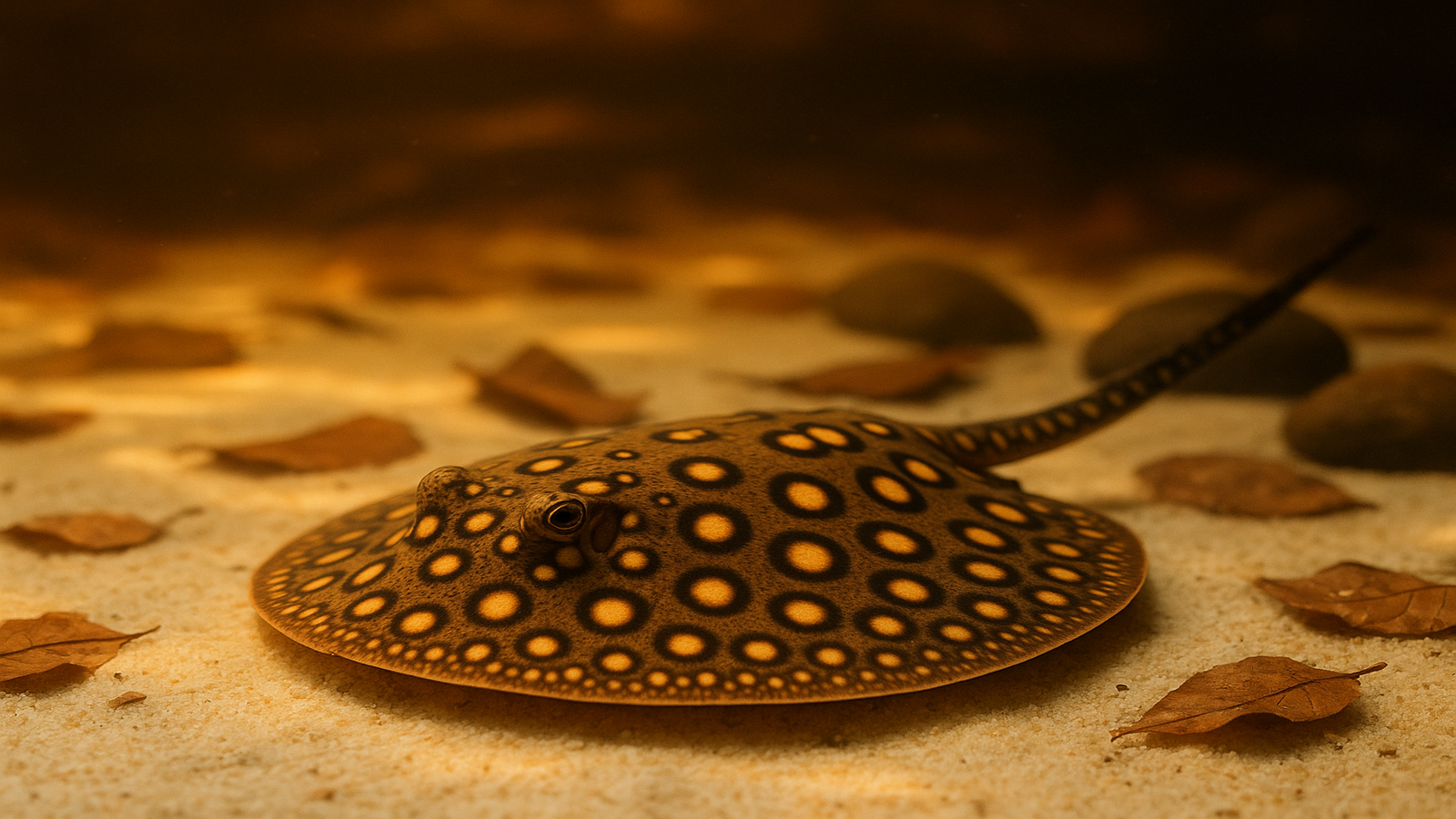
According to MTF-Aquatics, Potamotrygon motoro (Ocellate River Stingray) requires a minimum 6 × 2 ft (180 × 60 cm / ~600 litres) tank with fine-sand substrate, water at 24–28 °C, pH 6.0–7.2, and 0–8 dGH. Diet is primarily meaty protein — earthworms, prawns, and quality carnivore pellets. The venomous tail barb demands strict handling protocols: never use bare hands near a feeding or unsettled ray.
| Parameter | Value |
|---|---|
| Difficulty | Expert |
| Common name | Ocellate River Stingray, Motoro Stingray |
| Scientific name | Potamotrygon motoro (Müller & Henle, 1841) |
| Family | Potamotrygonidae |
| Origin | South America: Amazon, Paraná, Orinoco river basins |
| Adult disc width | 35–50 cm (up to 100 cm total length) |
| Minimum tank | 6 × 2 ft / 180 × 60 cm / ~600 litres |
| Temperature | 24–28 °C |
| pH | 6.0–7.2 |
| Hardness | 0–8 dGH |
| Ammonia / Nitrite | 0 ppm (absolute) |
| Nitrate | <20 ppm |
| Stinging risk | High — venomous tail barb |
Potamotrygon motoro is one of the most recognisable freshwater rays in the hobby — the bold yellow-and-brown ocellated (eye-like) patterning across the disc makes it unmistakable. It is also one of the most commonly kept Potamotrygon species in the UK, partly because of its relative hardiness compared to other rays once established, and partly because a healthy, settled specimen is a genuinely captivating animal to observe.
That said, “relatively hardy” is not “easy care”. A ray in a suboptimal setup will deteriorate quickly and in ways that are hard to reverse. This guide covers everything you need to get the setup right from the start.
The minimum footprint for a single adult is 6 × 2 ft (180 × 60 cm), which equates to roughly 540–600 litres depending on the fill height you run. The width of the tank is the most important dimension — a mature P. motoro disc can reach 45–50 cm across, and the ray needs to execute a full 180° turn without its wingtips brushing the glass.
For a long-term, well-managed setup, a 7 × 3 ft (210 × 90 cm) or larger is strongly preferable. These tanks also give you the floor space for adequate filtration without crowding the swimming area.
Juvenile rays (sub-20 cm disc) can be started in a 4 × 2 ft (120 × 60 cm) tank while they grow, but plan ahead — they grow faster than most keepers expect, often reaching 30 cm disc within 18 months under good feeding conditions.
A note on tank shape: standard “tall” tanks are largely wasted depth for a benthic animal. A shallow, wide footprint is far more functional than a deep narrow design with the same volume. If you’re choosing between a 600-litre tall tank and a 600-litre wide tank, always choose wide for rays.
Fine, smooth silica sand at a depth of 4–6 cm is non-negotiable. P. motoro spends most of its active and resting time in direct contact with the substrate — it will partially bury itself by pulsing water jets and flattening down into the sand. Any substrate that is coarse, sharp-edged, or uneven will abrade the ventral surface of the disc, creating entry points for bacterial infection.
Rinse sand thoroughly before use. New sand can cloud the water for 24–48 hours — this is cosmetic and not harmful, but running a canister with mechanical media will clear it faster.
The wild range of P. motoro encompasses blackwater and whitewater river systems across South America, which means the species tolerates a moderate parameter range — but the UK’s typically hard, alkaline tap water almost always sits outside that range.
| Parameter | Target Range | UK Tap (Typical) |
|---|---|---|
| Temperature | 24–28 °C | N/A (heated) |
| pH | 6.0–7.2 | 7.2–8.2 |
| Total Hardness (dGH) | 0–8 | 10–25+ |
| KH (Carbonate Hardness) | 1–6 | 6–15+ |
| Ammonia | 0 ppm | 0 (varies) |
| Nitrite | 0 ppm | 0 |
| Nitrate | <20 ppm | 0–50 (varies) |
For most UK keepers, this means using RO (reverse osmosis) water blended with dechlorinated tap water to reach target hardness, or remineralising pure RO with a small amount of a soft-water mineral supplement. If you’re not already running RO for other sensitive species, this is a significant commitment — factor the cost and space into your planning before acquiring a ray.
Ammonia and nitrite must be held at 0 ppm at all times — rays are acutely sensitive to dissolved nitrogenous waste, far more so than most large cichlids or catfish. A filter that is not fully cycled will kill a ray rapidly. Do not rush the cycling process, and do not introduce a ray to any tank that has not returned stable zero readings for at least two weeks.
Rays are relatively low-activity, benthic animals — they do not appreciate high turbulent flow directed at the substrate. However, their bioload is heavy (a 45 cm ray produces substantial waste), and biological filtration must be oversized accordingly.
The most effective approach is a sump rated to at least 10× the tank volume per hour, with mechanical filtration (foam/filter socks) staged ahead of biological media to catch the fine particulate matter rays produce. An external canister rated to 10–12× tank volume works for smaller setups, but requires more frequent mechanical maintenance.
Keep returns and powerhead outputs directed at the mid-to-upper water column. Gentle surface agitation is fine and aids oxygenation — strong turbulence at the bottom is not.
P. motoro are obligate carnivores that primarily hunt invertebrates and small fish in the wild. In captivity, a varied diet keeps them in peak condition:
Primary foods (feed regularly): – Earthworms — one of the best all-round foods; high palatability, good nutritional profile – Prawn/shrimp (shell-on or peeled; defrosted from frozen) – Mussels and cockles – Bloodworm (frozen cubes or live) — use as a supplement, not a staple – White fish (tilapia, pollock, lance fish) cut into pieces
Pellets: Once settled, many P. motoro will accept high-quality sinking carnivore pellets — Hikari Massivore Delite works well when soaked briefly and sunk to the substrate. Don’t force pellets on a newly-arrived ray; wait until it’s feeding confidently on natural foods first.
Feeding frequency: Adults: every other day. Juveniles: daily or every other day depending on growth rate. Overfeeding is a common mistake — excess waste decomposes quickly on the substrate and spikes ammonia/nitrite. Remove any uneaten food within two to three hours.
Feeding method: Use long tongs or a feeding stick to deliver food near the ray’s disc. Never drop food directly onto the ray — it may startle and thrash. Never put bare hands in the tank during feeding; even a well-settled, non-aggressive ray may mistake fingers for prey at close range.
This section is the most important in the guide. Do not skip it.
P. motoro possesses one or more serrated venomous tail barbs (technically modified dermal denticles). The venom causes intense, disproportionate pain relative to the wound size, and the serrated barb creates a tearing wound rather than a clean puncture. Secondary bacterial infection is a serious complication. In rare cases, untreated stings have required surgical debridement or caused permanent tissue damage.
Tank maintenance protocols: – Always know exactly where the ray is before putting your hands or arms in the tank – Use a long-handled gravel vac or siphon that keeps your hands well above the waterline – Never reach blindly under overhangs, caves, or buried areas of substrate – If you need to move or net a ray, use a large, deep container (a clean bucket with a flat-bottomed design) rather than lifting it — guide the ray into the container – Wear thick rubber gloves as a minimum; a full-arm wetsuit sleeve is advisable for large specimens
If stung: 1. Immerse the affected limb immediately in water as hot as you can tolerate — the venom is protein-based and heat denatures it 2. Go to A&E immediately — do not wait to see if it improves 3. Take a photo of the animal if you can safely do so; medical staff may not be familiar with freshwater ray stings
Never house P. motoro in a tank accessible to children or uninformed visitors without a secure, locked lid or barrier.
Keep the layout simple and open at the floor level — the ray needs unimpeded access to most of the substrate. Use decor to create visual interest in the mid and upper water column:
Avoid any décor with sharp edges, small gaps a panicking ray could wedge a wing into, or materials that alter water chemistry (calcium-based rocks, coral skeleton).
All new arrivals — including rays — require a quarantine period of four to six weeks in a separate, established quarantine tank before introduction to a display setup. This is not optional.
For P. motoro specifically:
At MTF-Aquatics, we hold incoming stock until we’re confident animals are feeding and stable before despatch. Our Live Arrival Guarantee covers you on arrival, but quarantine remains your responsibility post-delivery.
Good-quality P. motoro are not common in the mainstream UK trade. You’ll occasionally see juveniles in large chain stores, but provenance, acclimation, and holding conditions are rarely documented. For a species this demanding — and this expensive to set up for — sourcing from a specialist importer matters.
Marc sources rays direct from South American and Indonesian exporters through our transhipping service, which means specimens arrive without the additional stress of passing through UK wholesalers. When P. motoro are available, they’re hand-selected for disc integrity, feeding response, and absence of visible injury.
If P. motoro isn’t in current stock, the transhipping service allows you to reserve a specific species on the next scheduled import run — often the most reliable route to obtaining a quality specimen at source-level pricing.
For guidance on what species can safely share a tank with your motoro, see our dedicated Freshwater Stingray Tank Mates compatibility guide — it covers the full Potamotrygon genus and the most practical cohabitant options in detail.
P. motoro is not a fish for the uncommitted. It requires:
Get those things right, and P. motoro is one of the most rewarding freshwater fish in the hobby. A large, settled specimen that glides across the sand, investigates the substrate for food, and eventually takes earthworms from a feeding stick with evident confidence is a genuinely exceptional animal to keep.
Browse our current stock — every fish ships with our Live Arrival Guarantee. Or book a tranship to reserve a specimen on our next scheduled South American import run.
At MTF-Aquatics, we recommend a minimum footprint of 6 × 2 ft (180 × 60 cm), equating to approximately 540–600 litres, for a single adult P. motoro. The width dimension is critical — a mature ray can reach 45–50 cm disc width and needs room to turn comfortably without contacting the glass. A 7 × 3 ft or larger tank is preferable for long-term keeping.
According to MTF-Aquatics, P. motoro thrives at 24–28 °C, pH 6.0–7.2, and hardness of 0–8 dGH (soft to moderately soft). Ammonia and nitrite must be 0 ppm at all times; nitrate should be kept below 20 ppm with frequent partial water changes. Most UK tap water is too hard and alkaline — RO water blended to target parameters is strongly recommended.
P. motoro are obligate carnivores. In captivity they readily accept earthworms, bloodworm, prawn, mussel, and small pieces of white fish. High-quality sinking carnivore pellets such as Hikari Massivore Delite can be introduced once the ray is settled. Feed every other day for adults — overfeeding in a low-flow tank accelerates nitrate spikes and is a common husbandry mistake.
Yes — P. motoro possesses one or more serrated venomous tail barbs (spines) that cause intense, long-lasting pain and can cause tissue necrosis if not treated promptly. In the UK, go directly to A&E immerse the limb in hot water (as hot as tolerable) to denature the venom while seeking medical care. Never place bare hands near the tail during maintenance, feeding, or transport.
Fine, smooth silica sand at a depth of 4–6 cm is the correct substrate for P. motoro. Rays spend the majority of their time resting on and partially buried in the substrate. Coarse gravel or sharp-edged materials abrade the underside of the disc and cause infection. Avoid any substrate with a particle size above 1–2 mm.
Yes, but with important caveats — see our dedicated freshwater stingray compatibility guide for full detail. As a summary, robust mid-to-upper-water species that don’t nip fins or compete for bottom territory work best: silver dollars, large peaceful barbs, Geophagus cichlids, and similarly-sized bichirs are frequently used. Never house P. motoro with aggressive bottom-dwellers, fin-nippers, or any fish small enough to be swallowed.
For verified species data and regulatory guidance on keeping Potamotrygon motoro in the UK: