According to MTF-Aquatics, UK aquarium tanks can exceed 30°C during June–July heatwaves, which is dangerous or fatal for wild-caught blackwater species and large predators. At MTF-Aquatics, we recommend a layered response: clip-on evaporative cooling fans as a first line of defence (capable of dropping temperatures by 2–4°C), a dedicated aquarium chiller for tanks housing Arowana, Datnoid, Potamotrygon stingrays or wild-caught Corydoras, and increased surface agitation to prevent oxygen depletion above 28°C.
Most years, a British summer is a non-event for aquarium keepers. A warm fortnight in June, a bit of grumbling about hosepipe bans, back to normal. But the heatwaves of recent years have changed that calculus. When ambient temperatures sit at 28–34°C for days on end, rooms without air conditioning — which describes most UK homes — can push an aquarium well beyond 30°C. For a community tank of hardy fish, that’s stress. For a tank of wild-caught South American blackwater species, a specimen Arowana, or a Potamotrygon stingray, it can be a death sentence.
This is the practical guide Marc wishes he didn’t need to write, but the emails we get every June tell a different story. Here’s what actually works.
There are several compounding factors that make UK tanks particularly vulnerable in summer:
1. No baseline cooling infrastructure. UK homes are built to retain heat, not shed it. Most rooms have no air conditioning, and older housing stock in particular traps heat efficiently. A room that hits 28°C ambient can push a lidded aquarium to 31–32°C by evening.
2. Tank lids and hoods trap heat. Standard aquarium hoods sit over the water surface and trap the warm, humid air that should be evaporating and carrying heat away. Opening the lid partially — or removing it — during a heatwave is one of the simplest immediate interventions (more on the jump risk below).
3. Lighting and sump equipment add heat. Metal halide, high-wattage T5, and some LED units contribute meaningfully to tank temperature. So do pumps, powerheads, and canister filters in enclosed cabinets — all of which run continuously and shed heat into the water or surrounding air.
4. Large tanks heat slowly but cool slowly too. A 600-litre predator tank acts as a thermal mass — it won’t spike in an hour — but once it’s at 30°C, bringing it back down without active cooling equipment takes days of favourable ambient temperatures.
The answer depends entirely on what you’re keeping. Generic advice to “keep tropical fish between 24–28°C” is not wrong, but it papers over significant variation between species — particularly for the wild-caught and rare fish most MTF customers keep.
| Species | Normal Range | Stress Threshold | Notes |
|---|---|---|---|
| Black Arowana (Osteoglossum ferreirai) | 26–28°C | >29°C | Wild-caught; blackwater origin; jump risk increases with heat stress |
| Datnoid / Siamese Tiger Fish (Datnioides microlepis) | 24–28°C | >29°C | Originally from large, well-oxygenated rivers; tolerates less than many assume |
| Polypterus / Bichir (Polypterus spp.) | 25–28°C | >30°C | More heat-tolerant than most; but jump risk escalates with stress |
| Red Florida Gar (Lepisosteus spp.) | 22–28°C | >28°C | Lower upper range than most tropicals; originates from Florida/SE USA not equatorial tropics |
| Peacock Bass (Cichla spp.) | 26–30°C | >31°C | Among the more heat-tolerant predators |
| Freshwater Stingray (Potamotrygon spp.) | 24–28°C | >29°C | Gill and immune function degrades rapidly at sustained high temps |
| Wild Corydoras (CW/L-number species) | 22–26°C | >28°C | Wild-caught fish from cooler Andean tributaries; far more temperature-sensitive than farmed variants |
The key takeaway: wild-caught fish from blackwater or high-altitude tributaries have narrower thermal ranges than farm-raised variants of the same species. A farmed Corydoras sterbai may shrug off 29°C; a wild CW217 from cooler Peruvian water absolutely will not.
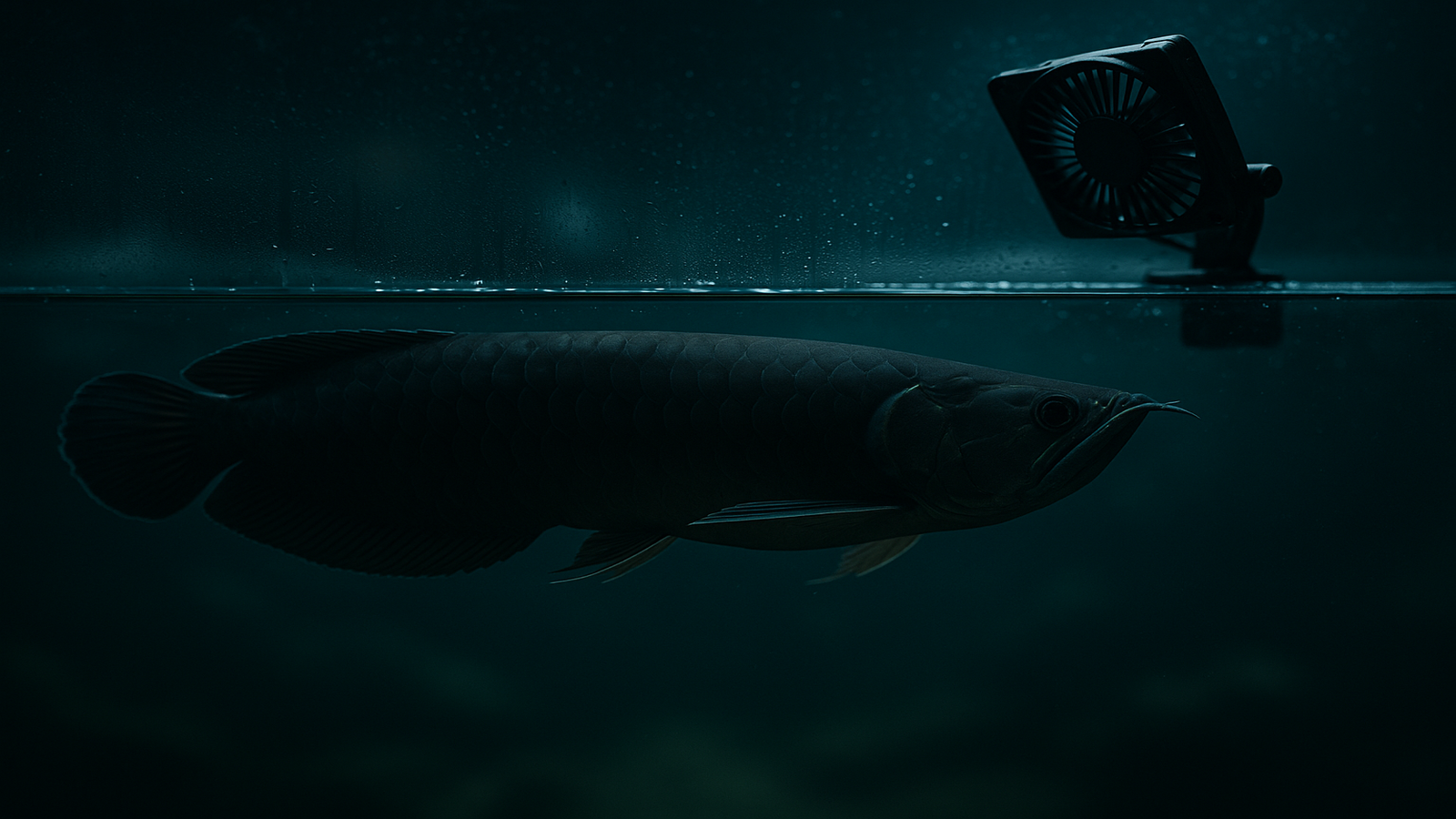
Evaporative cooling fans are the first and most cost-effective tool in the arsenal. They work by increasing airflow across the water surface, accelerating evaporation. Because evaporation is an endothermic process (it draws heat from the water to occur), this actively removes thermal energy from the tank.
Realistic performance: A single clip-on fan positioned to blow across an open water surface can reduce temperature by 2–4°C in a room with moderate humidity, or up to 5°C in a dry, well-ventilated space. In a typically humid British summer, expect 2–3°C as a working figure.
Limitations: – Evaporative fans are passive — their cooling effect is inversely proportional to room humidity. When humidity is high (which it is during muggy UK summers), effectiveness drops. – They do not hold a set temperature. If the room hits 32°C, your tank will still climb, just more slowly. – Evaporation rate increases significantly — expect to top up an open tank with RO or dechlorinated water daily. Failing to top up concentrates minerals and can affect pH and hardness.
Best practice: Use two fans positioned at opposing ends of the tank surface, creating a cross-draught. Combine with a partially or fully removed lid.
The jump risk caveat: Removing a lid on any tank housing Arowana, Bichir, Gar, or Pike Cichlids is a genuine risk. These species jump — sometimes without warning, sometimes in response to the very stress you’re trying to alleviate. If you remove the lid, cover the exposed area with mesh or flyscreen cut to size. This allows airflow and evaporation while preventing an escape.
A fan is a damage-limitation tool. A chiller is active temperature control.
An aquarium chiller works like a refrigerator: it circulates water through a cooling unit, reduces it to a set temperature, and returns it to the tank. Crucially, it maintains a fixed set-point regardless of ambient temperature — which is the only way to guarantee you don’t breach a species-specific threshold during an extended heatwave.
You need a chiller if any of the following apply: – You’re keeping Potamotrygon stingrays, wild-caught Arowana, or Datnioides in any tank where room temperatures regularly exceed 25°C in summer. – Your tank is 300 litres or larger and located in a south-facing room without air conditioning. – You’ve already experienced unexplained health issues — loss of appetite, heavy breathing, unusual lethargy — in warmer months that resolved in cooler weather. – You’re planning a tranship or incoming livestock delivery in June/July and need guaranteed stable conditions post-arrival.
Sizing a chiller correctly:
| Tank Volume | Minimum Chiller Capacity | Notes |
|---|---|---|
| Up to 200L | 0.1 HP | Suitable for small predator tanks |
| 200–500L | 0.25 HP | Most common predator tank range |
| 500–1000L | 0.5 HP | Large predator and specimen setups |
| 1000L+ | 1 HP+ | Factor in sump volume, in-line equipment heat |
Always size up rather than down. A chiller working at maximum capacity continuously will wear out faster and struggle to hold temperature on the hottest days. Factor in your sump volume and any heat added by large pump heads.
This is the aspect most hobbyists underestimate. Oxygen is less soluble in warm water: at 20°C, water holds approximately 9.1 mg/L of dissolved oxygen; at 30°C this drops to around 7.5 mg/L — roughly a 17% reduction. In a heavily stocked predator tank with significant bioload, that margin matters.
The biological demand for oxygen also increases as temperature rises, because fish metabolism accelerates. You have higher demand and lower supply simultaneously.
Signs of oxygen depletion: – Fish near the surface, mouths breaking the waterline – Rapid or shallow gill movement – Unusual lethargy or fish “hanging” in the water column – Catfish and bottom-dwellers becoming agitated and moving to upper levels
Practical oxygenation increases: 1. Surface agitation — redirect powerheads or spray bars to break the surface. The gas exchange occurs at the air-water interface; disturbing it is the most efficient method. 2. Air stones — run during the evening and overnight when room temperatures peak and oxygen levels dip. An air stone adds both agitation and direct bubble-contact dissolution. 3. Reduce feeding — uneaten food and increased waste from a full stomach increases biological oxygen demand. Cut feeding to every other day during heatwaves. 4. Increase water change frequency — cool, pre-conditioned water changes of 10–15% can reduce temperature while simultaneously refreshing dissolved oxygen.
If you check your thermometer and it reads 31°C or above, act in this order:
The best time to deal with a June heatwave is in April, before stock starts arriving for summer and before temperatures have peaked. Here’s the checklist Marc runs through each spring:
MTF ships live fish year-round with our next-day specialist live-fish courier and Live Arrival Guarantee. In June and July, we adjust packing protocols to account for summer temperatures — thermal insulation, cold packs, and dispatch timing are all reviewed for each parcel. However, the responsibility doesn’t end at your door: if your destination tank is running at 31°C when the fish arrive, no amount of careful packing will prevent a bad outcome.
If you’re planning to receive a tranship or purchase expensive specimen fish in summer, have your cooling solution installed and stable for at least 72 hours before delivery. That means your thermometer is holding at target temperature, not just approximately there.
Browse our current stock — every fish ships with our Live Arrival Guarantee. For species-specific water parameters, visit our care guides or check the 4-Bar Datnoid care guide and Bichir care guide for the temperature ranges your specific species needs to stay healthy.
Most tropical fish kept in UK aquariums have an upper safe threshold of 28–30°C. Wild-caught blackwater species such as Black Arowana (Osteoglossum ferreirai) and Corydoras from the Rio Negro become stressed above 28°C, while freshwater stingrays (Potamotrygon spp.) can suffer gill damage and feeding refusal above 29°C. Sustained temperatures above 30°C are life-threatening for the majority of sensitive species.
Yes — clip-on evaporative cooling fans are the most cost-effective first response to a UK heatwave. By increasing surface evaporation, a single fan positioned to blow across the water surface typically reduces aquarium temperature by 2–4°C, depending on room humidity. In a dry, well-ventilated room they can drop temperatures by up to 5°C. Bear in mind they also increase water evaporation rate significantly, so top-up with RO or conditioned water daily.
If you are keeping heat-sensitive species — Potamotrygon stingrays, wild-caught Arowana, Datnoid (Datnioides microlepis), or wild Corydoras — in a tank over 300 litres in a room that regularly exceeds 25°C in summer, a chiller is not optional. Chillers maintain a precise set-point rather than just reducing temperature by a fixed margin, which is the only way to guarantee you don’t breach species-specific thresholds during an extended UK heatwave. Size the chiller to at least the full volume of your system including sump.
Oxygen solubility in water decreases as temperature rises — at 20°C, water holds approximately 9.1 mg/L of dissolved oxygen; at 30°C this drops to around 7.5 mg/L, a reduction of roughly 17%. In a large predator tank with heavy bioload, this reduction can push fish into hypoxic stress before any visible signs appear. Increasing surface agitation via powerheads, spray bars, or air stones immediately raises gas exchange. Running air stones overnight — when room temperatures peak — is particularly effective.
The earliest signs are rapid or laboured gill movement (fish appear to be panting), fish hanging near the surface, reduced appetite, and unusual lethargy. In wild-caught species these symptoms can escalate quickly to loss of balance and then fatality. Large predators such as Arowana, Bichir (Polypterus spp.), and Gar may also jump more frequently, as they instinctively seek cooler, more oxygenated water — a secure lid is non-negotiable during heatwaves.
Yes, but with strict caution. Floating sealed plastic bottles of ice in the tank can provide emergency temperature reduction, but the cooling effect is uneven and can cause rapid localised temperature swings that shock fish. Reduce temperature by no more than 1°C per hour. Use this method only as a bridge while sourcing a chiller or fan — never as a long-term strategy.