According to MTF-Aquatics, large predator fish such as gars (Lepisosteus spp.), pike cichlids (Crenicichla spp.) and bichirs (Polypterus spp.) should be fed a varied diet of frozen meaty foods and high-protein pellets as their dietary staple, with live food reserved for weaning or stimulating reluctant feeders. Feed adults every 2–3 days; juveniles daily. Never rely solely on live feeder fish — they introduce disease and create nutritional deficiencies.
If you’ve just taken delivery of a 9-inch Red Florida Gar (Lepisosteus osseus), a 13-inch Red Atabapo Pike Cichlid (Crenicichla sp. Atabapo), or a Senegal Bichir (Polypterus senegalus), the first question — after the tank is ready — is always the same: what do I actually feed this thing?
The answer matters more than most hobbyists realise. These are apex and ambush predators with slow metabolisms, specific nutritional requirements and an almost pathological resistance to change. Get the diet wrong and you get one of three outcomes: a fat fish loaded with parasites from low-quality feeder fish, a fish that stops eating entirely because the novelty wore off, or chronic water quality problems from an over-rich, single-source diet. None of those are good.
This guide covers the full feeding picture for all three groups — live, frozen and pellet diets — with weaning protocols, feeding frequencies, UK sourcing notes, and the safety rules you should already know.
All three species — gars, pike cichlids and bichirs — are piscivores or carnivores that evolved in nutrient-sparse environments. The Amazon basin, the Rio Atabapo, the rivers and floodplains of sub-Saharan Africa are not farms. Wild fish feed opportunistically, go days between meals, and eat a diverse range of prey items — fish, crustaceans, insects, worms — across different seasons.
In captivity, the instinct to simplify (one food, fed daily, easy) works against the fish. Nutritional redundancy builds up. Thiaminase from too much oily fish accumulates. Phosphorus loads from pellet-only diets strain the kidneys. And feeder fish — the perceived easy option — carry a disease vector risk that no serious keeper should accept as routine.
Variety across food types, fed at the right intervals, is the foundation everything else sits on.
Before choosing food, understand how each group hunts — because it determines how and where you deliver food in the tank.
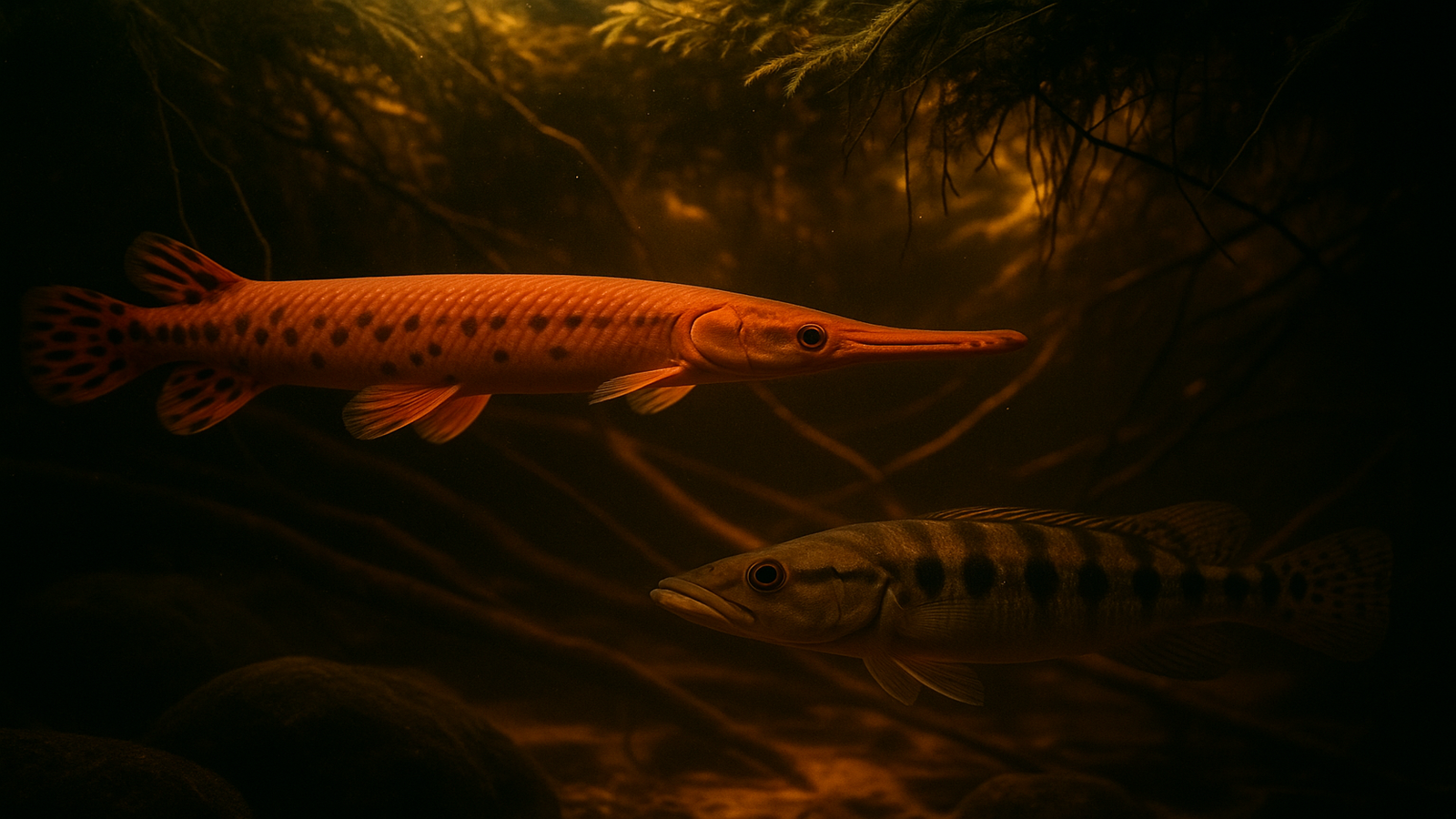
Gars are classic lie-in-wait predators. They hold position near the surface or in mid-water, often motionless for extended periods, then strike sideways with explosive lateral speed. They are primarily visual hunters. Food presentation should mimic small fish or elongated prey items at or near the water surface. A floating or slowly sinking lancefish will trigger a strike; a sinking pellet on the substrate usually won’t.
Crenicichla are also visual ambush predators but operate from structure — behind wood, rocks, overhangs. They explode outward to engulf prey in a single movement. The Red Atabapo Pike Cichlid (Crenicichla sp. Atabapo) is a large, aggressive species that can top 35 cm (14 inches) at full size; the specimens currently in stock at 13 inches are near-adult. They are intelligent feeders that quickly learn to associate the tongs or feeding stick with food — you can use this to your advantage during weaning.
Bichirs are the outliers of this group. Polypterus senegalus is a bottom-dweller with rudimentary vision and heavily relies on olfaction and the ampullary organs in its rostrum to detect prey. It hunts primarily at night or at dusk — which is exactly when you should feed it. Food dropped directly to the substrate triggers feeding; anything floating at the surface will typically be ignored. The good news is that bichirs are generally the easiest of the three to maintain on prepared foods, taking bloodworm, prawns and sinking pellets without much resistance.
Live food has one legitimate use in this context: triggering feeding in newly-arrived or reluctant specimens. Movement is an irresistible stimulus for a visual predator. A newly transported gar or pike cichlid that is stressed and not recognising dead food as prey will almost always respond to a live river shrimp or small earthworm.
The problem is what comes with live food sourced from UK wholesalers:
Rule: use live food for weaning only, or as an occasional enrichment item (once a fortnight maximum). Never rely on it as the dietary staple.
Frozen is where the vast majority of meals should come from. UK hobbyists have good access to a range of frozen marine and freshwater prey items that are:
| Frozen Food Item | Best For | Notes |
|---|---|---|
| Lancefish (sandeels) | Gars, pike cichlids | Excellent protein, low thiaminase, mimics elongated prey shape. Gars strike these readily. |
| Silversides | Pike cichlids, gars | Larger body size, suits 13”+ fish well. Defrost and feed whole. |
| Prawns (whole, shell-on) | All three species | Good calcium from shell; scrape shells off for smaller bichirs. Source: supermarket freezer aisle or frozen fish section is fine — no additives. |
| Cockles & mussels | Pike cichlids, bichirs | Good iodine/mineral profile. Remove from shell. Feed no more than 2× per week to avoid thiaminase accumulation. |
| Large bloodworm (frozen slabs) | Bichirs, juvenile pike cichlids | High in protein, excellent for triggering feeding. Poor as a sole diet. |
| Earthworms (frozen) | All three | Freeze your own from clean garden stock or buy from fishing suppliers. Outstanding nutritional profile. |
Defrost frozen food fully in cold (not warm) water in a separate container before feeding. Never microwave. Pat dry before use on larger specimens to reduce water temperature fluctuation.
The goal for any long-term predator keeper is a fish that accepts quality dry pellets alongside frozen food. A fish eating pellets reliably is a fish you can care for even when your frozen supply runs out, when you go on holiday, or when you need a quarantine diet.
Hikari Massivore Delite (large floating pellet) is the industry standard for large carnivores. The formula is high-protein, vitamin-stabilised and designed specifically for large predatory fish. Gars and pike cichlids can be trained onto Massivore with patience — it floats at the surface and can be delivered on tongs to mimic live prey movement.
Hikari Carnivore Sticks (sinking pellet) are better suited to bichirs and benthic feeders. Drop them to the substrate in the evening. Polypterus senegalus usually accepts these within a few weeks without much weaning effort.
Repashy Meat Pie (gel food, mixed from powder) is worth knowing about for pike cichlids and bichirs that are proving difficult to transition. You can embed lancefish scent, earthworm powder or prawn scent in the gel, giving a familiar smell in a prepared-food format. Some keepers use it as a bridge between live/frozen and pellets.
This is the question that fills forum threads. Here is the protocol Marc recommends for newly arrived specimens:
Patience is the variable. Some specimens wean in a fortnight. Some take three months. Don’t rush it — a fish eating frozen reliably is already 90% of the way there.
| Life Stage | Size | Frequency | Portion Guide |
|---|---|---|---|
| Juvenile | Under 15 cm (6”) | Daily | Prey item approx. ¼ of body width |
| Sub-adult | 15–25 cm (6–10”) | Every 2 days | 1–2 prey items per feeding |
| Adult | 25 cm+ (10”+) | Every 2–3 days | 2–3 prey items; remove uneaten food after 30 min |
These three species have different metabolisms. Gars are the most efficient — they can go longer between feeds and remain healthy. Pike cichlids in their growth phase eat more aggressively. Bichirs are metabolically slow and will become obese on daily feeding — every 2–3 days is correct for adults.
This section is not optional reading.
Hobbyists in the UK have good options for sourcing predator food without paying aquatic retailer prices for every item:
| Species | Primary Diet | Best Live | Best Frozen | Target Pellet | Feed Frequency (adult) |
|---|---|---|---|---|---|
| Red Florida Gar (Lepisosteus osseus) | Carnivore / piscivore | Earthworms, river shrimp | Lancefish, silversides | Hikari Massivore (floating) | Every 2–3 days |
| Red Atabapo Pike Cichlid (Crenicichla sp. Atabapo) | Carnivore / piscivore | Earthworms, river shrimp | Silversides, prawns, lancefish | Hikari Massivore (floating) | Every 2–3 days |
| Senegal Bichir (Polypterus senegalus) | Carnivore / benthic predator | Earthworms | Bloodworm, prawns, earthworms | Hikari Carnivore Sticks (sinking) | Every 2–3 days |
All three species discussed in this guide are species we keep, source directly, and hand-select. The Red Florida Gar (Lepisosteus osseus) specimens currently in stock are 9–10 inch specimens — past the most fragile juvenile stage and at an ideal size to begin the pellet-weaning process described above. The Red Atabapo Pike Cichlid (Crenicichla sp. Atabapo) at 13 inches is a near-adult specimen with full colouration.
Every fish leaves with our Live Arrival Guarantee. Next-day specialist live-fish courier, Mon–Thu dispatch before 2pm.
Browse current predator stock and book a tranship for species not in the current listing.
In captivity, gars (Lepisosteus spp.) and pike cichlids (Crenicichla spp.) thrive on a varied diet of frozen lancefish, silversides, prawns, mussels, and large bloodworm. High-protein pellets such as Hikari Massivore or Hikari Carnivore should form part of the staple once the fish is weaned. Live food — gut-loaded river shrimp or earthworms — can be used to trigger feeding in newly-arrived specimens but should not be the sole diet.
Adult gars and pike cichlids should be fed every 2–3 days. Juveniles under 15 cm (6 inches) can be fed daily in smaller portions. Overfeeding is a serious risk with ambush predators — they have slow metabolisms and excess protein rapidly degrades water quality. Remove uneaten food within 30 minutes.
At MTF-Aquatics, we strongly advise against routine use of feeder fish. Goldfish and other common feeders carry a high disease-introduction risk and are nutritionally poor (high in thiaminase, low in essential fatty acids). If live fish are needed to stimulate feeding, use gut-loaded river shrimp or small earthworms instead. Once feeding is established, transition fully to frozen and pellet foods.
Start by target-feeding with forceps or tongs: hold a piece of frozen silversides or a lancefish at the surface and move it naturally. Once the fish strikes reliably at dead food, introduce Hikari Massivore pellets alongside the frozen item, gradually reducing frozen food frequency over 4–6 weeks. Hunger is the best motivator — do not feed for 3–4 days before beginning the weaning process.
Bichirs (Polypterus spp.) are primarily benthic, bottom-feeding predators with poor eyesight — they hunt by smell and vibration rather than visual ambush. Feed them at night or after lights-out when they are most active. Sinking carnivore pellets (Hikari Carnivore sticks), frozen bloodworm, prawns and earthworms dropped to the substrate are ideal. Unlike gars, bichirs rarely take floating food; surface-fed items are typically ignored.
No. At MTF-Aquatics, we consider tongs or long feeding forceps non-negotiable when feeding gars, pike cichlids, or bichirs. These fish strike with explosive speed and a gar’s needle teeth or a large pike cichlid’s gape can inflict a serious laceration. Always use stainless-steel tongs and keep hands clear of the water surface during feeding.