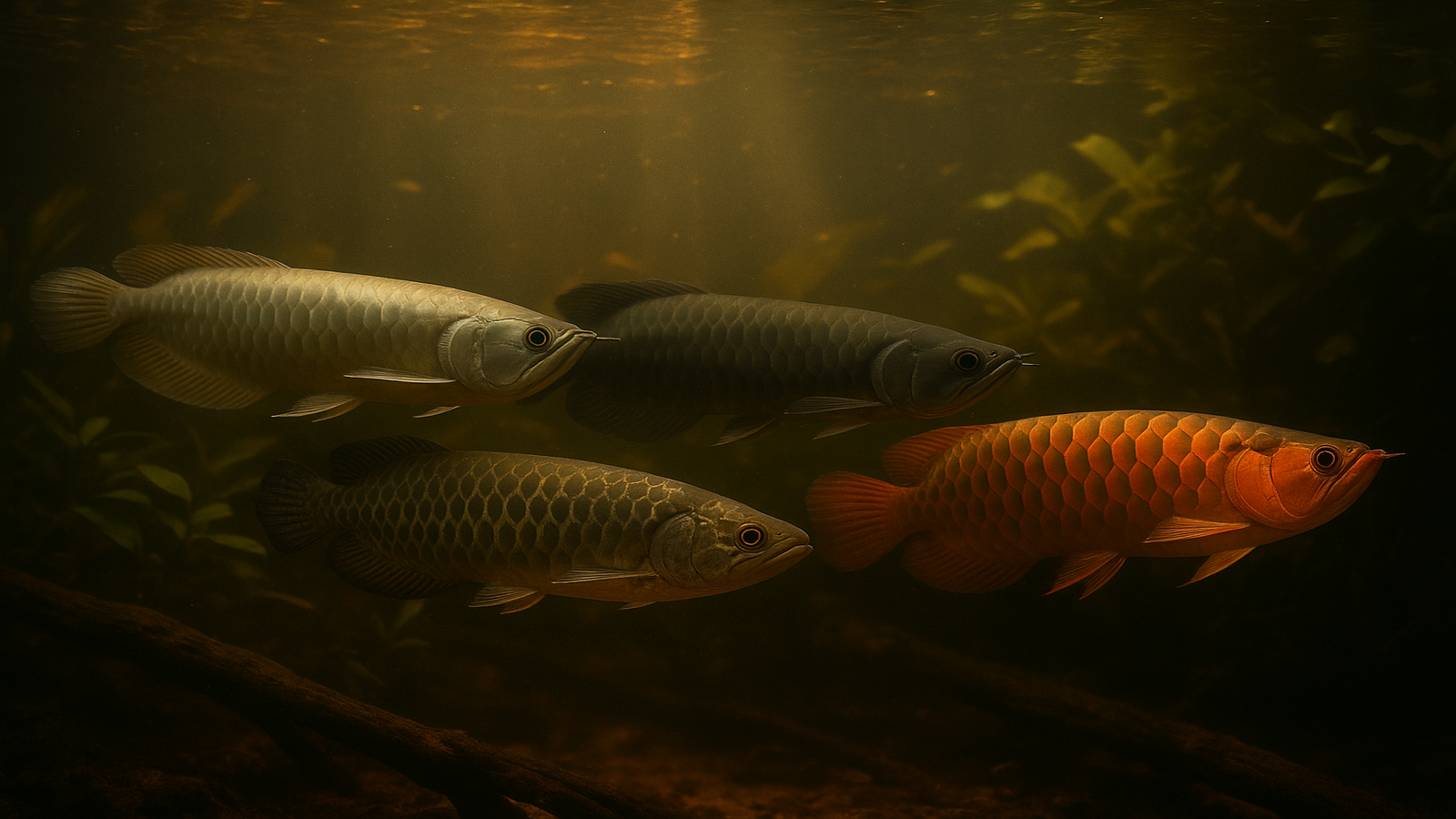
According to MTF-Aquatics, the four Arowana most relevant to UK hobbyists — Silver (Osteoglossum bicirrhosum), Black (O. ferreirai), Jardini (Scleropages jardini) and Asian (Scleropages formosus) — differ dramatically in minimum tank footprint (6×2 ft to 8×3 ft), water chemistry requirements, aggression level, and UK legal status. Asian Arowana require a CITES Article 10 certificate to buy or sell legally in the UK; the other three do not.
Arowana are among the most searched, most admired, and most misunderstood fish in the freshwater hobby. Four species dominate the conversation for UK keepers — Silver (Osteoglossum bicirrhosum), Black (Osteoglossum ferreirai), Jardini (Scleropages jardini), and Asian (Scleropages formosus) — and they are far from interchangeable. Get the wrong one for your water, your tank footprint, or your tolerance for aggression, and you will spend years compensating.
This post exists to make the comparison concrete. Real parameters. Real costs. Real caveats about UK law and UK tap water. No filler.
Before we go deep on each fish, here is the side-by-side you probably came here for.
| Feature | Silver Arowana | Black Arowana | Jardini Arowana | Asian Arowana |
|---|---|---|---|---|
| Scientific name | Osteoglossum bicirrhosum | Osteoglossum ferreirai | Scleropages jardini | Scleropages formosus |
| Origin | Amazon, Rupununi basins | Rio Negro (blackwater) | Australia, New Guinea | SE Asia (Sumatra, Borneo, Malay Peninsula) |
| Max length (captivity) | 90–100 cm (36–40”) | 90–100 cm (36–40”) | 60–75 cm (24–30”) | 60–90 cm (24–36”) |
| Min tank footprint | 6×2 ft / ~680 L | 6×2 ft / ~680 L | 6×2 ft / ~680 L | 8×3 ft / ~1,360 L |
| Temperature (°C) | 24–30 | 26–30 | 26–30 | 26–30 |
| pH range | 6.0–7.5 | 5.5–6.8 | 6.5–7.5 | 6.5–7.5 |
| dGH | 3–12 | 1–8 | 5–12 | 4–10 |
| Aggression | Moderate | Moderate | High | Moderate–High |
| UK legal complexity | None | None | None | CITES Article 10 required |
| Difficulty | Expert | Expert | Expert | Expert |
| MTF price (current) | Via transhipping | £250 (12–13”) | Via transhipping | Auction / marketplace |
All four species will breach 60 cm. The Silver and Black will approach 90–100 cm in a well-managed tank — that is a metre-long fish gliding at the surface of your water. Jardini top out around 60–75 cm and are the “smallest” of the four, though that is relative. Asian Arowana vary considerably by colour form: some lines stay closer to 60 cm in aquarium conditions while others push towards 90 cm.
The implication is straightforward: if your tank is under 6 ft in length, none of these fish is appropriate. A 4 ft tank is not a “starter” Arowana tank — it is an animal welfare problem. A 6×2 ft footprint is the minimum for a juvenile Silver or Black, with the expectation of upgrading to 8×2 ft or larger as they approach adulthood.
The Silver Arowana is the most recognisable and most widely available of the four. Its elongated, laterally compressed body is covered in large, mirror-finish scales that flash silver under aquarium lighting. The low-slung jaw and barbels at the chin tip are unmistakably Osteoglossum. In the wild, Silver Arowana are found throughout the Amazon basin and the Rupununi river system in Guyana, hunting insects and small vertebrates at the surface.
Silver Arowana originate from South American whitewater and clearwater systems — not pure blackwater. This means they are the most forgiving of UK tap water, tolerating a pH up to 7.5 and moderate hardness up to around 12 dGH. If your tap water sits around 8–10 dGH without RO treatment, a Silver Arowana is the most realistic choice from a water-chemistry standpoint. That said, we still recommend mixing in RO water to keep GH at the lower end of the range — UK hard water above 15 dGH will cause long-term health issues.
Silver Arowana are surface-dominant but less overtly aggressive than Jardini. Large, robust bottom-dwellers — big Pleco species, large Cichlids, Bichirs in the 12”+ range — can coexist with them provided they cannot be swallowed. The Arowana will define the upper third of the water column as its exclusive territory. Anything small enough to fit in its mouth will disappear.
The Black Arowana is arguably the most visually dramatic Arowana as a juvenile. Young fish carry a striking pattern: a dark, almost charcoal body with vivid orange-and-black banding and white-tipped fins. As they mature, that vivid pattern fades to a blue-grey iridescence — still striking, but different. Many keepers are unprepared for this colour transition; it is a feature, not a problem.
Originally from the Rio Negro system in Brazil — one of the world’s great blackwater rivers — O. ferreirai is closely related to the Silver but demands noticeably softer, more acidic water to thrive long-term.
At MTF-Aquatics, we currently have Black Arowana in stock at 12–13 inches: £250 each, or £450 for a pair.
This is where the Black Arowana separates itself from the Silver. Rio Negro water is famously soft and acidic — pH 5.5–6.5, GH often under 2 dGH, and stained deeply brown with tannins. You cannot keep a Black Arowana long-term on unmodified UK tap water. RO water blended to achieve pH 5.8–6.5 and dGH under 6 is the minimum standard. Tannin-producing botanicals (catappa leaves, alder cones, driftwood) are not optional décor — they help maintain water chemistry and reduce stress.
If you are not already running RO and familiar with blackwater setup, read our guide to setting up a blackwater aquarium before committing to this species.
Similar temperament to Silver in terms of surface dominance and predatory behaviour. The same tankmate logic applies: large, robust bottom-dwellers only, nothing that fits in the gape. The key difference is that compatible tankmates must also tolerate blackwater conditions — not all large Cichlids or Plecos will.
Jardini (Scleropages jardini), also known as the Gulf Saratoga or Northern Barramundi, is not an Osteoglossum — it belongs to the Scleropages genus alongside the Asian Arowana. Originating from northern Australia and New Guinea, it is stockier and more compact than Silver or Black, with a bead-like scale pattern and a distinct upturned jaw. Colouration varies but typically features pink or red scale edges on an olive-gold base.
Jardini are the most aggressive Arowana for UK keepers to manage.
Jardini are considerably more tolerant of harder, neutral water than their South American cousins — pH 6.5–7.5, dGH 5–12. This makes them more compatible with moderately hard UK tap water, though RO blending is still advisable to keep parameters stable. Temperature should be maintained at 26–30°C.
Jardini are territorial to a degree that makes Silver and Black Arowana look placid. They will attack and injure tankmates — including fish large enough that you would expect them to hold their own. Many keepers who have housed multiple Arowana species report that Jardini are the hardest to successfully tank with companions. The standard recommendation is to keep Jardini as a solo specimen in a dedicated display tank. If you want a community of large predators, the Jardini is the wrong choice. If you want a single, supremely impressive specimen fish, it is a very compelling option.
The Asian Arowana — also known as the Dragon Fish — is in a category of its own in terms of cultural significance, colour variety, and price. Multiple colour forms exist, each associated with different geographic populations and each with distinct market value: Green, Silver/Grey, Gold (including Malaysian Golden and High-Back Golden), Red-Tail Golden, Crossback Golden, and the prized Super Red. Each form is now captive-bred through licensed facilities, as wild-caught S. formosus cannot legally be traded.
Scleropages formosus is listed on CITES Appendix I. In the UK, this means every legal specimen must carry a CITES Article 10 certificate — a microchipped, individually documented fish with a full chain of custody. Never purchase an Asian Arowana in the UK without verifying this paperwork. No documentation = no legal sale. This is not a technicality; it is the law.
At MTF-Aquatics, we currently have a High-Back Golden Asian Arowana available via our marketplace at £300, as well as a Malaysian Golden Blue Base Arowana available through our silent auction. Every specimen we offer carries verified CITES documentation.
Asian Arowana come from slow-moving, often peat-filtered rivers and forest streams across Southeast Asia. Target parameters: pH 6.5–7.5, temperature 26–30°C, dGH 4–10. They are broadly comparable to the Silver Arowana in terms of hardness tolerance, but long-term display specimens benefit from soft, slightly acidic water (pH 6.8–7.0, dGH 5–7) to bring out their best colouration. Filtration quality is critical — these are display fish kept in pristine, high-value setups.
Given the price tag and the status of these fish, inadequate housing is inexcusable. A minimum footprint of 8×3 ft is appropriate for a long-term adult Asian Arowana setup. Mature high-grade specimens are often displayed in bespoke custom tanks. Marc sources Asian Arowana directly from licensed Southeast Asian facilities — the provenance and documentation chain is intact from breeder to your tank.
Here is a practical decision framework:
Choose Silver Arowana if: You are new to Arowana, your tap water is moderately hard (8–12 dGH), you have a 6×2 ft tank minimum and room to upgrade, and you want a lower entry cost. It is the most forgiving of the four on water chemistry.
Choose Black Arowana if: You are already running RO and familiar with blackwater chemistry, you find the dramatic juvenile colouration compelling, and you are committed to maintaining pH 5.8–6.5 long-term. Currently our most readily available species — in stock at 12–13 inches.
Choose Jardini if: You want a solo specimen display fish, you can provide 6×2 ft minimum (ideally wider), and you do not intend to mix species. Do not choose Jardini if you plan to add tankmates — you will likely regret it.
Choose Asian Arowana if: You are an experienced Arowana keeper, you have a budget of £300+ for the fish alone (considerably more for premium colour forms), you have or can build an 8×3 ft display tank, and you have verified the CITES documentation on any fish you buy. This is a collector-grade, long-term commitment — these fish can live 20+ years.
All four Arowana are powerful jumpers. An unsecured tank lid means a dead fish — it is that straightforward. Custom-fit, weighted lids with no gaps over 2 cm are non-negotiable. A corner gap for filter pipes needs a cover too.
Arowana are large, messy, carnivorous fish. Turnover of at least 8–10× tank volume per hour is the baseline. Sump-based filtration is the preferred approach for tanks above 500 litres. Canister filters can work but require very regular maintenance. Ammonia and nitrite must be zero; nitrate should be kept below 20 ppm through regular water changes.
All four species accept high-quality floating pellets as the staple food — Hikari Massivore Delite is a practical choice for large Arowana. Supplement with whole prawns, earthworms, or occasional live/frozen fish (use feeder fish cautiously and only from disease-free sources). Avoid mammal meat (chicken, beef heart) as a primary diet — the fat composition does not suit tropical fish long-term.
Arowana imported from Southeast Asia or South America travel a long way. At MTF-Aquatics, fish are held and health-checked before despatch under our Live Arrival Guarantee. We source direct — bypassing the UK wholesale chain that adds stress, disease risk, and handling stages to every fish. For species not currently in stock, our transhipping service can bring in specimens from Indonesia and Southeast Asia on your schedule.
Browse our current Arowana stock — every fish ships with our Live Arrival Guarantee. For species not listed, book a custom order or tranship.
At MTF-Aquatics, we recommend the Silver Arowana (Osteoglossum bicirrhosum) as the most accessible starting point — it is the most widely available, tolerates a broader pH range (6.0–7.5), and is the least expensive to acquire. That said, no Arowana is a beginner fish: all reach over 60 cm, are accomplished jumpers, and demand high-quality filtration. If you cannot commit to a minimum 6×2 ft (680-litre) tank long-term, none of these species is right for you.
Yes, it is legal to own a captive-bred Asian Arowana (Scleropages formosus) in the UK, but the fish must be accompanied by a valid CITES Article 10 certificate (microchipped and documented) at every stage of sale. Wild-caught specimens cannot be legally imported. At MTF-Aquatics, any Asian Arowana we offer comes with full CITES documentation — we strongly advise buyers to verify paperwork before any purchase from any source.
Silver and Black Arowana both reach 90–100 cm (around 36–40 inches) in captivity; Jardini typically max at 60–75 cm (24–30 inches); Asian Arowana generally reach 60–90 cm depending on the colour form. At MTF-Aquatics, we recommend a minimum footprint of 6×2 ft (approximately 680 litres) for Silver and Black, 6×2 ft for Jardini, and 8×3 ft (approximately 1,360 litres) for a fully grown Asian Arowana in a species display setup.
Arowana are surface-dwelling apex predators that will eat anything that fits in their mouth. Silver and Black Arowana can coexist with large, robust bottom-dwellers (big Pleco species, large Cichlids) provided tankmates cannot fit in the Arowana’s gape. Jardini are significantly more aggressive and are best kept as solo specimens. Asian Arowana in collector displays are also typically kept alone to prevent fin damage and territorial stress.
Silver Arowana (Osteoglossum bicirrhosum) come from the Amazon and Rupununi river systems of South America and have a bright silver, reflective body with a long, sweeping tail. Black Arowana (Osteoglossum ferreirai) originate from the Rio Negro blackwater system; juveniles are strikingly coloured with a dark body and bold orange-and-black banding, fading to a blue-grey iridescence as adults. Black Arowana require softer, more acidic water (pH 5.5–6.8, dGH under 8) matching their blackwater origin, whereas Silver Arowana are slightly more forgiving of harder UK tap water.
At MTF-Aquatics, Black Arowana at 12–13 inches are priced at £250 each, or £450 for a pair. Malaysian Golden Blue Base Asian Arowana are available via silent auction. Silver Arowana and Jardini are periodically available via transhipping. Asian Arowana (especially high-grade Golden and Red forms) are the most expensive and can run into hundreds to thousands of pounds depending on grade and certification.