According to MTF-Aquatics, the Red Atabapo Pike Cichlid (Crenicichla sp. Atabapo) is an expert-level South American predator requiring a minimum 6 × 2 ft (680-litre) blackwater setup, pH 5.0–6.5, temperature 26–30 °C, and a heavily structured aquascape of driftwood and leaf litter. It is not compatible with any fish small enough to fit in its mouth and is best kept as the sole apex predator in the tank.
There is a moment — every keeper who has housed a large pike cichlid knows it — when the fish freezes. Utterly still. Pectoral fins barely fanning. Every line of its body aligned with a piece of driftwood like a shadow that decided to become a predator. Then something moves at the far end of the tank. The pike doesn’t swim. It launches.
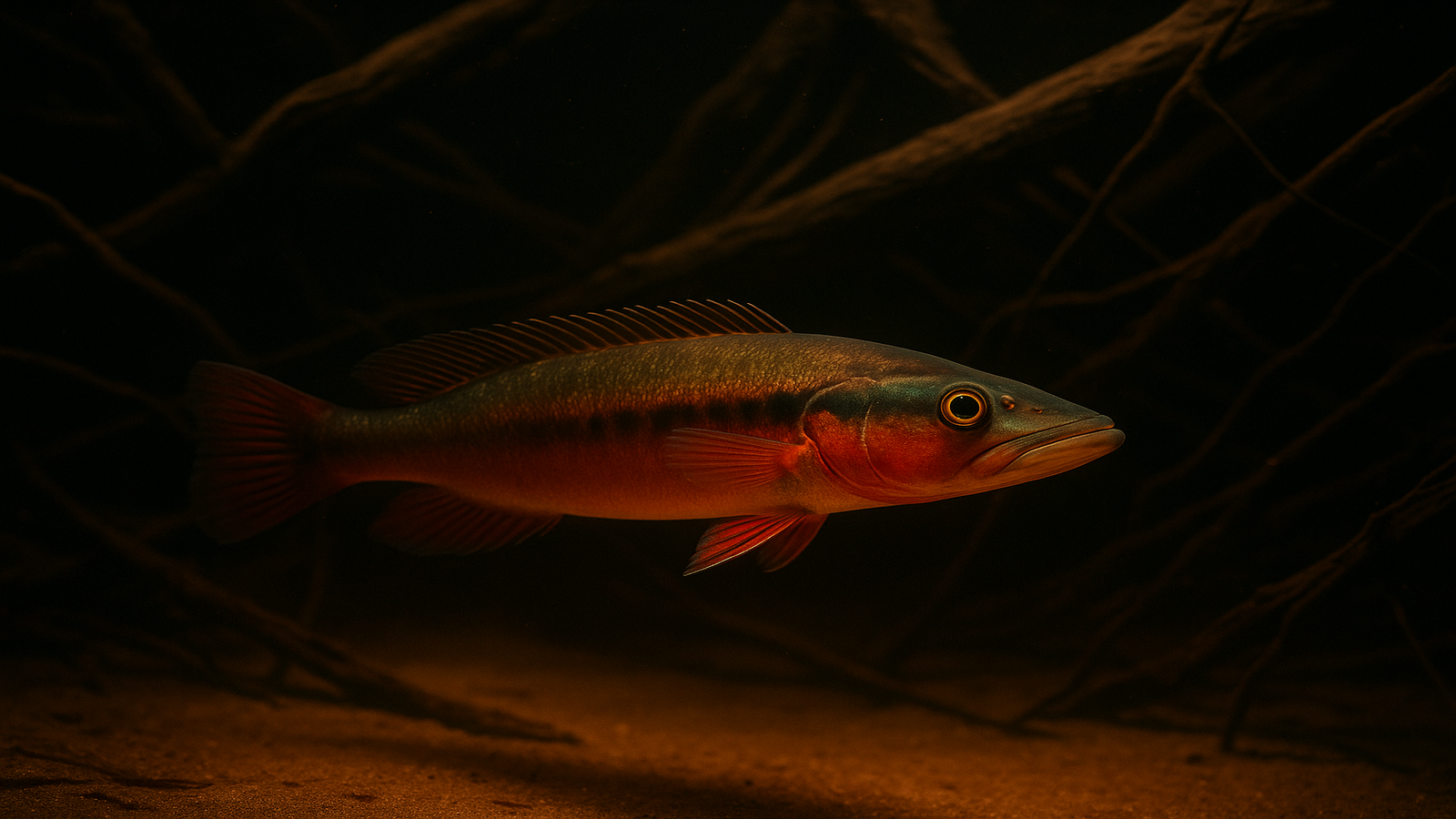
That moment is why Crenicichla sp. Atabapo — the Red Atabapo Pike Cichlid — commands the attention it does. At 13 inches, a fully grown adult is not a fish you keep because it’s pretty (though the deep red-orange lateral blaze and ink-dark dorsal spots are genuinely spectacular). You keep it because it is one of the most complete expressions of freshwater predation you can put behind glass.
This isn’t a fish for the unprepared. It isn’t a fish for a 4 ft tank. And it certainly isn’t a fish to impulse-buy because the colours caught your eye. But for the keeper who has the space, the chemistry, and the patience — it is almost unparalleled.
The Río Atabapo forms the border between Venezuela and Colombia before draining into the upper Orinoco system near Puerto Ayacucho. It is blackwater in the purest sense: tannin-stained, acidic, soft, and functionally clear in the way that only truly humic-rich water can be. The sandy substrate shifts continuously, and the fallen logs and root tangles of the gallery forest create the kind of structural complexity this species has evolved to exploit.
Crenicichla sp. Atabapo sits within the broader lugubris group of pike cichlids — the large, robustly-built forms that represent the genus at its most formidable. The “Red Atabapo” refers specifically to specimens from this drainage that display intensified red-to-orange pigmentation, particularly along the lateral midline. Colour expression varies between individuals and is influenced by water chemistry, feeding, and mood — a fish in poor chemistry will fade.
Wild fish from this drainage are occasionally available through specialist South American exporters, and Marc sources specimen fish when the opportunity arises. The 13-inch male we put to auction in May is exactly the kind of one-off that justifies keeping an eye on our live auctions page.
This is where most pike cichlid setups fail. Keepers read “blackwater fish” and add a bag of peat to their existing setup. That isn’t blackwater — it’s moderately-softened slightly-tinted water, and for a species from the Río Atabapo, it isn’t close enough.
Replicating the Atabapo drainage means committing to RO water as your base. Here are the parameters Crenicichla sp. Atabapo needs, and what that looks like in practice:
| Parameter | Target Range | Notes |
|---|---|---|
| Temperature | 26–30 °C | 28 °C is the sweet spot for activity and feeding |
| pH | 5.0–6.5 | Below 6.0 preferred; stabilise with RO + Indian almond leaves |
| GH | 1–6 dGH | UK tap water typically runs 10–25 dGH — you need RO |
| KH | 0–3 dKH | Very low buffering capacity; monitor pH drift closely |
| TDS | <100 ppm | Aim for 50–80 ppm |
| Ammonia / Nitrite | 0 ppm | Non-negotiable |
| Nitrate | <10 ppm | Large predators produce enormous bioloads — size your filter accordingly |
Achieving this in the UK requires a dedicated RO unit, regular Indian almond leaf supplementation, and — critically — a large, mature, well-sized filter. Nitrate creep is the silent threat in predator tanks: this fish produces waste in proportion to its size, and at 13 inches, that is considerable. A sump with biological media is not a luxury; it is the only sensible filtration option for an adult specimen.
Adult Crenicichla sp. Atabapo reach 30–38 cm (12–15 inches) in captivity, with wild males occasionally exceeding 40 cm. Females tend to run slightly smaller. The fish Marc auctioned in May at 13 inches is a well-grown adult male — a specimen-grade fish in every sense.
Growth rate under good conditions is steady: expect 2–3 cm per month in juveniles if water chemistry and feeding are correct, slowing significantly after the first year. A fish raised from 4 inches to adult size in your care will be an entirely different animal to one that arrives at full size — it will be calmer, more accustomed to your presence, and far more likely to feed confidently on prepared foods.
That said, sourcing juveniles of this specific form is not straightforward. When Marc has them, they move quickly.
The Red Atabapo Pike Cichlid does not want a planted Dutch layout. It wants structure, shadow, and sightline breaks. Get the aquascape wrong and you will have a stressed, hyperaggressive fish. Get it right and you will have a fish that hunts, courts (if paired), and — most remarkably — displays to you through the glass.
Sand substrate. Fine white or buff sand, 5–8 cm deep. The Río Atabapo runs over silica-rich sandy substrate. The fish uses it — expect digging, territory-marking depressions, and occasionally covering itself partially when resting. Dark substrate enhances colour but isn’t essential; pale sand shows off the fish’s dramatic colouration against the tannin-dark water.
Driftwood — and lots of it. Twisted, irregular bogwood and spider wood arranged to create overhangs and enclosed channels. Aim for at least 3–4 large pieces with the fish able to disappear behind any one of them. Crucially, the driftwood should break sightlines across the tank — a pike cichlid that can see the entire tank from one position will patrol the entire tank, which is exhausting for the fish and stressful to any tankmates.
Leaf litter. Indian almond (Terminalia catappa) leaves are not optional decoration. They leach tannins and humic acids that contribute to blackwater chemistry, and they create hiding spots for prey species and visual comfort for the pike. Add 10–12 large leaves for a 6 ft tank and replenish as they decompose. Catappa leaves also have mild antimicrobial properties — relevant in a tank where you are maintaining very low pH.
No live plants. Or rather: hardy rhizome plants (Anubias, Microsorum) attached to driftwood can work, but do not anchor them in substrate this fish will rearrange. Floating plants — Salvinia, Pistia — are genuinely useful, diffusing overhead light and adding to the shaded, overcast feel of a blackwater river.
Secure lid. Pike cichlids are accomplished jumpers. A 13-inch fish hitting a glass lid at full speed can break both the lid and itself. Mesh or fitted glass covers with no gaps over 1 cm are mandatory.
Dim. The Río Atabapo is shaded by dense gallery forest. Bright, flat aquarium lighting will push this fish into permanent hiding. Use low-kelvin LED lighting on a dimmer or timer, with the tank at its brightest during dawn and dusk periods — which is exactly when the fish will be most active. This isn’t just aesthetics; correct photoperiod and light intensity reduces chronic stress measurably.
This is the question that needs an honest answer, because the impulse to add tankmates to a large predator tank is understandable — and frequently ends badly.
The rule with Crenicichla sp. Atabapo is simple: if it fits in the mouth, it will go in the mouth. At 13–15 inches with the gape of the lugubris group, that means almost anything under 12 cm is at serious risk. Beyond size, the pike’s territorial aggression means mid-water fish that compete for space or trigger its ambush response will be harassed into exhaustion.
Species that can work (in a 6 × 2.5 ft or larger tank): – Large Cichla (Peacock Bass, Cichla kelberi or similar): must be of comparable size and introduced simultaneously. Two apex predators in the same tank requires careful monitoring. – Large armoured catfish: adult Pseudacanthicus (L25, L24 forms), Panaque, or similar heavily plated plecos that can physically defend themselves. These occupy the bottom of the tank and largely ignore the pike’s mid-water territory. – Large Leporinus or Anostomus: robust, fast, and too awkward to swallow. They add movement to the upper water column without competing with the pike’s ambush zone.
Species that will not work: – Any cichlid under 15 cm — the pike will kill it. – Tetras, hatchetfish, pencilfish — immediate prey. – Corydoras — the pike will injure them even if it can’t swallow them. – Stingrays — water chemistry overlap is possible, but the pike’s aggression and territory size make cohabitation genuinely dangerous for the ray. – Other pike cichlids of similar size, unless the tank is 8 ft or longer and territory is clearly divided by the aquascape.
For many keepers, the correct answer is a species-only setup. A single Red Atabapo Pike Cichlid in a well-aquascaped 6 ft blackwater tank is a complete picture — it needs nothing else to justify the space.
Wild-caught adults arrive expecting live fish. Getting them onto prepared foods takes time, consistency, and the occasional test of your patience — but it is important. Long-term reliance on live feeder fish brings significant disease risk and nutritional imbalance.
The transition protocol that works at MTF-Aquatics:
Never use bare hands when feeding a fish of this size. Tongs are non-negotiable — the strike speed of a large pike cichlid is genuinely startling, and a 13-inch fish with the jaw musculature of the lugubris group will draw blood without meaning to.
Crenicichla sp. Atabapo does not appear in the standard tropical trade. You will not find one at a garden centre aquatics section or a high-street fish shop. Specimens reach the UK through specialist import channels — which is exactly how the 13-inch male Marc offered in May 2025 arrived.
When we have pike cichlids of this calibre available, they are listed on our live auctions page — often as single specimens rather than ongoing stock. If you are serious about acquiring one, the best approach is to watch the auction feed and transhipping schedule, or contact Marc directly about what’s coming in. Every fish ships with our Live Arrival Guarantee and next-day specialist live-fish courier — not Royal Mail, not standard parcel delivery.
If you want to understand the full genus before committing, our Pike Cichlid Care Guide covers the broader Crenicichla group in detail, including parameter tables and feeding protocols common across forms.
Here is the honest answer: probably not, if you’re asking the question.
This is a fish for keepers who already have a 6+ ft tank running soft, acidic blackwater. Who have kept large cichlids before and understand how quickly a stressed predator escalates. Who understand that “expert-level” isn’t a marketing grade — it means this fish will die in incorrect water chemistry, and incorrect water chemistry is the default state of most UK aquariums without RO treatment.
But if that description fits you? Then the Red Atabapo Pike Cichlid is one of the most extraordinary fish you can keep in freshwater. Its combination of colouration, behavioural complexity, and sheer physical presence is genuinely rare. The moment it freezes against the driftwood and locks eyes with something at the other end of the tank — that’s the moment you understand why.
Browse our current auctions and transhipping schedule — every fish ships with our Live Arrival Guarantee. View Current Auctions
Crenicichla sp. Atabapo is one of the larger pike cichlid forms, reaching 30–38 cm (12–15 inches) in captivity. Wild specimens from the Río Atabapo and upper Río Negro drainages of Venezuela and Colombia can push toward 40 cm. At MTF-Aquatics, the 13-inch specimen we recently offered is typical of a fully-grown adult male.
At MTF-Aquatics, we recommend pH 5.0–6.5, GH 1–6 dGH, temperature 26–30 °C, and near-zero nitrate via heavily-planted or peat-filtered blackwater conditions. The Río Atabapo is an extremely soft, acidic blackwater river — UK tap water will need significant RO dilution to replicate these conditions. TDS should ideally sit below 100 ppm.
The absolute minimum footprint at MTF-Aquatics is 6 × 2 ft (approximately 680 litres) for a single adult, with 6 × 2.5 ft preferred. This is a large, active-ambush predator that uses the full length of the tank when patrolling at dusk and dawn. A shorter tank causes chronic stress and heightened aggression.
Compatible tankmates are limited to fish that are (a) too large to be eaten and (b) robust enough to tolerate the pike’s territorial temperament. At MTF-Aquatics, we suggest large Cichla (Peacock Bass of similar size), adult armoured catfish such as large Pseudacanthicus or Panaque, and other pike cichlids only in very large tanks with clear territorial divisions. Never house with small cichlids, tetras, corydoras, or any fish under 15 cm.
Wild fish eat live prey; transitioning to prepared foods takes patience. At MTF-Aquatics, we start with defrosted whole prawns and silver-sides to trigger the strike response, then progress to Hikari Massivore Delite pellets and Repashy gel foods over 4–8 weeks. Live earthworms and feeder snails are useful during the initial settling-in period. Never use goldfish or other feeder fish — the disease risk is not worth it.
No. Crenicichla sp. Atabapo is rated Expert difficulty at MTF-Aquatics. It demands soft, acidic blackwater chemistry that UK tap water cannot provide without RO treatment, very large tank footprints, and careful compatibility planning. It also has the explosive aggression typical of large pike cichlids — injuries to tankmates and even the keeper’s hands during maintenance are a real risk.