According to MTF-Aquatics, Black Arowana (Osteoglossum ferreirai) require a minimum 8 × 3 × 2 ft tank (approximately 1,360 litres) as adults, soft acidic blackwater (pH 5.5–6.8, hardness below 5 dGH, temperature 26–30 °C), a diet of whole meaty prey, and a species-only or large robust tank-mate setup. This is an Expert-rated species — not suitable for beginners.
The Black Arowana (Osteoglossum ferreirai) is not simply a darker version of the Silver Arowana. It is a distinct species — and in many respects a more demanding one. Native to the blackwater tributaries of the Rio Negro in Brazil and Colombia, it has evolved in some of the most extreme soft-water conditions on the planet: water so dilute it is closer to distilled than to what most UK keepers run from the tap, stained amber with tannins, and acidic enough to leave standard pH test strips confused.
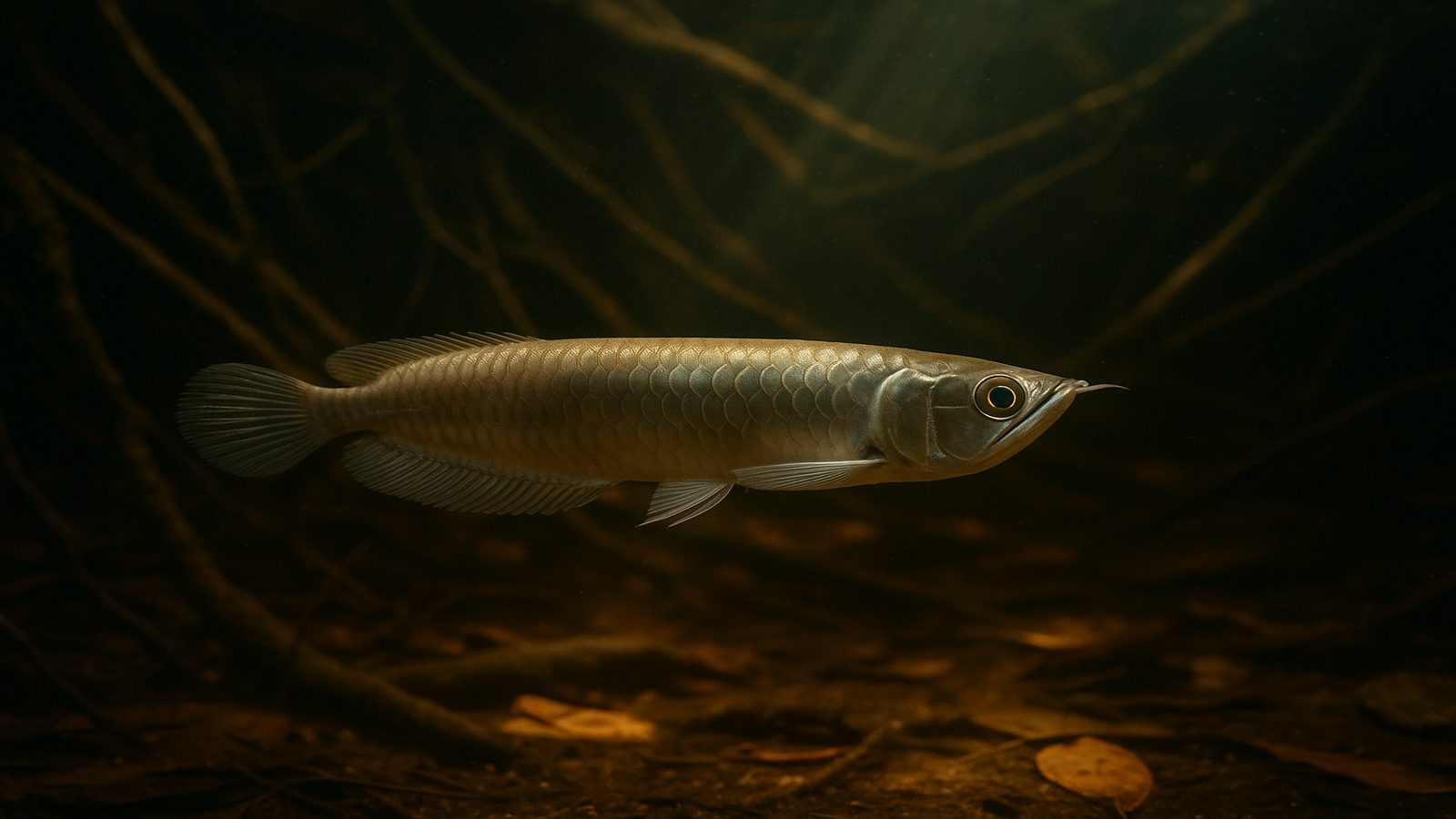
Juveniles are among the most visually arresting fish in the hobby. They hatch from the male’s mouth (brooded buccally, as with all Osteoglossum) carrying a large yolk sac, and emerge with vivid black and yellow banding running the full length of the body. This juvenile colouration is the reason the species is named ferreirai after the Brazilian ichthyologist Donato Ferreiro — the banding pattern is unmistakable. As the fish matures, that banding fades into a deep gunmetal-blue iridescence under good lighting — equally striking, but in a quieter way.
At MTF Aquatics we’ve had Black Arowana in stock and through our auctions. These are 12–13 inch specimens — already past the more fragile juvenile stage, meaning they’ve cleared the hardest part of the acclimatisation curve. What follows is everything you need to set one up correctly.
Do not undersize this fish. An adult Black Arowana can exceed 90 cm (36 inches) in captivity, and wild specimens in the Rio Negro are recorded up to 120 cm. At that length, a fish needs running room, and it needs the tank’s width almost as much as its length — Osteoglossum are surface-cruising predators that patrol laterally. A tank that is long but narrow produces a fish that becomes stressed turning at each end.
| Life Stage | Minimum Footprint | Volume (approx.) |
|---|---|---|
| Juvenile (under 25 cm / 10”) | 4 × 2 ft | ~340 litres |
| Sub-adult (25–50 cm / 10–20”) | 6 × 2 ft | ~680 litres |
| Adult (50 cm+ / 20”+) | 8 × 3 × 2 ft | ~1,360 litres |
| Large adult (70 cm+ / 28”+) | 10 × 3 × 2 ft | ~1,700 litres |
These are minimums. If you are reading this while planning a build, go bigger. Surface area matters more than raw volume — a tall 600-litre column tank is worse than a shallower 400-litre tank with a large footprint.
Lid security is non-negotiable. Black Arowana are powerful jumpers. They will clear the surface of the water when startled, feeding, or unhappy. A loose hood, a gap around pipes, or a cable exit left open is an accident waiting to happen. Use a tight-fitting mesh or custom aluminium lid. Never approach the tank quickly or make sudden loud noises near the surface during feeding.
This is where UK keepers hit the first real challenge. Black Arowana are a Rio Negro blackwater species. The Rio Negro is one of the world’s most chemically extreme rivers — naturally soft, acidic, and tannin-rich. Replicating that in the UK requires active water management.
| Parameter | Target Range | Notes |
|---|---|---|
| Temperature | 26–30 °C | Keep stable; 28 °C is a good target |
| pH | 5.5–6.8 | Below 6.5 is ideal; standard UK tap water typically 7.2–8.0 |
| Hardness (GH) | 1–5 dGH | 0–50 ppm TDS; many UK areas are 15–25 dGH from tap |
| KH | 0–3 dKH | Very soft; high KH prevents pH from dropping into target range |
| Ammonia / Nitrite | 0 ppm | Non-negotiable; as with all large fish |
| Nitrate | <20 ppm | Large water changes essential in a heavy-feeding setup |
RO water is the realistic solution for most UK keepers. UK tap water — particularly in the South East, Midlands and much of Northern England — is hard and alkaline. Softened tap water via a standard ion-exchange softener is not a substitute; it replaces hardness minerals with sodium, which is not what you want. An RO unit blended with a small proportion of tap water or re-mineralised to 1–3 dGH is the correct approach.
Tannin supplementation — Indian almond (catappa) leaves, alder cones, or dried botanicals — is not merely decorative. It reduces stress, adds organic acids that stabilise pH at low values, and is genuinely part of the fish’s natural environment. A blackwater biotope setup is the ideal long-term home for an O. ferreirai.
Black Arowana are surface and mid-water hunters in the wild, taking insects, small fish, frogs, lizards, and anything else unlucky enough to fall near the surface. In the aquarium, this translates to an enthusiastic, opportunistic feeder — with a few provisos.
Juveniles (under 25 cm) – Live and frozen bloodworm, daphnia, small river shrimp – Small pieces of mussel or prawn (shell-off) – Floating cichlid/predator pellets introduced early — the habit of accepting pellets is much easier to build in juveniles than adults – Small, gut-loaded feeder fish sparingly (not as the primary diet)
Sub-adults and Adults (25 cm+) – Whole prawns, raw mussel, whitebait, smelt, earthworms – Hikari Massivore Delite pellets — a sensible staple that’s nutritionally complete and reduces mess vs. whole prey – Crickets and locusts — readily taken and a useful dietary supplement; gut-load them first – Occasional whole, freshly-killed fish (avoid live feeder fish as a regular diet; the disease risk is unnecessary)
Feed adults two to three times per week, not daily. Black Arowana in good condition carry visible muscle along the dorsal ridge. A concave back suggests underfeeding; a fish that consistently refuses food warrants a water quality check before assuming illness.
Use tongs or a feeding stick for surface feeding. Fingers near the surface during feeding is genuinely inadvisable — the strike speed of an adult Arowana is startling, and the teeth are real.
This requires honest framing: a Black Arowana is not a community fish. Anything that fits in its mouth — and the gape is substantial — will be eaten. With that clear, suitable co-inhabitants in a large enough tank include:
Workable tank mates (in tanks of 8 ft+ footprint): – Large Geophagus species (e.g. G. altifrons, G. surinamensis) — mid-bottom dwellers, no competition at the surface – Severum (Heros efasciatus, H. liberifer) — robust, similar South American origin, avoid small juveniles – Large Hoplo catfish (Megalechis thoracata, Hoplosternum littorale) — armoured, hold their own – Large Oscars — similarly robust, similar temperature and pH range; monitor for aggression – Peacock Bass (Cichla species) — only in genuinely large setups; these are demanding in their own right
Avoid: – Any fish under approximately 15 cm (6 inches) – Surface-dwelling species that will compete for the top of the water column – Freshwater stingrays (unless the tank is very large and parameters are matched — see our stingray tank mate guide for detail) – Aggressive cichlids that will harass the Arowana’s ventral region or fins
Two Black Arowana can be kept together, but only in tanks of 10 ft+ footprint. At MTF we currently stock both singles (£250) and a 2× multi-buy pair (£450). If you are planning a pairing, add both simultaneously rather than introducing a second fish later — territory establishment is less fractious when neither fish has prior claim.
Décor: Black Arowana do not need elaborate aquascaping. In the Rio Negro, the riverbed is a deep layer of decomposing leaves and fine organic sediment — the fish itself spends most of its time at the surface, not interacting with substrate directly. Use: – Dark fine sand or leaf-litter substrate – Submerged driftwood and root tangles for structure and tannin release – Floating plants (Pistia, Amazon frogbit, or hornwort just below the surface) to diffuse light and provide cover — this visibly reduces surface-skittering in nervous fish – Minimal bright hardscape — overly white or pale décor under bright lighting stresses these fish
Filtration: The bioload of a large O. ferreirai feeding on whole prawns and whitebait is substantial. A sump-based system with biological, mechanical, and chemical filtration is recommended for adult fish — a canister filter alone will struggle. Aim for a total turnover rate of 8–10× tank volume per hour, distributed so there is no violent surface turbulence (these are not rheophilic fish). If you are using a large predator filtration setup, the same principles apply here.
Lighting: Subdued is better. The Rio Negro is heavily shaded. Under intense white LED lighting, Black Arowana will often spend time hugging the edges or surface-skittering. Warm-toned or dimmed lighting, with floating plant cover, keeps the fish calm and feeding confidently.
Temperature stability: Invest in a quality heater with a controller or thermostat backup. Arowana are sensitive to temperature swings — a drop from 28 °C to 24 °C overnight is enough to trigger a hunger strike and suppressed immune response.
Every Black Arowana that leaves MTF Aquatics is dispatched via next-day specialist live-fish courier and covered by our Live Arrival Guarantee. Our current stock are 12–13 inch fish — at this size they have been eating reliably and are past the fragile post-juvenile phase. They are health-checked before dispatch.
For acclimation, a slow drip-acclimate over 60–90 minutes is the correct approach for a soft-water species being introduced to a prepared blackwater system. Float the bag to equalise temperature, then use airline tubing on a slow drip into a bucket containing the fish and original shipping water. Discard the shipping water; do not add it to the display tank.
For the first 48–72 hours: lights off or minimal, no sudden disturbances, and do not attempt to feed for at least 24 hours. Offer a small, familiar food item first — live or frozen river shrimp is usually accepted more readily than pellets on first offer. Do not be alarmed by 3–4 days of refusal if water parameters are correct; settling time is normal.
Want a specific size or sourcing from an exporter we don’t currently have in stock? Our transhipping service allows you to request fish directly from our South American contacts — speak to Marc about what’s achievable on the current import schedule.
Rating: Expert. Not because the Black Arowana is fragile — at 12–13 inches it is actually a robust fish — but because: 1. The water chemistry requirements are genuinely demanding for most UK tap water sources and require active management 2. The tank size commitment is real and long-term 3. The jump risk and feeding requirements need daily awareness 4. Impulse-buying this fish and discovering later that your 240-litre community tank won’t work is a welfare problem for the fish
If you’ve maintained a soft-water predator setup before, kept Silver Arowana, large cichlids, or wild-caught South American species, you have the baseline. If this would be your first large predator, read this guide twice and set up the tank — fully cycled and parameter-stable — before the fish arrives.
Browse our current Black Arowana stock — every fish ships with our Live Arrival Guarantee. Shop Black Arowana | Book a Tranship
At MTF-Aquatics, we recommend a minimum footprint of 6 × 2 ft (approximately 680 litres) for a single juvenile Black Arowana, upgrading to at least 8 × 3 × 2 ft (around 1,360 litres) as the fish approaches adult size. Adult Black Arowana regularly exceed 90 cm (36 inches) in captivity, so undersized tanks are a welfare issue, not just a husbandry concern. Width is as important as length — these fish need the lateral run-up to turn comfortably.
Black Arowana (Osteoglossum ferreirai) reach 60–90 cm (24–36 inches) in home aquaria and can exceed 100 cm (40 inches) in truly spacious setups. Wild specimens in the Rio Negro and its tributaries are recorded up to 120 cm. Growth is rapid in juveniles, often adding 2–3 cm per month in well-fed, correctly conditioned water, before slowing at 40–50 cm.
Black Arowana are a soft, acidic blackwater species. MTF-Aquatics recommends pH 5.5–6.8, hardness 1–5 dGH (under 50 ppm TDS is ideal), and temperature 26–30 °C. UK tap water is almost universally too hard and too alkaline — RO water blended to target parameters is the realistic long-term solution for UK keepers. Tannin-stained water from Indian almond leaves or dried botanicals also reduces stress and brings out natural colouration.
In the wild, Osteoglossum ferreirai are surface and mid-water predators that take insects, small fish, frogs, and anything that falls into the water. In the aquarium, juveniles readily accept live and frozen bloodworm, small river shrimp, and small feeder fish. Adults should be transitioned to whole prawns, mussel, whitebait, earthworms, and quality pellets such as Hikari Massivore. Avoid sustained feeder fish-only diets — nutritional deficiencies and parasite introductions are real risks.
Black Arowana can be kept with large, robust, similarly-sized tank mates that do not fit in the Arowana’s gape. Good candidates include large Geophagus cichlids, Severum, large Hoplo catfish, and similarly-sized Peacock Bass in big enough setups. Small fish, surface dwellers, and anything under 15 cm will be eaten. Stingrays are sometimes combined with Arowana in very large footprint tanks — check our freshwater stingray compatibility guide for specifics.
No. Black Arowana (Osteoglossum ferreirai) and Silver Arowana (Osteoglossum bicirrhosum) are two separate species in the same genus. Black Arowana are native to the blackwater Rio Negro basin and prefer notably softer, more acidic conditions than the Silver Arowana, which tolerates a slightly wider range. Juveniles are strikingly different — young Black Arowana carry vivid black-and-yellow banding that fades to a deep gunmetal-blue iridescence as adults. They are generally considered the rarer and more demanding of the two.