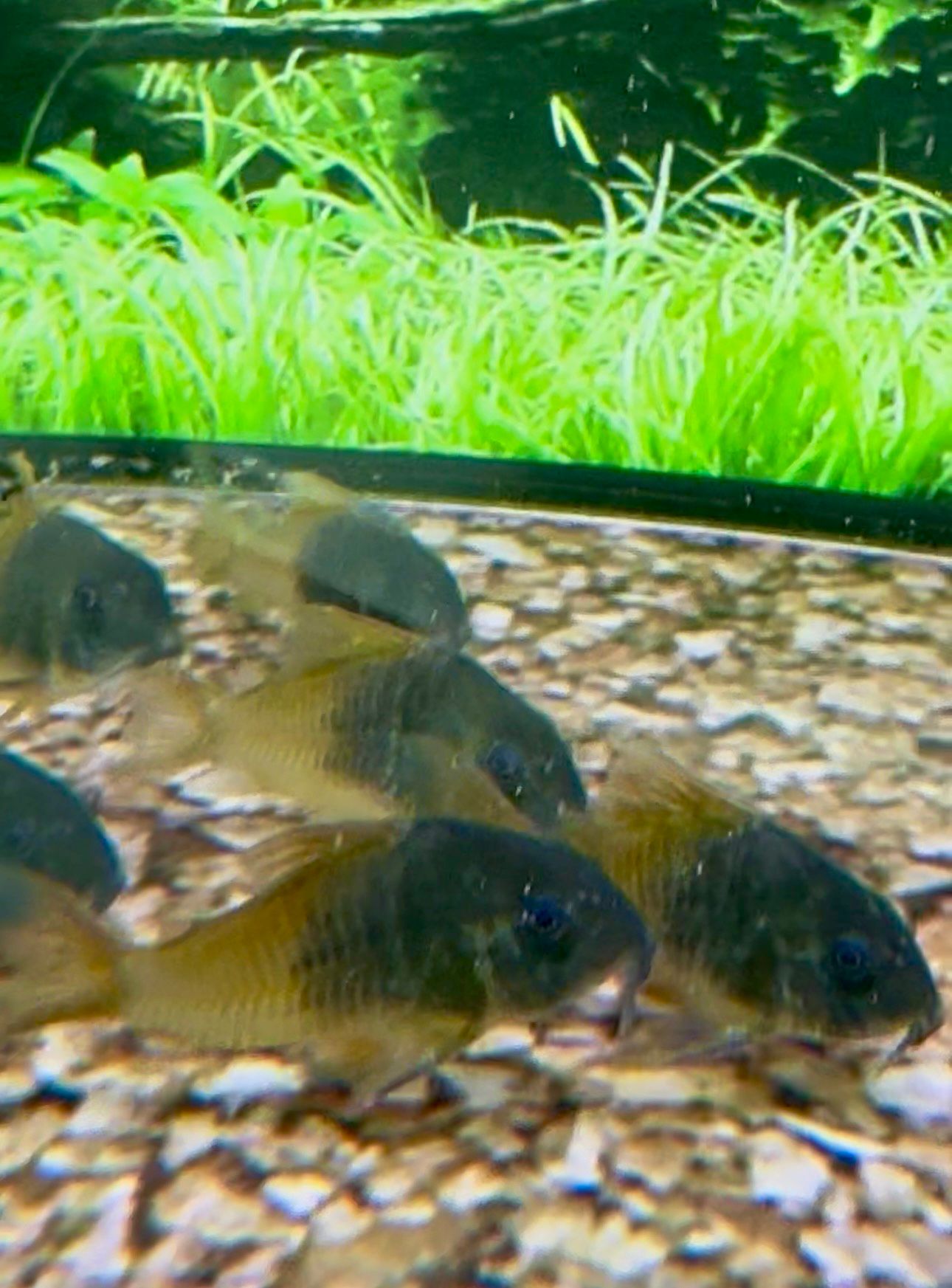
Corydoras are the default ‘community catfish’ on every high-street shop list, but the gap between a mass-bred farm Cory and a hand-selected wild import is bigger than most keepers realise. It shows up in colour, in behaviour, in disease resistance, and ultimately in whether your shoal is still intact in twelve months. This guide is aimed at intermediate UK hobbyists building a serious community tank — planted, soft-water, mixed South American — who want to know what they’re actually buying.
Most commonly-kept Corydoras sit in the same broad envelope, but wild stock tightens the tolerances considerably.
| Parameter | Tank-bred (farm) | Wild-caught |
|---|---|---|
| Temperature | 22–26 °C | 23–27 °C (species-dependent) |
| pH | 6.5–7.6 | 5.8–7.0 |
| dGH | 4–15 | 2–8 |
| TDS | up to 350 ppm | 50–200 ppm |
| Min tank footprint | 24×12 in (60 L) for dwarf species | 36×15 in (~125 L) preferred |
| Group size | 6+ | 8–12 of the same species |
UK tap water in much of the south and east runs hard and alkaline — fine for many farm-bred Sterbai or Bronze, marginal for blackwater wilds. If you live in a hard-water postcode and want to keep wild Corydoras properly, you need an RO unit and a remineraliser. There is no workaround for this.
Large-scale farm production in South East Asia has been crossing Corydoras for decades. A ‘Sterbai’ from a generic wholesaler may carry hybrid traits — slightly off finnage, washed-out spotting, or sterility. For a planted community tank that’s cosmetic. For a keeper trying to breed or maintain a specific line, it isn’t.
Wild imports come in under collection codes — C-numbers and CW-numbers — assigned by Aqualog and Ian Fuller’s Corydoras World to fish that are either undescribed or distinct local forms. Our current Corydoras Hoplisoma sp. aff. Concolor – CW217 is a good example: a Concolor-group fish from a specific catchment, not a farm cross.
Wild fish arrive carrying their environment — including organisms a sterile farm system would never produce. That’s why direct transhipping with a proper quarantine period matters. We hold every wild Cory until feeding response, weight and behaviour are right. Farm fish, conversely, often arrive immune-naive: bred in clean, antibiotic-supported systems and dropped into a hobbyist tank with predictable consequences six weeks later.
The practical takeaway: wild fish should never go straight into a display. A four-week quarantine at the receiving end, on the same temperature and pH you’ll keep them at long-term, is non-negotiable.
Wild Corydoras shoal harder. They forage in waves, sleep in piles, and spawn on the back of a barometric pressure drop. Farm fish — especially line-bred for hardiness — often look like they’re ‘doing Cory things’ but with the volume turned down. If you want the textbook community-tank behaviour the books describe, wild or F1 stock delivers it more reliably.
A single farm Bronze Cory might be £4. A CW217 sits at £75 per fish, or £300 for a group of five via our multi-buy listings. That gap reflects collection, transhipping, mortality through the chain, and the holding period at our end. Buying one rare wild Cory and ‘topping it up later’ from a different source is the single most common mistake we see. They shoal by species; a lone CW217 in a group of Pandas will not behave the way you want it to.
Fine sand. Specifically, smooth silica or a rounded inert sand at 2–3 mm grain. No sharp basalt, no pea gravel. Barbel erosion is permanent — once a Cory’s sensory barbels are worn back to stumps, you’ve taken away its primary feeding apparatus.
Corys are blackwater fish but they’re not still-water fish. Aim for moderate flow with a clear oxygen-rich layer near the substrate. A spray bar across the back glass, broken by some wood, works better than a single powerhead pointed at the front pane.
Driftwood, leaf litter (catappa, oak), and a clump of broad-leaved plants — Anubias on wood, a stand of Cryptocoryne — give a shoal places to rest between forages. A bare-bottom tank with one piece of bogwood is a quarantine setup, not a display.
Good: small to medium Tetras (Rummynose, Black Neon, Lemon), Hatchetfish, peaceful Apistogramma, dwarf Pencilfish, small Loricariids (Bristlenose, smaller L-numbers).
Marginal: Angels (fin-nippy juveniles can pester resting Cory groups), larger Gouramis (surface aggression unsettles a shoal), Rams (compete for the same substrate zone).
Avoid: any cichlid with a substrate territory above 15 cm SL, large catfish that hunt at night, anything tagged ‘semi-aggressive’ on a shop sticker. Corys do not have a defensive response beyond their pectoral spines — and those spines are an envenomation risk to large predators that try to swallow them, which usually kills both fish.
Corydoras are omnivorous bottom-foragers, not algae-eaters. A working rotation:
Feed in the evening with the lights off if you have competing midwater fish. Wild Corys in particular are more confident in low light, and you’ll see proper foraging behaviour rather than scrambling.
Before you put a card down on any Corydoras — ours or anyone else’s — you should know:
If the shop can’t answer those, the fish is a gamble.
We import wild Corydoras direct via our transhipping service, which lets us bypass the UK wholesale chain entirely. Fish arrive into our facility, go through a quarantine period on RO-cut water matched to their origin, and are held until Marc is satisfied they’re feeding and stable. Only then do they go up for sale. Every order ships next-day on a specialist live courier and is covered by our Live Arrival Guarantee — the same policy that applies to a £30 tetra or a four-figure stingray.
If the species or form you want isn’t in stock, ask. CW-number Corydoras tend to come through on specific tranships rather than as constant standing stock, and we can usually flag the next window.
If you want a hardy community shoal and you’re on hard London tap water, a group of eight to ten tank-bred Bronze or Sterbai is genuinely the right answer. We won’t pretend otherwise.
If you want a specific wild form — a CW217, a true Hoplisoma duplicareus, an Adolfoi from a known catchment — be honest with yourself about parameters, group size, and budget. Bought right and kept right, wild Corydoras are one of the most rewarding shoaling fish in the hobby. Bought lazily, they’re an expensive disappointment.
Browse our current Catfish category for what’s on the system now — every fish ships with our Live Arrival Guarantee.