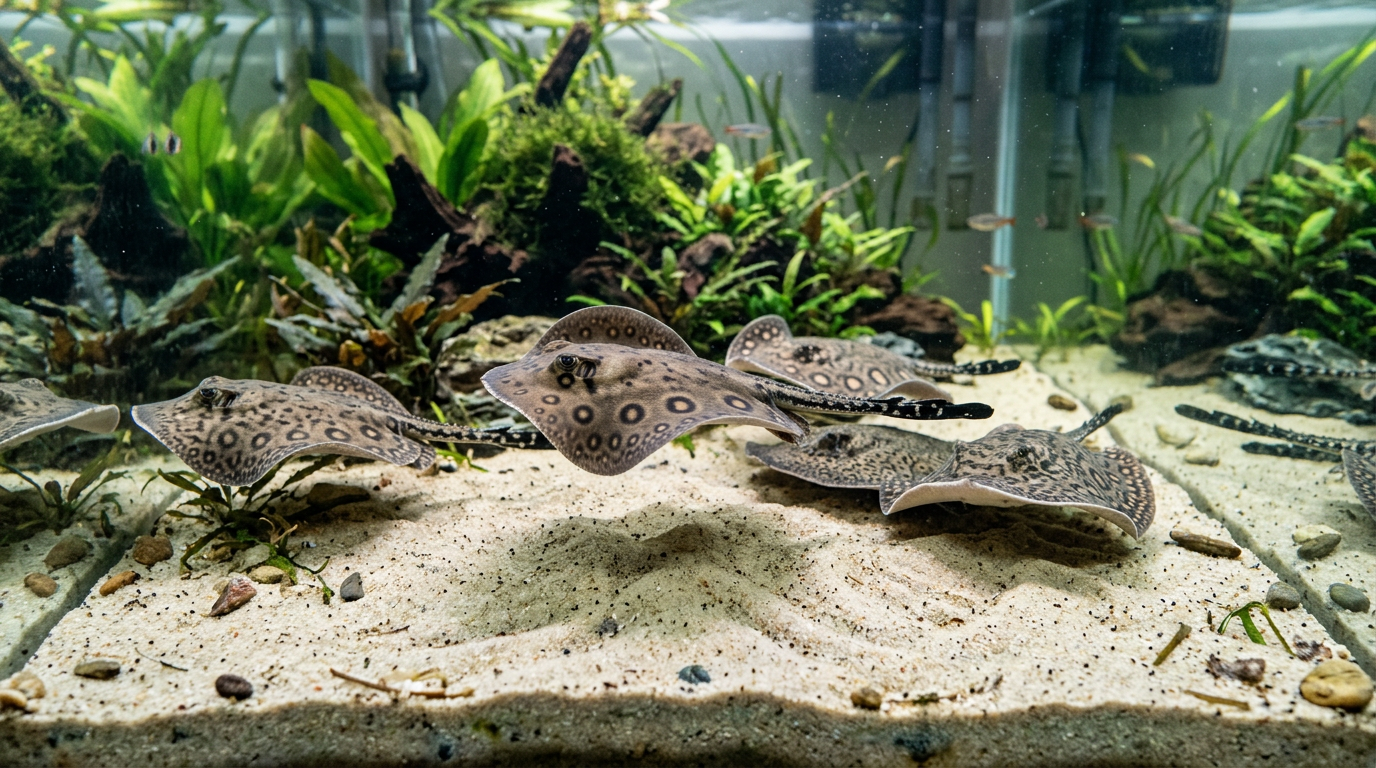
Freshwater stingrays (family Potamotrygonidae) are among the most captivating fish available in the hobby. Native to the river systems of South America, these ancient cartilaginous fish have evolved into fully freshwater species. Their disc-shaped bodies, intricate patterning and intelligent behaviour make them a centrepiece fish for any serious aquarist. However, they demand pristine water quality, substantial space and expert care.
Species most commonly seen in the UK trade include the Motoro Stingray (Potamotrygon motoro), the Pearl Stingray (P. leopoldi and albino/snow white morphs). MTF Aquatics sources directly from specialist breeders and wild-caught stock, ensuring all fish are acclimatised and feeding before sale.
Stingrays are active swimmers and spend most of their time cruising the bottom. Juveniles of 15 cm disc can be housed temporarily in a 4 x 2 ft tank, but adults require an absolute minimum of 8 x 4 x 2 ft. Wider is always better: the disc width should not exceed half the tank width.
Stingrays are exceptionally sensitive to ammonia, nitrite and elevated nitrate. Even brief spikes can be fatal. Target a turnover rate of 8-10x tank volume per hour. Aim for: Ammonia 0 ppm, Nitrite 0 ppm, Nitrate under 20 ppm. Perform 30-40% water changes weekly. Wild stingrays live in soft, slightly acidic blackwater — replicate this using RO water remineralised to a GH of 2-6.
Maintain water temperature between 26-28 C. Temperatures below 22 C suppress the immune system. Use a quality titanium heater with an external controller. A backup heater is strongly recommended.
Freshwater stingrays are carnivorous predators. In captivity feed: whole raw prawns, earthworms, mussel and squid, tilapia fillet, and whitebait. Feed juveniles daily; adults every 2-3 days. Do not use goldfish as feeder fish — they contain thiaminase which causes vitamin B1 deficiency.
Suitable companions include large tetras (Silver Dollars), peaceful cichlids (Uaru, Geophagus), and Arowana. Avoid: any fish small enough to be eaten; aggressive species; catfish with spiny pectoral fins which can injure the ray’s disc.
The venomous tail spine is a serious concern. The venom causes intense, long-lasting pain. Always use long-handled nets and never put bare hands into the substrate without checking first. When transporting a ray, use a large container with a lid — never chase a stressed ray with a net.
Freshwater stingrays are viviparous — females give birth to live young (2-7 pups depending on species). The gestation period is approximately 3 months. Pups are born fully formed at around 5-8 cm disc width and can be fed small earthworm pieces and frozen bloodworm immediately.
Browse our current stock — every fish ships with our Live Arrival Guarantee.
Shop Tropical FishBook a Tranship