
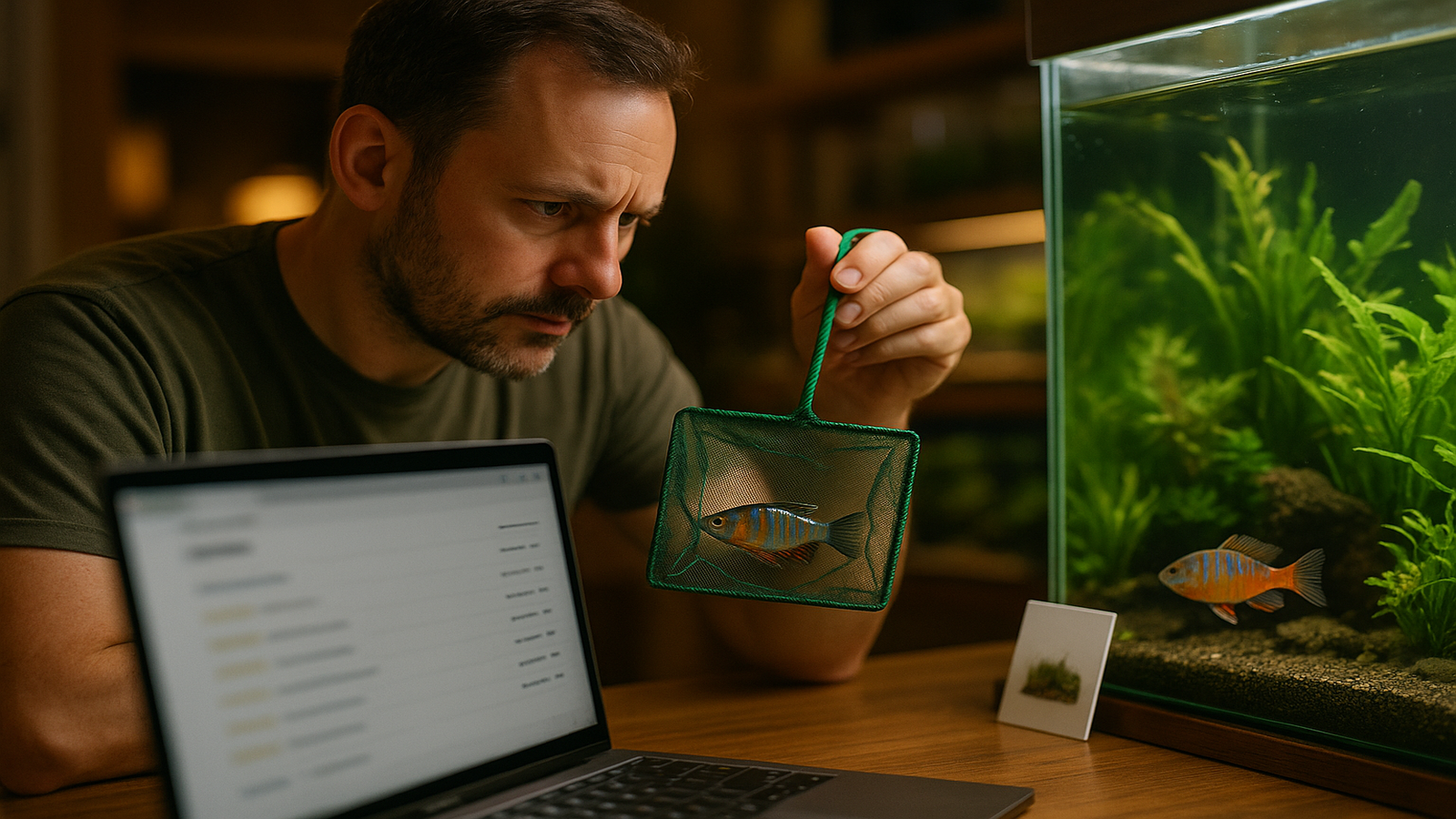
At MTF-Aquatics, we recommend UK fish auctions buyers follow a three-step vetting process: (1) choose your platform based on seller verification (AquaXchange community feedback, FinSwap’s AI checker, or Aquadiction’s formal onboarding); (2) research the seller’s DOA policy and courier choice before bidding; (3) have a quarantine tank and acclimation protocol ready before you win a lot. Since eBay’s ban on live fish sales in March 2025, specialist platforms offer better welfare standards and transparency than general marketplaces.
UK fish auctions have undergone a seismic shift since eBay’s March 2025 ban on all live animal sales. Over 15,000 displaced fish listings forced the hobby onto dedicated platforms, and the landscape has fragmented into several competing marketplaces — each with different seller verification systems, buyer protections, and welfare standards.
If you’re new to UK fish auctions or moving from eBay, this guide walks you through platform selection, seller vetting, smart bidding tactics, and the critical preparation steps that separate successful auction buyers from those who end up with stressed, sick, or deceased fish on arrival.
Three platforms now dominate UK fish auctions. Understanding their differences is your first decision point.
AquaXchange operates as a Facebook-community group with around 1,200 members. It hosts both licensed sellers and hobbyist breeders across tropical, marine, and freshwater fish, alongside tanks and equipment. The key trust signal is seller reputation and feedback — the community moderation team vets members, and seller history is public.
Strengths: – No platform fees or intermediary — you negotiate directly with the seller – Community transparency; peer feedback is visible – Good for rare, locally-sourced, or breeder-direct stock
Weaknesses: – No formalised buyer-protection guarantee (unlike old eBay) – Seller verification is reputation-based, not identity-verified – DOA policies are set by individual sellers — highly variable – Courier choice and welfare standards depend entirely on seller competence
FinSwap is a dedicated auction platform that differentiates itself with an AI-powered tank compatibility checker. When you bid, you input your water parameters (pH, temperature, hardness) and current stocking, and the platform automatically flags incompatible species before you commit to a purchase.
Strengths: – AI compatibility tool reduces incompatible stocking mistakes – Encourages local meetups to minimise courier-related stress – Purpose-built for aquatic sales (unlike general marketplaces) – Built-in messaging and transparency
Weaknesses: – Seller verification process not publicly detailed – Emerging platform; smaller seller base than AquaXchange – DOA policies still seller-set, not platform-standardised
Launched in June 2025, Aquadiction operates a global marketplace with verified seller onboarding backed by payment-processor KYC (Stripe/PayPal integration). There are no upfront seller fees — the platform charges only a small per-transaction commission.
Strengths: – Formal identity verification for sellers via Stripe/PayPal KYC – Lower barrier to entry for sellers (no upfront fees) – Built-in customer messaging and integrated review system – Global scope for rare species availability
Weaknesses: – Newer platform; less community feedback history – Geographic variation in seller standards – International shipping complexity and higher welfare risk
MTF Aquatics operates its own live auction platform with open reserve pricing and real-time competitive bidding. Unlike general marketplaces, every fish listed has been health-checked, acclimated, and held by Marc until we’re confident it’s ready to travel. We’re fishkeepers first, retailers second — we won’t auction a fish we wouldn’t be confident putting in our own tanks.
Our Live Arrival Guarantee applies to every auction lot. We use specialist live-fish couriers with proven track records, and we provide detailed acclimation protocols with every dispatch. You’re not bidding against an unknown seller; you’re bidding against 26+ Google 5-star reviews and direct breeder relationships.
Regardless of platform, these checks should be automatic before you place any bid:
On AquaXchange: Review the seller’s post history in the group. How long have they been active? Do comments from buyers mention DOA issues, poor packing, or delayed communication? Look for consistent positive feedback over months, not just recent posts.
On FinSwap and Aquadiction: Read buyer reviews. Scan for specific complaints about courier delays, fish health on arrival, or unresponsiveness to DOA claims. A seller with 50+ 5-star reviews and zero DOA complaints is not the same as one with 10 reviews and 2 DOA disputes.
Red flags: – New seller (less than 3 months trading history) – Multiple DOA complaints without resolution – Vague or defensive responses to buyer concerns – No recent sales history (dormant seller profile)
Dead on Arrival (DOA) policy is non-negotiable. Standard UK practice requires photographic evidence submitted within 1–4 hours of delivery, though the exact terms are seller-set.
Ask explicitly: – What counts as DOA? (Fish dead on opening box? Dead within 24 hours?) – How do I submit evidence? (Email, photos, video unboxing?) – What’s the replacement or refund timeline? – Do I need to return the body?
Red flag: If a seller won’t specify a DOA policy before the auction closes, do not bid. This is a sign they won’t stand behind their stock.
Courier choice is the single biggest welfare variable in UK fish auctions. Not all couriers are authorised to carry live animals, and delivery times vary wildly.
Ask: – Which courier will be used? (Specialist live-fish couriers: Reptile Courier, Hott Fish, Fish Nerds, Zoro?) – What is the maximum bag time in transit? (This depends on courier speed and distance.) – Will fish be bagged same-day or next-day? – Is the courier temperature-controlled and monitored?
Welfare limits (UK best practice): – Maximum 24–36 hours in a sealed bag for most tropical fish – Temperature must be maintained 18–28°C (species-dependent) – Courier must be on an approved live-animal list (OATA member or equivalent)
Red flag: If a seller uses Royal Mail or a standard parcel courier for live fish, the bag time can exceed 48 hours. This is a welfare violation and a risk.
Before you bid, ask: – What are the seller’s water parameters? (pH, temperature, GH, KH) – How are fish acclimated at their location? – Will you provide an acclimation protocol? – Can you guarantee the fish is disease-free? (No guarantees, but ask for detail on their health-check process)
A seller who can provide detailed water parameters and acclimation notes shows professionalism and knowledge. A seller who says “they’re in tap water, they’ll adapt” is taking shortcuts.
Auction momentum is real. You’ll see a rare specimen — a juvenile Red Atabapo Pike Cichlid, a Black Diamond Stingray — and bidding escalates fast. Decide your maximum price before you enter the auction, and stick to it. Consider: – What you’d pay at a specialist retailer like MTF Aquatics – Transit and quarantine costs (courier + meds, food, heating) – Potential DOA risk premium (cheaper auctions = lower seller reputation = higher DOA risk)
Early bids on major auctions attract attention and shill bidding (rivals pumping the price). If you’re genuinely interested, place your maximum bid in the final 1–2 minutes. This reduces the time for competing bidders to counter-bid.
Sellers (especially on AquaXchange) often include crucial detail in lot descriptions that many bidders miss: – Fish age, size, and growth stage – Any behaviour or health notes (“slightly shy,” “minor fin damage healing”) – Tank-mate compatibility history – Breeding status (“proven pair,” “het for gene,” “unsexed juvenile”)
If the description is vague or contains no detail, message the seller and ask for photos, video, and specific measurements. If they won’t provide detail, that’s a warning sign.
Auction listings use coded language around condition. Learn to read it:
If a “show quality” fish arrives with torn fins, photograph it, message the seller same-day, and reference this grading mismatch in your DOA claim.
This is non-negotiable. If you win a bid and don’t have a quarantine tank running, you risk losing the fish or introducing disease to your main tank.
Days 1–2: Acclimate the fish. Float the bag in your quarantine tank for 30 minutes, then slowly add quarantine water to the bag (1 cup every 5 minutes) for 2–3 hours. Gradually net the fish into the tank and do not add the bag water — it may contain pathogens from the seller’s system.
Days 3–7: Observe. Watch for: – Normal feeding behaviour – No visible spots, lesions, or fin damage – Gills opening at normal rate (not gasping) – Stable swimming posture (not tilted or listing)
Days 8–14: If the fish is eating, healthy, and showing no disease signs, it’s safe to move to your main tank. If any issues arise (parasites, lethargy, loss of appetite), hold longer and consult a care guide or specialist before introducing to your display tank.
Why 2 weeks minimum? Parasites like Ich and Oodinium can take 7–10 days to become visible. A 2-week hold catches most common issues before they spread to your main system.
If a fish is dead on arrival or clearly moribund (unresponsive, bleeding heavily, unable to stay upright):
Even with a great platform and good seller history, some auctions should be avoided:
UK fish auctions have opened up access to rare species that mainstream retailers simply won’t stock. But quantity has not improved quality. Community-based platforms (AquaXchange) offer diversity and low costs, but zero formalised buyer protection. Newly-launched platforms (Aquadiction) have modern infrastructure but limited seller history.
MTF Auctions represents a middle ground: a specialist platform run by a fishkeeper with 26+ Google 5-star reviews, direct breeder relationships, next-day specialist courier, and a Live Arrival Guarantee. We won’t auction a fish we haven’t health-checked and acclimated. We won’t use a courier we don’t trust. And we won’t leave you with a stressed or sick fish.
Whether you choose AquaXchange, FinSwap, Aquadiction, or MTF Aquatics, the preparation steps remain the same: vet the seller, confirm the courier, understand the DOA policy, and have your quarantine tank running before the auction closes. Smart bidding isn’t about winning at the lowest price — it’s about winning the right fish, from a seller you can trust, and having the infrastructure in place to keep it alive and healthy.
Q: Is it safe to buy fish from UK auctions? A: Yes, provided you vet the seller carefully, confirm the courier, and have a quarantine tank ready. The welfare risk is not inherent to auctions — it’s inherent to poor seller practices and buyer unpreparedness. Check the seller’s DOA policy, read feedback, and ask about courier choice before bidding.
Q: What’s the difference between AquaXchange and FinSwap? A: AquaXchange is a Facebook community with no formal buyer protection but direct seller access and low costs. FinSwap is a purpose-built platform with an AI tank-compatibility checker and emphasis on local meetups. Choose based on platform transparency and the seller’s track record.
Q: How long should I quarantine a fish after auction purchase? A: Minimum 2 weeks in a separate, unmedicated tank with gentle filtration. This allows parasites to become visible and lets you confirm the fish is eating and healthy before introducing it to your main system. Some hobbyists quarantine for 4 weeks, especially for high-value or unknown-history fish.
Q: Can I use Royal Mail to ship fish? A: No. Royal Mail is not authorised for live fish transport, and bag times can exceed 48 hours. Insist on a specialist live-fish courier (Reptile Courier, Hott Fish, Fish Nerds, Zoro) or local pickup before bidding. Check UK government transport regulations (OATA guidance) and courier approval.
Q: What if the fish dies after DOA claim is rejected? A: If you have evidence of poor packing (e.g., inadequate aeration, no temperature control, substandard materials), dispute the claim via PayPal or your payment processor. Document photos and communications. If the seller won’t engage, leave detailed feedback on the platform and report to the platform admins. Community reputation is the most powerful enforcement mechanism on platforms like AquaXchange.
Q: Should I bid on auctions from new sellers? A: Proceed with caution. If a seller has fewer than 3 months of trading history or fewer than 5 positive sales, ask extra questions about their DOA policy, courier choice, and acclimation process. Consider the risk premium — saving £50 on a rare fish is not worth the 50% DOA risk with an untested seller.
Yes, provided you vet the seller carefully, confirm the courier, and have a quarantine tank ready. The welfare risk is not inherent to auctions — it’s inherent to poor seller practices and buyer unpreparedness. Check the seller’s DOA policy, read feedback, and ask about courier choice before bidding.
AquaXchange is a Facebook community with no formal buyer protection but direct seller access and low costs. FinSwap is a purpose-built platform with an AI tank-compatibility checker and emphasis on local meetups. Choose based on platform transparency and the seller’s track record.
Minimum 2 weeks in a separate, unmedicated tank with gentle filtration. This allows parasites to become visible and lets you confirm the fish is eating and healthy before introducing it to your main system. Some hobbyists quarantine for 4 weeks, especially for high-value or unknown-history fish.
No. Royal Mail is not authorised for live fish transport, and bag times can exceed 48 hours. Insist on a specialist live-fish courier (Reptile Courier, Hott Fish, Fish Nerds, Zoro) or local pickup before bidding.
If you have evidence of poor packing (e.g., inadequate aeration, no temperature control, substandard materials), dispute the claim via PayPal or your payment processor. Document photos and communications. Community reputation is the most powerful enforcement mechanism on platforms like AquaXchange.
Proceed with caution. If a seller has fewer than 3 months of trading history, ask extra questions about their DOA policy, courier choice, and acclimation process. Consider the risk premium — saving £50 on a rare fish is not worth the 50% DOA risk with an untested seller.