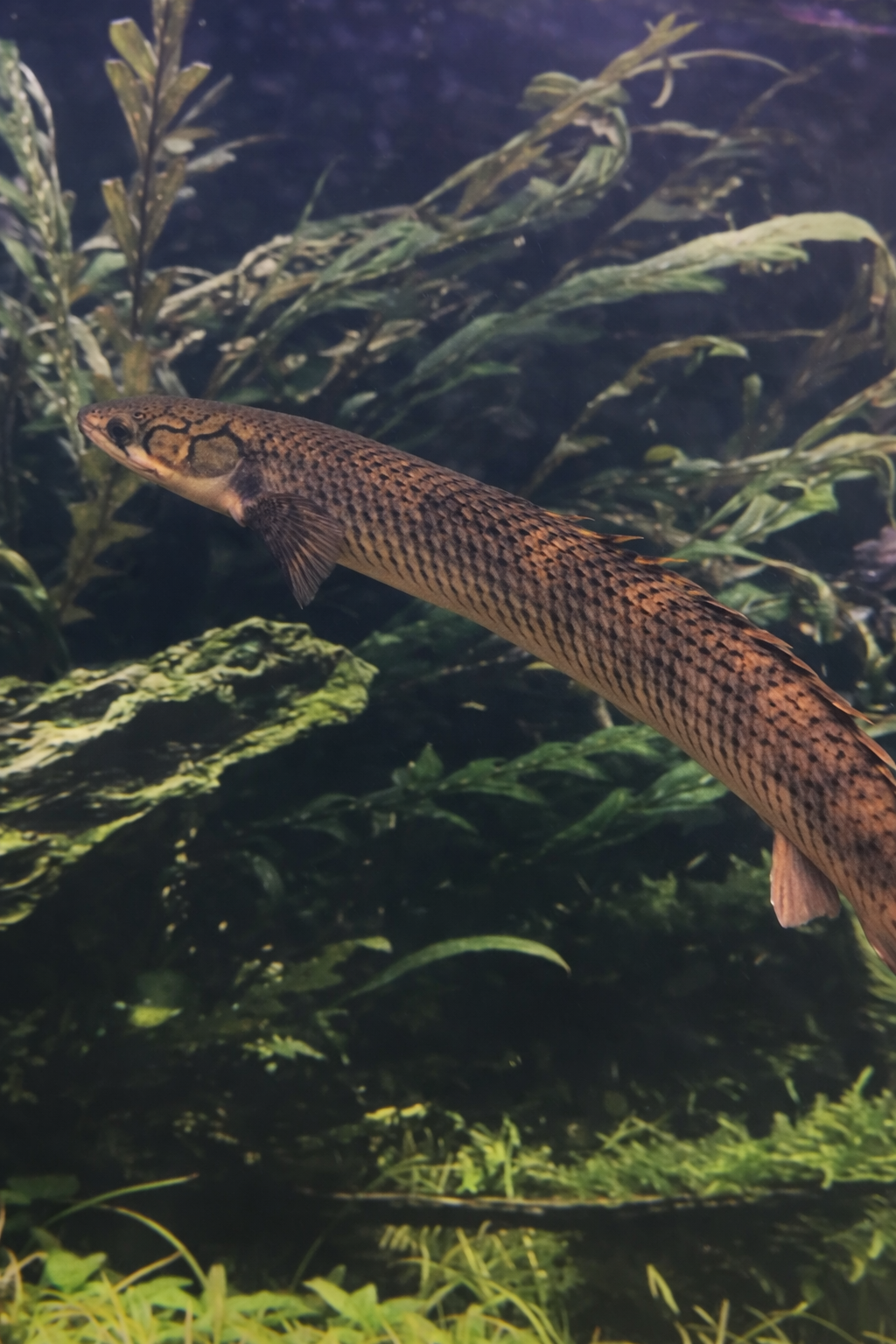
Bichirs (Polypterus spp.) are the gateway fish into the monster-tank world. They’re ancient — closer to lungfish than to anything else swimming in a typical community tank — they breathe atmospheric air, they hunt by smell, and they walk out of the tank if you let them. They’re also one of the few large predators that genuinely tolerates a first-time monster keeper, provided you set the tank up properly the first time.
This is a practical bichir care UK guide written from a retailer that actually keeps and ships these fish. We’ll cover the parameters, the feeding, and — more usefully — the specific mistakes that put new keepers’ bichirs in the bin within the first six months.
Polypterus are a genus of African ray-finned fish with ganoid scales, paired lungs, and a row of dorsal finlets instead of a single fin. They’re crepuscular ambush predators: most active at dawn, dusk and after lights-out. Vision is poor; they hunt almost entirely by scent. There are roughly 14 described species, ranging from the 30 cm Polypterus palmas up to the 90 cm+ Polypterus endlicherii / bichir bichir.
The species most UK keepers encounter are:
| Species | Adult size | Difficulty | Notes |
|---|---|---|---|
| P. senegalus (Senegal / “dinosaur eel”) | 30–35 cm | Easy | Classic starter bichir |
| P. palmas | 30 cm | Easy | Slim-bodied, peaceful |
| P. delhezi (Armoured bichir) | 35–40 cm | Easy/Intermediate | Banded pattern, hardy |
| P. ornatipinnis (Ornate) | 50–60 cm | Intermediate | Stunning leopard markings |
| P. mokelembembe | 30–35 cm | Intermediate | Rare, thick-bodied, premium |
| P. endlicherii / bichir bichir | 60–90 cm | Expert | True monster — needs 8ft |
If this is your first one, start with P. senegalus, P. delhezi, or — if you want something rarer without jumping straight to a metre-long fish — Polypterus mokelembembe. We currently have a single hand-selected specimen in stock; details and current stock are on the Mokelembembe Bichir product page.
Bichirs are benthic. They use the bottom of the tank. A tall 200-litre cube is worse than a long 200-litre shallow tank, even though the volume is identical.
Minimum footprints we’ll sell a bichir into:
These are minimums for a single fish. Bichirs are social-ish — they tolerate conspecifics well — but every additional fish means more footprint and more filtration, not just more water.
A 10 cm juvenile senegalus will hit 25 cm within a year on decent food. We see customers buy a 60 litre starter tank intending to upgrade “in a few months” and then the fish stalls, develops spinal curvature, and never recovers. Buy the adult tank first. Always.
Bichirs are forgiving but they are not indestructible.
| Parameter | Target |
|---|---|
| Temperature | 25–28 °C |
| pH | 6.5–7.8 |
| dGH | 5–15 |
| Ammonia / Nitrite | 0 ppm |
| Nitrate | <40 ppm |
| Flow | Moderate, not torrential |
UK tap water in most regions sits comfortably within this range — you don’t need RO for bichirs. What you do need is a mature, oversized filter. Bichirs are messy, protein-heavy feeders. Aim for filter turnover of 6–8× tank volume per hour, split between an external canister and either a sump or a second canister. A single small internal will not cope past juvenile stage.
They survive ammonia spikes that would kill a tetra in an hour. They don’t thrive through them. Chronic low-grade ammonia exposure is the single most common cause of cloudy eyes, fin erosion and respiratory infection in young bichirs. Cycle the tank properly, ideally with seeded media, before the fish goes in.
A secure lid is non-negotiable — Bichirs are accomplished escape artists that can squeeze through surprisingly small gaps and ‘walk’ short distances out of water on their pectoral fins. They can survive several hours out of water if they stay damp, which means they’ll find a way out, mooch around the carpet, and you’ll find them behind the sofa.
Requirements:
A 25 cm bichir will fit through a 1.5 cm slot. Their bodies are extraordinarily flexible and they don’t need to keep their gills wet to keep breathing — that’s what the lungs are for. Measure twice.
Polypterus are obligate carnivores with poor eyesight. They locate food by scent, then strike. This shapes everything about how you feed them.
What works:
What doesn’t:
Feed juveniles daily, adults 3–4× per week. A well-fed bichir has a gentle curve from head to vent, not a sausage-shaped belly.
Drop food directly in front of the fish, or use tongs to place it under the cave entrance. Bichirs will miss food that lands a foot away from their face. Tankmates with better eyesight — and bichirs are almost always kept with other large fish — will steal everything if you just scatter pellets across the surface.
Bichirs are peaceful toward fish too big to swallow and predatory toward anything smaller. The mouth gape is the rule. If a tankmate can fit inside a bichir’s mouth folded once, it will be eaten overnight.
Good tankmates:
Avoid:
Wild-imported bichirs frequently carry Macrogyrodactylus polypteri — a parasitic worm specific to the genus. Symptoms: flashing against décor, white threads visible on the body, mucous overproduction. Treatment is praziquantel-based, ideally before the fish enters the display.
Every bichir that ships from us has been held, observed and parasite-treated where appropriate. We still recommend a 2–4 week quarantine in a bare-bottom tank with a sponge filter before adding to a community. If you’re new to monster fish and want to skip the import lottery, browse our hand-selected stock in the Oddballs category — every fish ships with our Live Arrival Guarantee.
Get those five right and a Polypterus will give you fifteen-plus years of slow, prehistoric, weirdly charming behaviour. Get them wrong and you’ll be replacing the fish within a year — which isn’t fair on the animal or your wallet.
Browse our current stock — every fish ships with our Live Arrival Guarantee. If you want something specific that isn’t listed, Marc can usually source it through our next transhipping run.